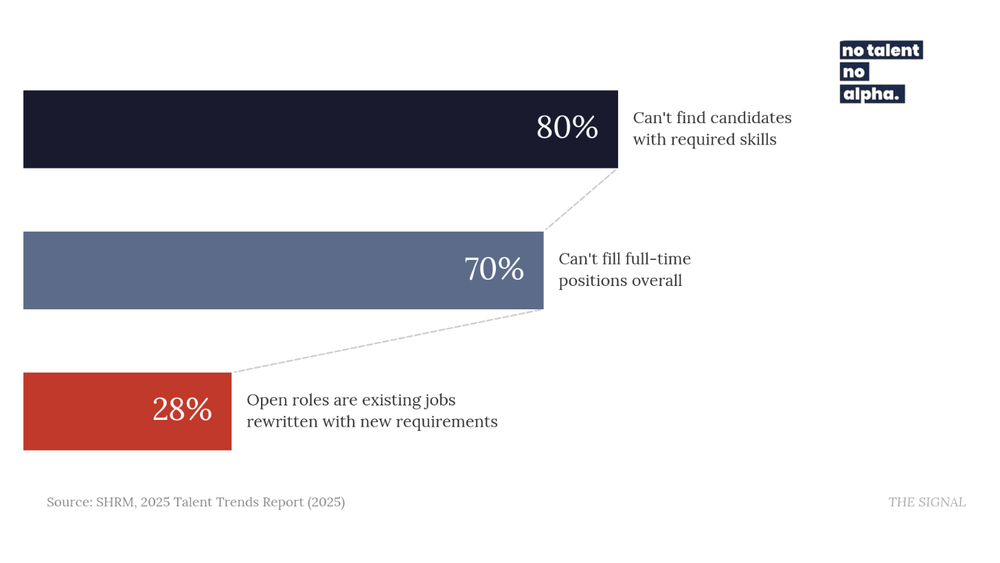
According to SHRM's 2025 Talent Trends report, 4 in 5 organizations—80%—report difficulty finding qualified candidates who have the new skills their roles now require, even as overall applicant volumes have recovered from their 2022 lows. Nearly 70% of organizations still report difficulty filling full-time positions overall. Of the jobs hardest to fill, 28% are existing roles that have been updated with new skill requirements, driven primarily by technology change (cited by 53% of organizations) and organizational growth (54%). Meanwhile, 45% of U.S. workers now report using AI in their jobs—but 63% describe their AI proficiency as beginner or intermediate.
Here's what's actually happening: The labor market isn't tight in the traditional sense—wages aren't spiking and candidates are available. The tightness is now skill-specific. Organizations keep rewriting what jobs require, particularly around technology, faster than the existing workforce can adapt. The result is a structural mismatch: plenty of candidates for the old version of roles, not enough for the current version. Employers post jobs with elevated requirements, get frustrated by thin pipelines, and often don't realize they've contributed to the problem by updating requirements without updating their development pipelines to match.
Why it matters for you:
- Your next hire might already be on your team: The SHRM data shows that organizations facing skill gaps that look internally first consistently fill roles faster and at lower cost than those that default immediately to external recruiting. If you have a strong performer who is 80% of the way to a new skill requirement, the investment in closing that gap is almost always less expensive than a six-month external search plus a recruiting fee. Run the math before you post the job.
- Your job description is your first skills-gap diagnostic: If you're struggling to fill a role, look at the requirements list you wrote. If it was drafted more than 18 months ago or copied from a previous posting, it's likely miscalibrated—either too narrow, demanding rare skill combinations that don't exist in the candidate pool, or too broad, attracting unqualified applicants. Before reposting, audit the requirements against what the role actually needs today.
- AI fluency is the new baseline—and you can close it internally: With 45% of the workforce using AI but two-thirds describing themselves as beginners, this is a skills gap that can be addressed through structured team development rather than hiring for it. Organizations that invest in deliberate AI upskilling now will have a real competitive advantage over those waiting to recruit AI-native candidates—who are increasingly rare and increasingly expensive.
Source: SHRM, 2025 Talent Trends Report (2025)
Watch this: The 28% of roles being updated mid-cycle—existing jobs with new skill requirements—is the number to track. As AI adoption accelerates across functions, that share will grow. Organizations that fail to map what their current roles now require versus what they're hiring for will face a widening mismatch in 2026. Expect the skills gap to intensify specifically in data literacy, AI tool fluency, and cross-functional coordination.
The contrarian play: Most organizations treat the skills gap as a recruiting problem. The companies pulling ahead are treating it as a product management problem—mapping their workforce skills like a product roadmap, identifying gaps before roles are posted, and building development tracks for high-potential employees who can grow into the need. You can execute this at the team level without waiting for a company-wide initiative.