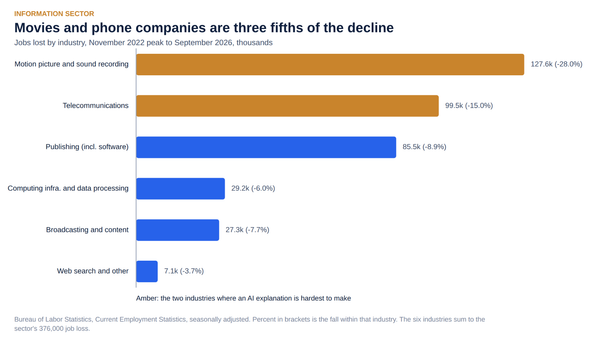
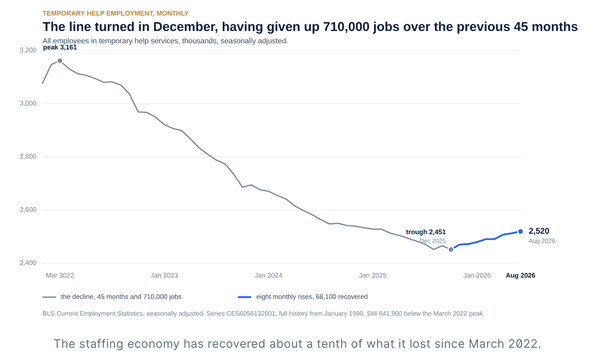
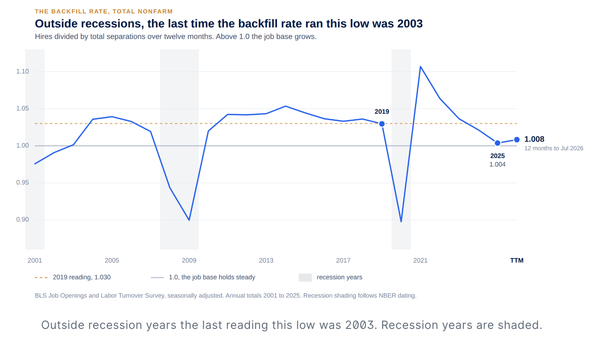
According to Indeed Hiring Lab's analysis of the latest Bureau of Labor Statistics employment data, the April 2026 jobs report added 115,000 jobs and held unemployment steady at 4.3%. But those headline numbers conceal a deep imbalance. Over the past 12 months, healthcare and private education employment grew by 618,000 jobs. Every other sector of the U.S. economy combined shed 367,000 jobs. Excluding healthcare, total employment has declined in 10 of the last 12 months on a three-month average basis.
Here's what's actually happening: Healthcare is a structurally non-cyclical sector. Demand grows with demographics regardless of the business cycle, and a persistent shortage of clinical workers means hiring continues even when other employers freeze. That sector is now functioning as a one-industry shock absorber for the entire labor market, papering over deterioration in every other corner of the economy. When commentators describe the labor market as "resilient" or "pinned in place," what they're actually describing is one sector growing fast enough to offset broad-based decline.
Why it matters for you:
- Your industry's labor market is worse than the headlines. Unless you're hiring nurses, medical technicians, or healthcare administrators, the macro data you're reading doesn't describe your reality. Outside healthcare, your sector has been losing jobs for most of the past year. That means your candidate pool is larger and your retention risk is lower than a 4.3% unemployment rate suggests — your real labor market is closer to a downturn.
- The "tight labor market" budget argument no longer holds. Compensation budgets built around assumed scarcity premiums are running on outdated logic. Indeed's Wage Tracker shows posted wages growing just 2.1% year-over-year while CPI runs at 2.4% — employers are already extracting concessions in the market. If you're planning 4–5% merit cycles citing labor market tightness, the data underneath that assumption no longer exists outside healthcare.
- Internal hiring requests need a new framing. Department heads requesting headcount based on "we can't find people" should be challenged with sector-specific data, not national averages. In most non-healthcare industries, candidate volume has materially increased and wage growth has softened. Use that ammunition to slow approvals, demand stronger requisition justifications, or redirect headcount to roles where the real market — not the national headline — supports the investment.
Source: Indeed Hiring Lab, April 2026 Jobs Report Analysis (May 8, 2026); Bureau of Labor Statistics, The Employment Situation — April 2026
Watch this: Healthcare's ability to carry the entire labor market depends on continued public and private health spending growth — both of which face fiscal pressure heading into 2027. If healthcare hiring slows even modestly while other sectors stay in their current pattern, the labor market doesn't soften. It inverts. The cushion absorbing every other sector's weakness is the only thing keeping headline numbers positive.
The contrarian play: While competitors set 2026 compensation and hiring plans based on a 4.3% national unemployment rate, build yours on sector-specific data. In most non-healthcare industries, you have meaningfully more leverage than the macro story suggests — more candidates, softer wage demands, lower turnover risk. The companies still pricing labor as if it's 2022 are the ones you'll out-recruit and out-retain over the next four quarters.