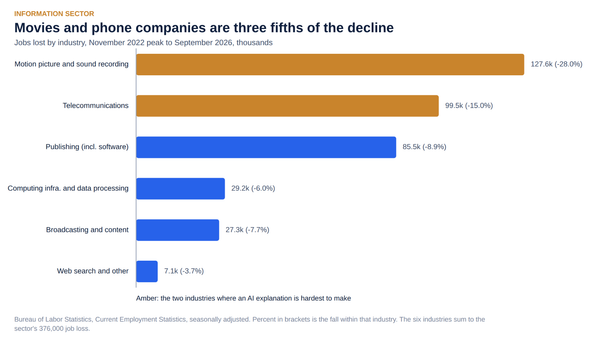
According to the Bureau of Labor Statistics' April 2026 Employment Situation, information sector employment declined another 13,000 in April, extending a contraction that has now erased 342,000 jobs — or 11.0 percent — since the sector's peak in November 2022. April's losses concentrated in telecommunications (-3,000), motion picture and sound recording (-6,000), and computing infrastructure providers, data processing, web hosting, and related services (-4,000). While the overall labor market added 115,000 jobs and the unemployment rate held at 4.3 percent, the information sector has now declined in nearly every month for three and a half years.
Here's what's actually happening: The information sector is undergoing a structural contraction that's distinct from the broader labor market story. Tech layoffs got most of the early coverage in 2022 and 2023, but the steady drip of losses since then — averaging roughly 8,000 jobs per month for over three years — has cumulatively moved more workers than most managers realize. These aren't just laid-off engineers from headline-grabbing FAANG cuts. They're telecom operations staff, data center technicians, post-production crews, and digital media workers across hundreds of mid-sized companies. The result is a deep, persistent pool of experienced information workers who have been absorbing into other sectors at compensation levels below their 2022 peaks.
Why it matters for you:
- Your tech compensation benchmarks are anchored to a market that no longer exists. Salary surveys from late 2022 and 2023 reflected peak-market pricing for information sector talent. With 342,000 fewer information sector jobs and three-plus years of net outflow, the clearing price for these workers has reset downward in most categories. If you're paying 2022-benchmark wages for engineering, data, or digital media roles, you're paying for scarcity that no longer exists. Re-benchmarking against current market data — not stale comp surveys — could free up 10 to 20 percent of your tech compensation budget for performance differentiation or strategic hires.
- Adjacent industries are absorbing your future hires already. Information sector workers don't sit unemployed — they migrate. Financial services firms, healthcare technology divisions, manufacturing automation teams, and government contractors have been hiring displaced information workers at a steady clip since 2023. If you're competing for technical talent and you're not actively sourcing from cross-sector candidates, you're fishing in the smaller, more expensive pool. The candidate with a software engineering background now working in a hospital's IT department is often a better hire — and a cheaper one — than the candidate still inside a struggling tech firm.
- Retention math changed for your existing tech staff. Workers in your information-adjacent roles know what's happening in their industry. They watch the layoff announcements. Their LinkedIn feeds are full of former colleagues looking for work. The retention assumption that "they'll leave for a better offer" has weakened substantially — outside offers in pure information sector roles are scarcer and lower-paying than they were three years ago. You can hold compensation steadier than your 2022 instincts suggest without elevating turnover risk, particularly for workers above the senior IC level where alternatives have thinned most.
Source: Bureau of Labor Statistics, The Employment Situation — April 2026 (Released May 8, 2026)
Watch this: The information sector has now declined in roughly 30 of the last 42 months. If May extends the streak, the cumulative loss crosses 350,000 and 11.5 percent — putting the sector's contraction on par with manufacturing's worst decade-long stretches. Watch the May 2026 release on June 5 for whether computing infrastructure and data processing continue to bleed, which would signal that even AI-adjacent infrastructure roles are not immune to the broader retrenchment.
The contrarian play: While competitors continue treating tech talent as scarce and pricing accordingly, build your 2026 technical hiring strategy around the assumption that the information sector workforce is in long-term oversupply. Open requisitions at the lower end of your salary bands, source heavily from candidates with information sector experience now working in other industries, and prioritize quality of hire over speed of hire. The companies that adjusted their tech compensation philosophy to current reality in 2023 saved millions; the companies that still benchmark to 2022 are funding the retention of workers whose outside options have evaporated.