According to ADP Research's People at Work 2026 report, released March 24, 2026, and based on a survey of more than 39,000 workers across 36 markets, 62 percent of workers globally put in up to five hours of unpaid work each week. But 12 percent go significantly further — logging 16 or more hours off the clock. In the United States, that figure is 20 percent. The people working the longest unpaid hours are not the workers at the bottom of the org chart. Half of all upper managers and senior leaders report at least six extra unpaid hours per week, and 20 percent of that group reports 16 or more.
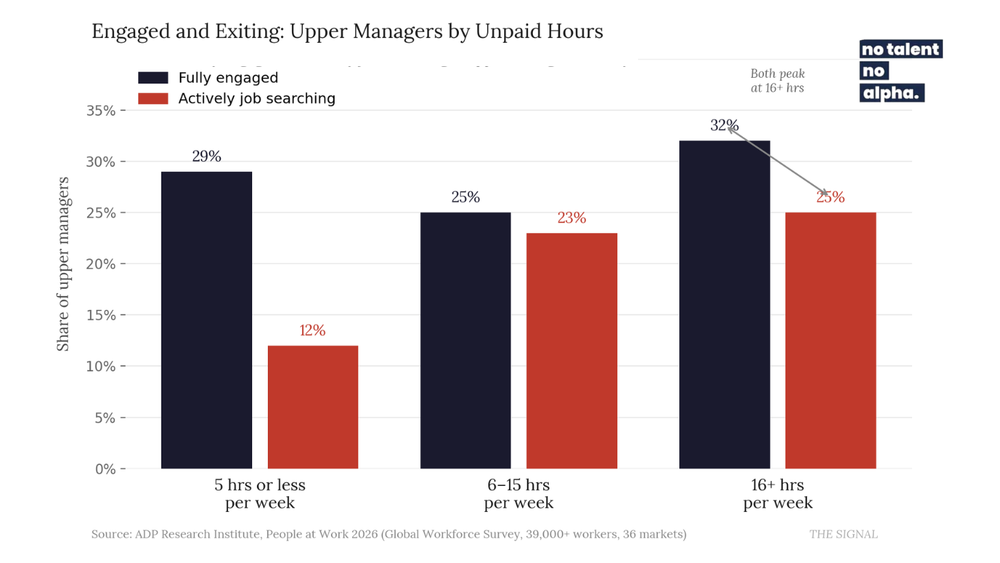
Here's what's actually happening: Unpaid hours and engagement move together — up to a point. Workers putting in the most free time were the most likely to say they find meaning in their work, and the most likely to be fully engaged. That looks like loyalty. It isn't. Workers in the 16+ unpaid hours cohort were also the most likely to be actively job searching. Among upper managers working that much off the clock, 25 percent are interviewing or looking. Among C-suite executives logging 16+ unpaid hours, 26 percent are. High engagement and high intent to leave are occupying the same person at the same time — and the unpaid hours are why.
Why it matters for you:
- Your engagement scores may be hiding a flight risk. The conventional read on high engagement is stability. The ADP data inverts this for employees logging large amounts of unpaid time. Workers who appear most committed — the ones staying late, finishing on weekends, answering messages off-hours — are precisely the group most likely to be scanning for other opportunities. If your highest-engagement signals are coming from people with unsustainable workloads, you're measuring dedication and misreading it as retention health.
- Managers are the most exposed group. Individual contributors show a relatively modest relationship between unpaid hours and turnover intent. The dynamic is most pronounced at the manager and executive layer — the people you'd least want to lose mid-cycle. Half of upper managers are already in the 6+ unpaid hours zone. These are the employees most likely to be fully engaged, most likely to feel productive, and most likely to be gone within 12 months. The cost of replacing a manager compounds beyond just salary.
- Unpaid hours don't improve productivity — they erode it. Among C-suite and upper managers logging 16+ unpaid hours, the share who said they were not as productive as they could be was dramatically higher than for those working five or fewer unpaid hours. Free time is generating more work, not better work. Employees working 6–15 unpaid hours a week showed the lowest engagement and highest stress of any cohort — the middle band is the worst outcome for everyone.
Source: ADP Research Institute, Today at Work 2026, Issue 1: People at Work (March 2026)
Watch this: The unpaid hours dynamic will sharpen as return-to-office pressure mounts. On-site workers currently report slightly fewer large blocks of unpaid time than remote workers, but RTO mandates typically increase managerial oversight burden without reducing workloads. If task volume stays constant and flexibility decreases, the 16+ hour cohort — already your highest flight-risk group — will grow.
The contrarian play: Most organizations treat high engagement as a green light on retention. The better signal is how that engagement is expressed. If your top performers and managers are logging large unpaid hours, the engagement number is telling you they care — and the unpaid hours are telling you the arrangement is unsustainable. Auditing where your highest-performers are spending off-clock time costs nothing and could reveal workload imbalances before they become resignation letters.