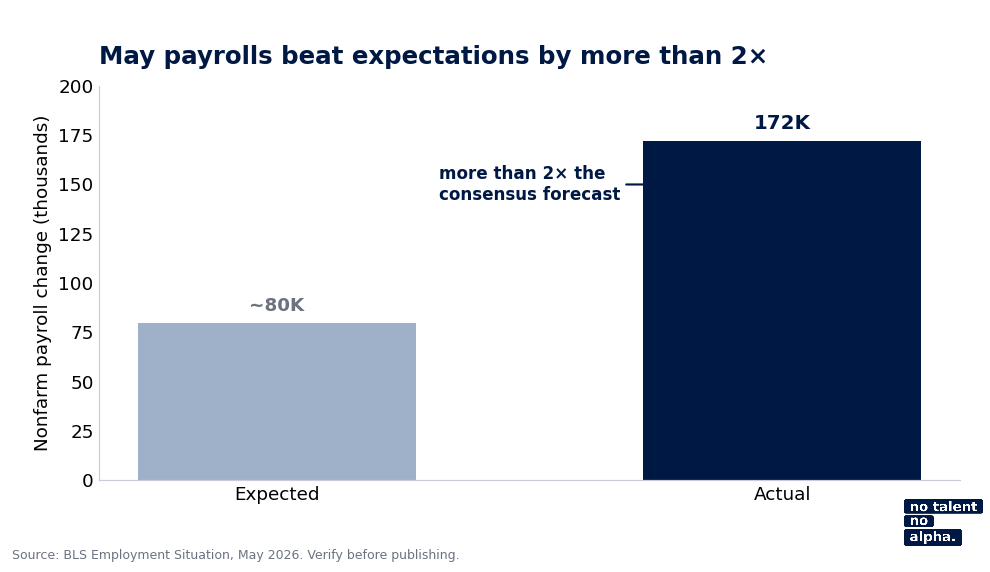
May payrolls landed at +172,000 — more than double the roughly 80,000 economists had penciled in. Unemployment held at 4.3%. On the headline, a hot month.
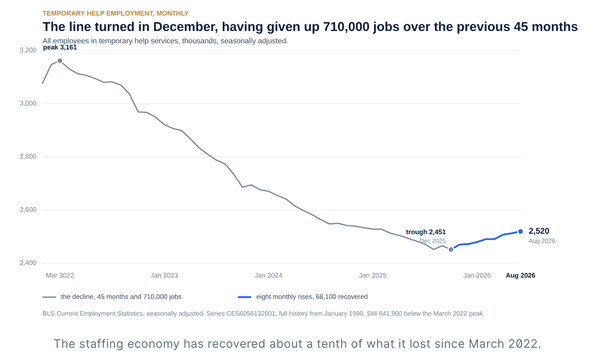
One layer down, it's less settled. The gains clustered in leisure and hospitality, local government, and health care. And the corner of the labor market that usually moves first — temporary help — kept shrinking, now around 1.57% of total payrolls, near a multi-year low.
That divergence is the story, and it's more useful than the headline.
Temp help is a leading indicator for a mechanical reason: when demand softens, firms cut flexible, contingent labor before they touch permanent headcount; when it returns, they add temps before committing to full-time hires. So a temp-help share grinding lower while the top-line beats expectations is the labor-market equivalent of a strong quarter posted alongside weakening forward bookings. The current read is good; the leading read is cooling.
For managers, the trap is picking one signal and running with it. "The market's hot, we'll struggle to retain people" overreacts to the headline. "Hiring's freezing, we can lowball" overreacts to the leading indicator. The accurate read is that they disagree — and when a coincident number and a leading number disagree, the leading one usually wins eventually.
Practically: don't loosen on the strength of one hot print. Keep your retention assumptions where a cooling market would put them, fill the roles that matter now while the headline still supports the budget, and treat the shrinking temp share as the early warning it usually is. Plan for leaner, not looser.
Bottom line: A headline that doubles expectations and a leading indicator that keeps falling aren't a contradiction to resolve — they're a sequence. The headline tells you where the labor market is. Temp help tells you where it's going.