

Your employee experience is only as good as your worst manager.
This is the insight most executives miss when they talk about “culture” and “values.” They invest in all-hands meetings, company offsites, mission statements, and engagement surveys. They hire Chief People Officers and consultants. They obsess over Glassdoor ratings.
But they tolerate massive variance in day-to-day management quality. And that variance destroys everything else they’re trying to build.
Here’s why: Your employees don’t experience your company culture through your mission statement. They experience it through their manager. Through how often they get 1-on-1s. Through the quality of feedback they receive. Through whether their development is taken seriously. Through whether they feel recognized for their work.
When management quality varies wildly across your organization, you don’t have one culture. You have ten different cultures depending on who someone reports to.
The Variance Problem Visualized
Let me show you what this looks like in practice. Consider two companies, both with the same average management quality score of 7.2 out of 10:
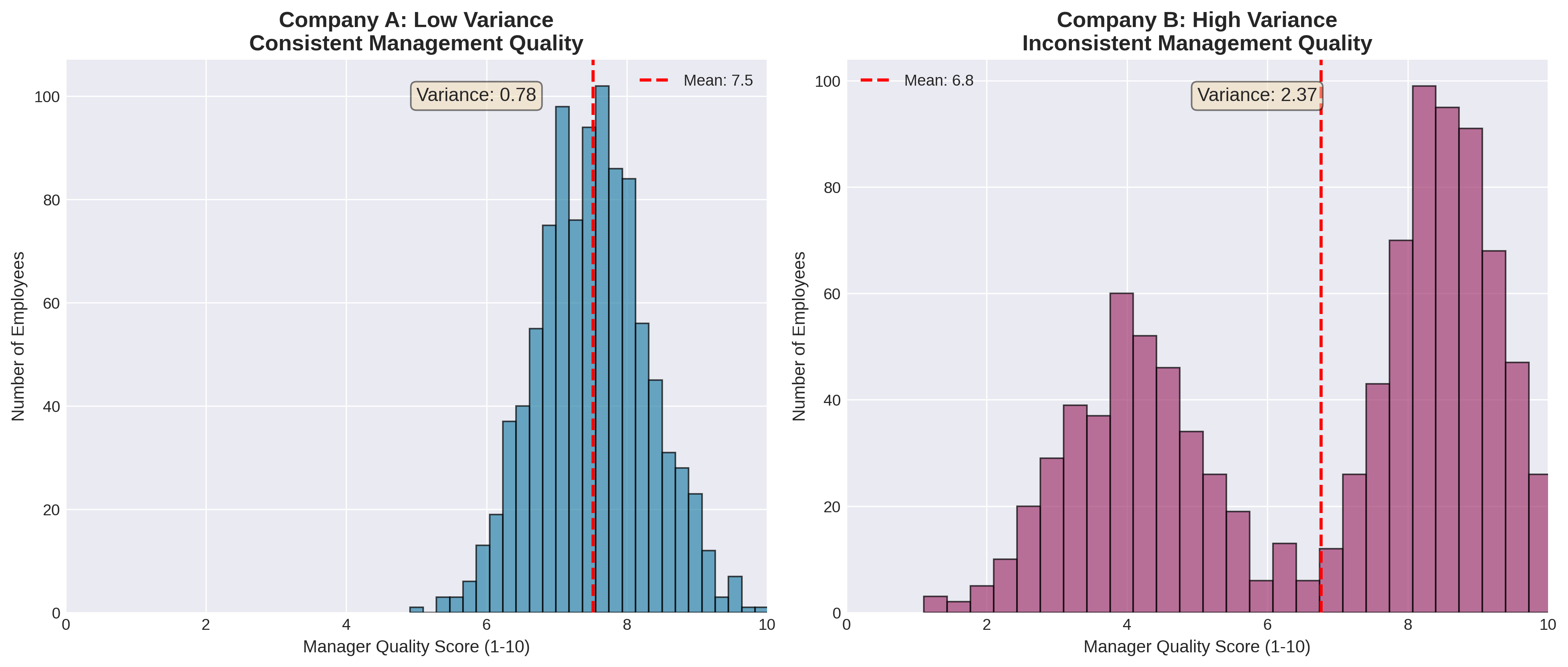
Company A has low variance. Most managers score between 6.5 and 8.5. Employees across the organization have reasonably consistent experiences. If you ask employees what it’s like to work there, you’ll get similar stories.
Company B has high variance. Some managers score 9+, delivering exceptional experiences. Others score below 5, creating toxic environments. The average is the same, but the lived experience is completely different.
In Company B, your career trajectory depends heavily on which manager you’re assigned to. Top performers in poorly-managed teams leave. Mediocre performers in well-managed teams stay and thrive. The organizational chart becomes a lottery.
“When within-company management variance exceeds between-company variance, employees aren’t choosing to stay at your company, they’re choosing to stay with their specific manager.”
This is the consistency principle: Reducing variance in management quality matters more than improving your average score.
A Realistic Example
Let me give you a concrete illustration. TechCo is a 450-person mid-market software company with eight departments. They run annual engagement surveys and pride themselves on being a “great place to work.”
Here’s what their department-level data actually shows:
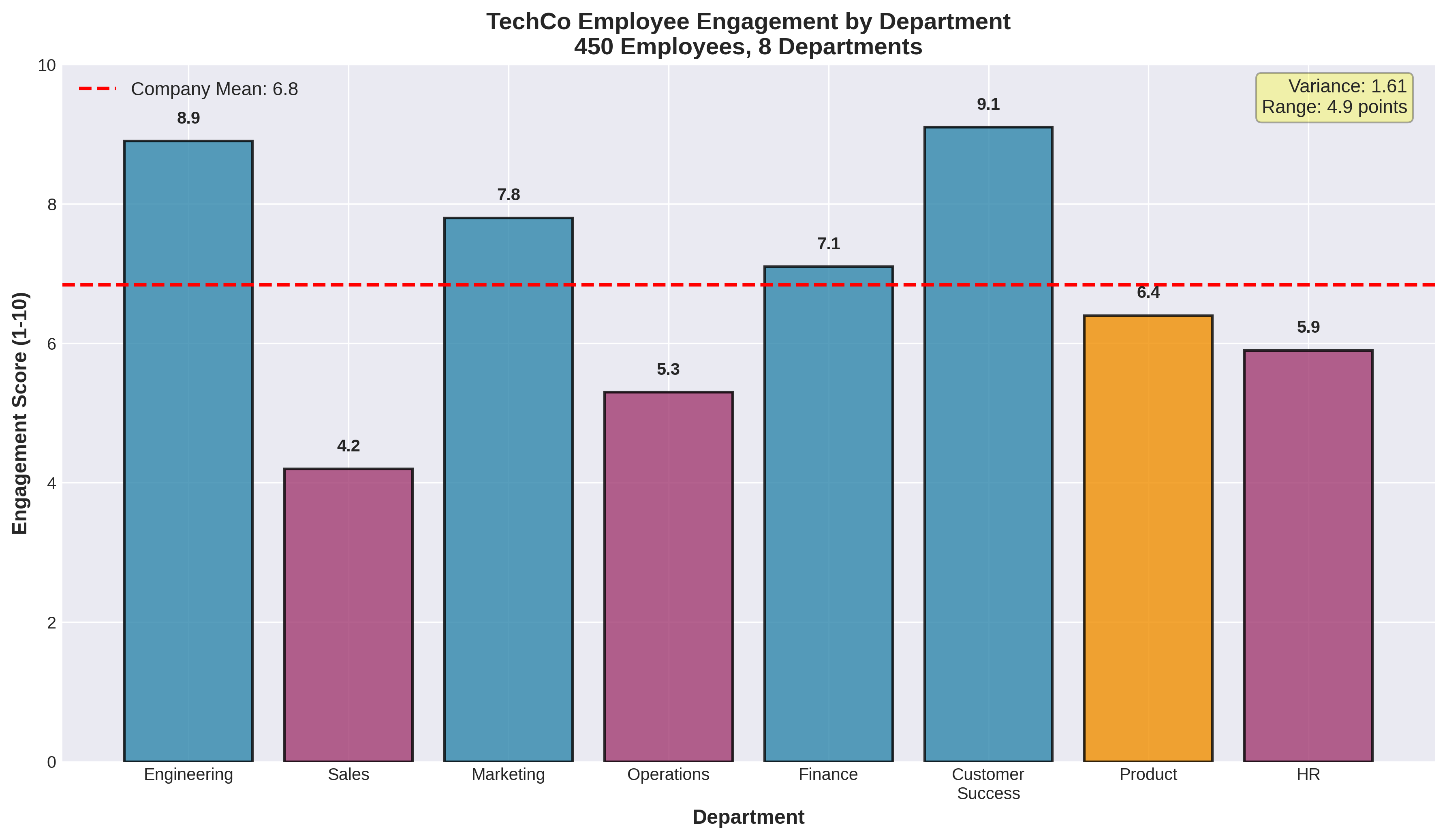
The company mean is 6.8, solidly above average. Leadership sees this number and feels good about their culture investments.
But look at the variance. Customer Success scores 9.1. Sales scores 4.2. That’s a 4.9-point spread on a 10-point scale.
This tells you everything you need to know: TechCo doesn’t have a culture problem. TechCo has a management quality problem.
KEY INSIGHT: When engagement scores vary by more than 3 points across departments in the same company, you’re looking at manager quality variance, not systemic or structural issues. Same policies, same compensation, same office, same mission, the only variable is management capability.
If TechCo’s problems were structural, bad compensation, unclear strategy, poor product-market fit, you’d see consistently low scores across all departments. If they had systemic HR problems, all departments would suffer equally.
High variance proves the problem is behavioral. It’s about who is managing teams, not what systems are in place.
The Diagnostic Framework
So how do you know if you have a variance problem? Here’s the framework:
THE VARIANCE THRESHOLD DIAGNOSTIC
Step 1: Calculate your management quality variance
Take any metric that reflects employee experience (engagement scores, retention by manager, eNPS, internal transfer requests, promotion rates, etc.) and calculate the standard deviation across managers or departments.
Step 2: Plot yourself on the framework
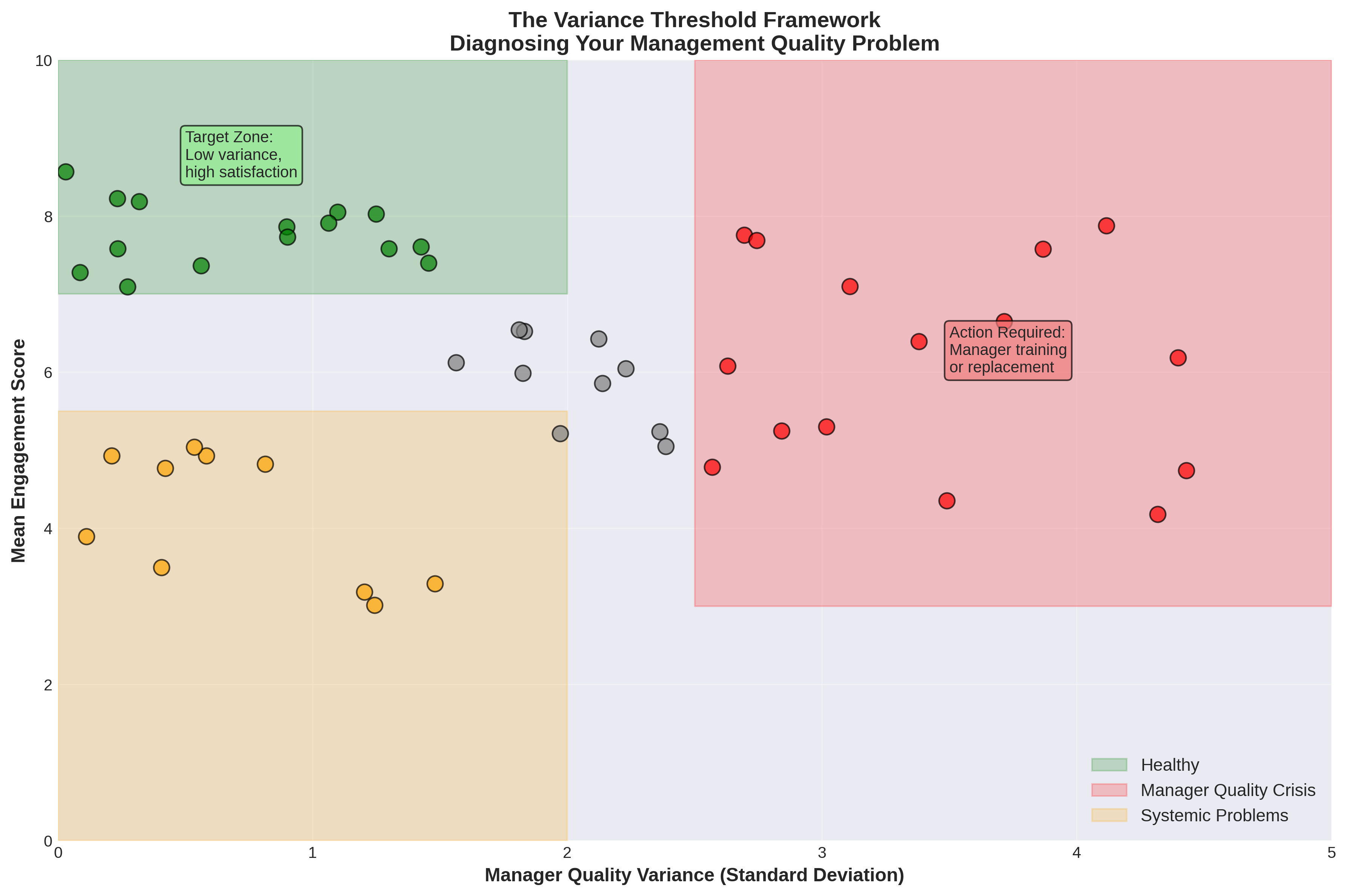
This framework gives you three zones:
Healthy Zone (Low variance, high mean): This is where you want to be. Variance under 2.0, mean engagement above 7. Your management quality is consistently good. Employees have similar experiences regardless of which team they join.
Manager Quality Crisis (High variance, any mean): Variance above 2.5 signals inconsistent management. Even if your mean is decent, the experience variance is creating internal equity problems. Your best people are concentrated in well-managed teams and everyone else is updating their LinkedIn.
Systemic Problems (Low variance, low mean): Consistently low scores across the board suggest structural issues—compensation, strategy, market position, product quality. Everyone is equally unhappy, which points to problems beyond individual manager capability.
The threshold rule: When your management quality variance exceeds 50% of your mean score, you have a crisis. For example, if your mean engagement is 7.0 and your standard deviation is greater than 3.5, variance is dominating your employee experience.
Why Consistency Matters More Than You Think
The financial impact of management variance is substantial and measurable. High variance doesn't just create "culture problems"—it destroys retention, productivity, and your ability to scale.
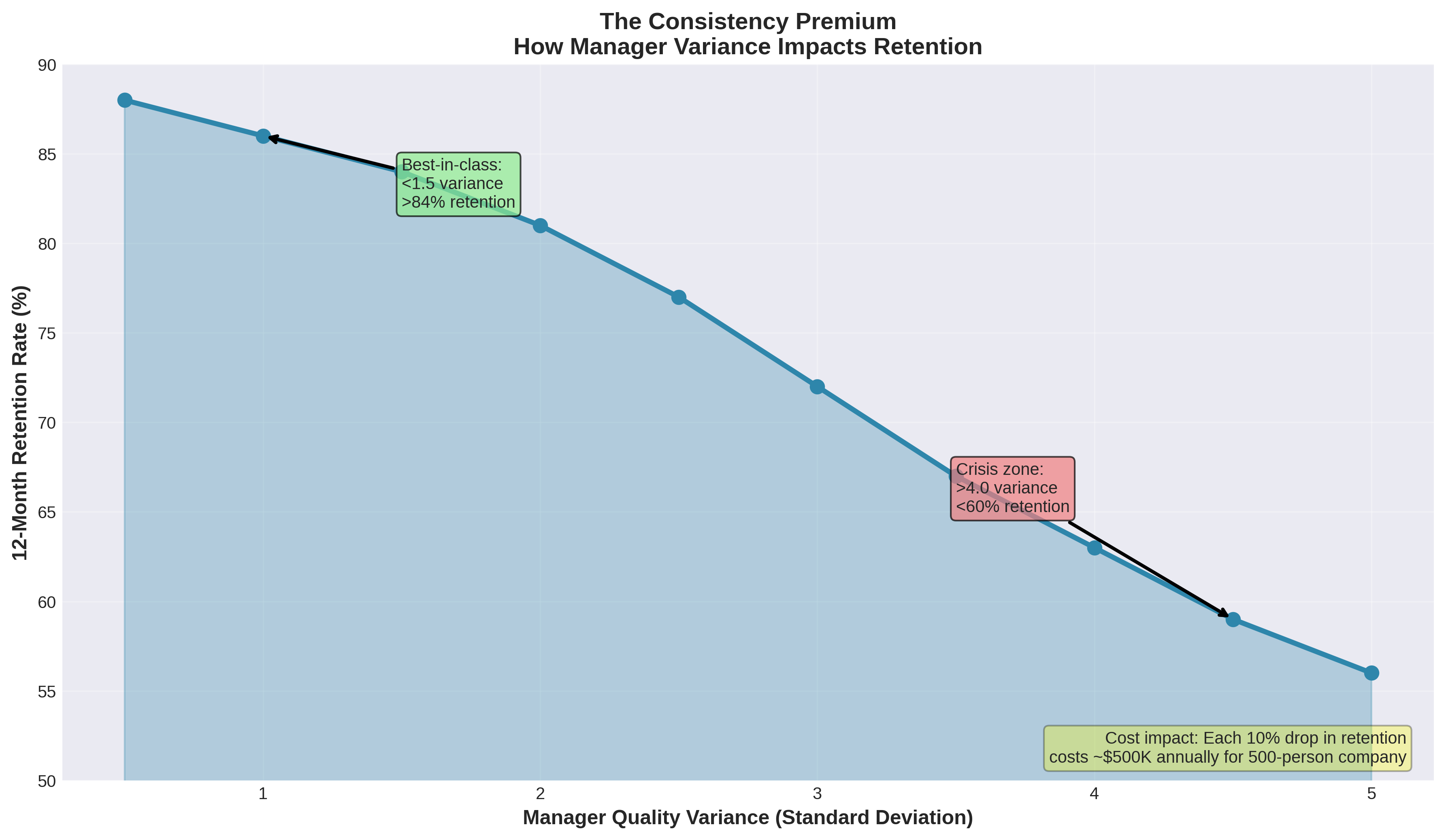
The research is unambiguous. Gallup's landmark study found that managers account for at least 70% of the variance in employee engagement scores across business units, meaning your management quality distribution is the primary driver of whether employees want to stay or leave.
Development Dimensions International (DDI) quantified the human cost: 57% of employees have left a job specifically because of their manager, with another 32% seriously considering it. That means only 12% of employees have never contemplated quitting because of poor management.
But here's the encouraging part: when companies actually fix this, the results are dramatic. One organization profiled by CoAdvantage reduced annual attrition from 27% to 12%, cutting turnover by more than half, simply by focusing on manager development and giving frontline leaders ownership over retention.
Let's put that in dollar terms for a 500-person company with average fully-loaded costs of $120K per employee:
High attrition (27% annual turnover): 135 departures × $120K × 0.5 replacement cost = $8.1M annual turnover cost.
Low attrition (12% annual turnover): 60 departures × $120K × 0.5 replacement cost = $3.6M annual turnover cost.
That's $4.5M in annual savings from getting management quality consistent. And that doesn't include the productivity loss, knowledge drain, or impact on team morale when good people leave.
Beyond retention, variance creates other expensive problems:
Internal inequity: Employees talk. When someone in Sales is having a miserable experience while someone in Engineering loves their job, it breeds resentment. People don’t blame their manager—they blame “the company” for allowing it.
Talent hoarding: Good managers become talent magnets. Everyone wants to transfer to the high-performing teams. This creates internal transfer wars, politics, and bottlenecks in hiring because people won’t take roles under poor managers.
Scaling failure: When you try to grow, variance compounds. Each new manager you add either improves consistency or makes it worse. Without systematic training and measurement, variance explodes as you scale.
Why High Variance Happens
If consistent management quality is so valuable, why do most companies tolerate massive variance? Three reasons:
1. Companies hire for domain expertise, not management capability
Your best engineer becomes an engineering manager. Your top salesperson becomes a sales manager. Your most productive individual contributor gets promoted to lead the team.
This is logical but wrong. Management is a distinct skill set. Being great at doing the work doesn’t mean you’ll be great at enabling others to do the work. But most companies don’t assess management capability during hiring or promotion decisions.
Result: You get random management quality based on whether someone happens to have natural talent for leading people.
2. Management training is treated as an HR checkbox
Most companies offer some form of “manager training”—usually a two-day workshop on giving feedback, running 1-on-1s, and conflict resolution. Attendance is tracked. Boxes are checked.
But there’s no skill development arc. No measurement of actual behavior change. No ongoing practice and feedback. Just a one-time event that everyone forgets within a month.
Real management capability requires deliberate practice over time, just like any other professional skill. Companies that treat it seriously invest in multi-month programs with coaching, peer feedback, and behavioral measurement.
3. No feedback loops for manager quality
Most companies run annual engagement surveys. They see the variance in scores across managers. They share the results. Then... nothing happens.
Why? Because manager quality variance isn’t tracked as a KPI. Nobody owns it. HR reports the numbers, leadership acknowledges them, and then everyone goes back to focusing on revenue, product, or market metrics.
Compare this to how companies treat product quality variance. If some customers had a 9/10 experience and others had a 4/10 experience with your product, you’d have emergency meetings. Root cause analysis. Immediate corrective action.
Employee experience variance should trigger the same response. But it rarely does.
The Consistency Playbook
So how do you actually fix this? Here’s the systematic approach:
Step 1: Measure variance as a KPI
You can’t improve what you don’t measure. Start tracking management quality variance alongside your existing engagement metrics.
Calculate standard deviation across managers for:
- Engagement scores
- 12-month retention rates
- Internal transfer requests
- Time-to-promotion
- Performance rating distributions
Set a target: Reduce variance by 30% year-over-year. Assign ownership. Report it monthly to executive leadership.
Step 2: Standardize the core management moments
You can’t standardize everything managers do. But you can standardize the highest-leverage moments that drive employee experience:
1-on-1s: Establish minimum frequency (weekly or bi-weekly), structure, and documentation standards. Train managers on preparation, active listening, and follow-through.
Performance reviews: Create templates, calibration sessions, and clear rubrics. The goal isn’t identical ratings—it’s identical fairness and clarity in how performance is assessed.
Feedback delivery: Train managers in specific, timely, actionable feedback. Role-play difficult conversations. Create frameworks like SBI (Situation-Behavior-Impact) that everyone uses.
Development planning: Require quarterly development conversations. Provide resources and training budgets that managers actually deploy. Track completion rates.
Recognition practices: Establish norms for acknowledging good work. Public praise in team meetings, written appreciation, spot bonuses—make it systematic, not random.
The 80/20 rule: Employees judge management quality based on these five moments. If you standardize these effectively, you’ll reduce 80% of variance while still allowing managers to have their own style in day-to-day interactions.
Step 3: Invest in real manager development
Treat management as a professional skill that requires years to develop, not a weekend workshop.
Best-in-class companies run programs like:
- Cohort-based training: New managers go through 3-6 month programs together with monthly workshops, peer feedback, and executive coaching
- Manager shadowing: New managers shadow high-performers for a month before taking on their first team
- Behavioral practice: Regular role-playing of difficult conversations (firing, performance improvement plans, conflict mediation) with professional feedback
- 360-degree feedback loops: Quarterly upward feedback from direct reports with coaching on specific behaviors to improve
The ROI is extraordinary. A well-run manager development program costs ~$5K per manager annually. If it reduces turnover in that manager’s team by even 10%, you’ve saved $60K+ per year in replacement costs.
Step 4: Make tough replacement decisions
Some managers won’t improve despite training and support. You need to act on that reality.
Create a clear framework for manager quality assessment:
- If variance is high and a manager is in the bottom quartile for 2+ consecutive quarters → performance improvement plan
- If no improvement after 6 months → move them back to individual contributor role or exit
- Don’t tolerate chronic underperformance in management roles. The damage compounds every quarter
This sounds harsh, but consider the alternative: leaving a poor manager in place destroys 5-10 careers (their direct reports), creates $500K+ in turnover costs annually, and signals to the organization that management quality doesn’t actually matter.
Step 5: Hire for management capability, not just domain expertise
When hiring external managers or promoting from within, assess management skills explicitly:
- Ask candidates to describe their approach to 1-on-1s, giving difficult feedback, developing people
- Do reference calls specifically about management style and team outcomes
- Test for self-awareness: “Tell me about a time your management approach failed”
- For promotions, require demonstrated management capability before the title (leading projects, mentoring junior people, etc.)
The best predictor of future management quality is past management behavior. Don’t promote someone into their first management role without evidence they can do it.
When Variance Is Actually A Good Thing
I’ve spent 7,000 words arguing that variance is bad. But there’s an important caveat: variance in outcomes is often desirable. Variance in management practices is not.
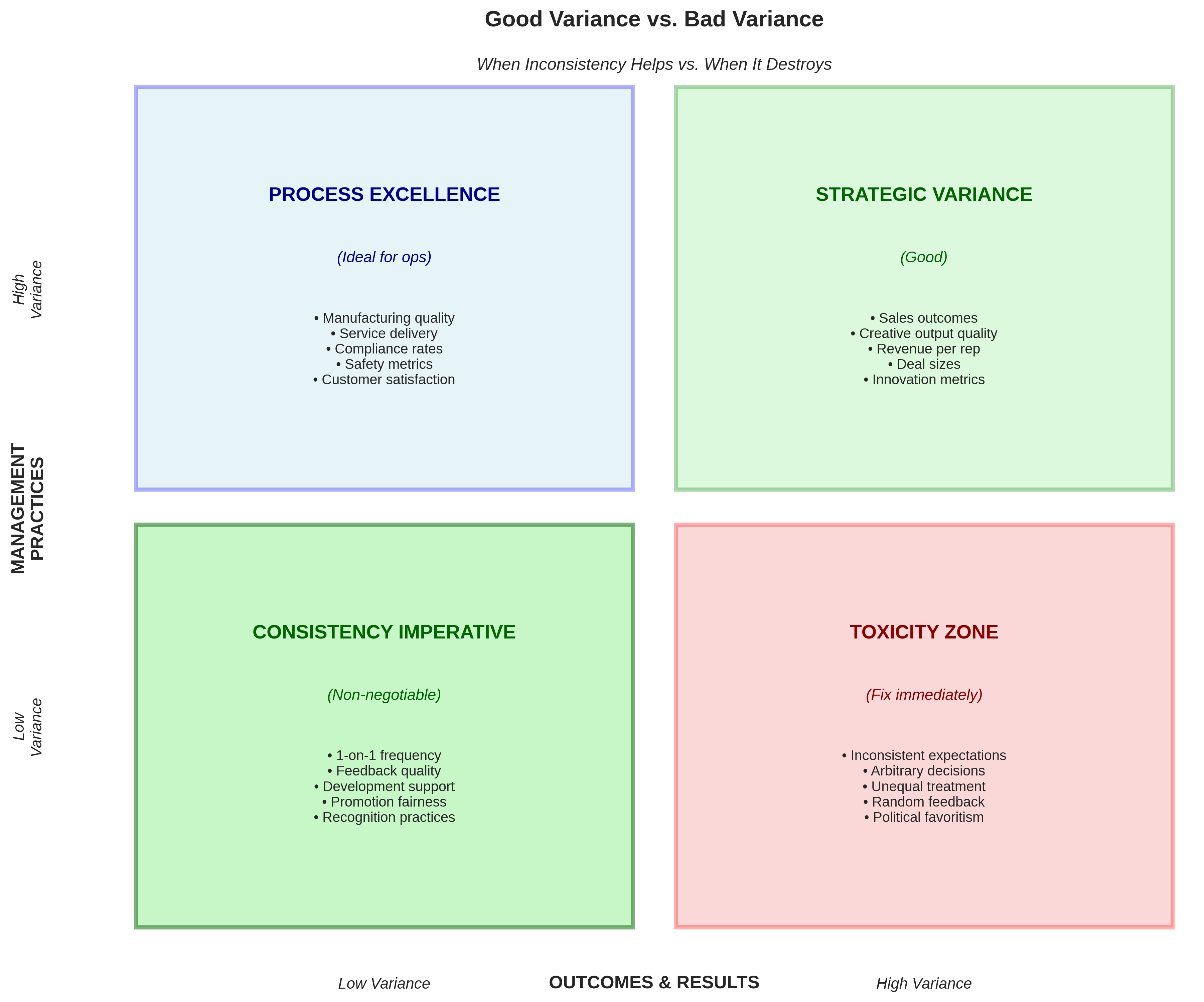
You want high variance in:
- Sales outcomes (revenue per rep, deal sizes, close rates)
- Creative output quality (design work, content, innovation)
- Research productivity (breakthroughs are inherently variable)
- Individual performance in roles with clear metrics
This variance signals that you have the right incentive structures, you’re allowing autonomy, and you’re not over-constraining talented people.
You want low variance in:
- Management practices (1-on-1 frequency, feedback quality, development support)
- Promotion fairness and clarity
- Access to opportunities and resources
- Quality of manager-employee relationships
The key distinction: outcomes should vary based on talent, effort, and opportunity. Treatment and support should be consistent.
Your top sales rep might close $5M while another closes $1M. That’s good variance—it reflects performance differences. But both should get the same quality of management, coaching, and development support. That’s where consistency matters.
The Scaling Problem
Everything I’ve described gets harder as you grow. At 50 people with 5 managers, you can maintain quality through personal attention and informal feedback. At 500 people with 50 managers, variance explodes unless you actively manage it.
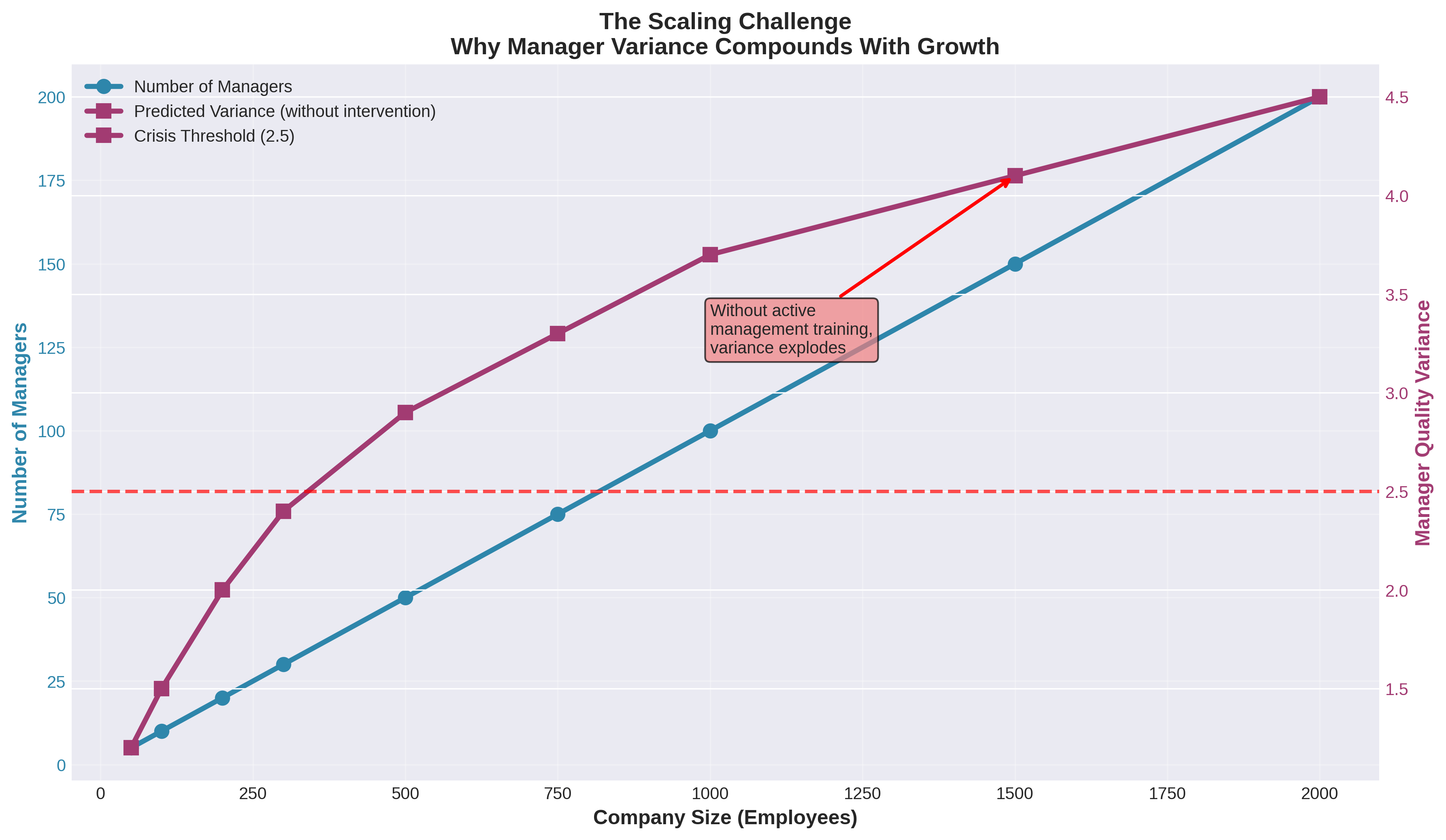
The math is brutal. If you have 5 managers and one is poor, 20% of your workforce has a bad experience. If you have 50 managers and 20% are poor, you now have 10 poor managers affecting potentially 100+ employees.
And it gets worse: poor managers hire poorly. They don’t develop their teams effectively. They create bad managers in the next generation. Variance becomes self-reinforcing.
This is why management consistency is a scaling prerequisite, not a nice-to-have. Companies that don’t solve this before hitting 200-300 employees face severe growing pains. High attrition. Talent concentration in a few “good” teams. Internal politics over which manager you report to.
The companies that scale smoothly treat manager quality variance as a primary growth constraint, right alongside capital, product, and market factors.
What Excellence Looks Like
Let me paint the picture of what great looks like.
In a company with low management variance:
- New employees get similar onboarding experiences regardless of which team they join
- Everyone gets weekly or bi-weekly 1-on-1s with their manager, and those meetings follow a consistent structure
- Performance reviews feel fair. People might disagree with their rating, but they understand how it was determined
- Promotions happen on predictable timelines with clear criteria. There’s no sense that some managers “advocate better” for their teams
- When someone transfers teams, they don’t experience culture shock. The new manager might have a different personality, but the core practices are familiar
- Exit interviews don’t reveal massive differences in experience between departments
This isn’t about eliminating manager personality or style. Great managers can be introverted or extroverted, data-driven or intuitive, hands-on or delegative. The variance you’re eliminating is in basic competence and care for people development.
Companies like Netflix, Stripe, and McKinsey obsess over management consistency. They invest millions in manager training. They track variance as a key metric. They make tough decisions about manager performance.
And the results show. Low regrettable attrition. Strong internal mobility. Employees who feel the company “culture” is real, not just a marketing claim.
The Bottom Line
Most executives think culture is built through values, mission statements, and company-wide initiatives. But employees don’t experience culture at the company level. They experience it through their manager.
When you tolerate high variance in management quality, you’re not building one culture. You’re building ten different cultures depending on who someone reports to. And the worst experiences dominate the narrative.
The fix isn’t complicated:
- Measure management variance as a KPI
- Standardize the core management moments that drive employee experience
- Invest in real management training, not HR checkboxes
- Make tough calls on managers who don’t improve
- Hire for management capability explicitly
The ROI is extraordinary. Lower turnover. Better retention of top performers. Faster scaling. A reputation as a place where management actually matters.
Your employee experience is only as good as your worst manager. Fix the variance, and you fix the culture.
“Culture isn’t what you say in all-hands meetings. It’s what your worst manager does on a Tuesday afternoon when nobody’s watching.”
What a weird and wonderful world,
