According to the Bureau of Labor Statistics' Employment Situation for March 2026, total nonfarm payroll employment increased 178,000 last month, and the unemployment rate held steady at 4.3 percent. Those numbers look unremarkable. What didn't make the headlines: the civilian labor force contracted by 396,000 workers in a single month. The labor force participation rate fell to 61.9 percent — its lowest level since December 2021 and nearly 1.4 points below its pre-pandemic baseline of 63.3 percent. An additional 325,000 workers joined the "marginally attached" category in March, bringing that total to 1.9 million. Discouraged workers — those who believe no jobs exist for them — jumped 144,000 in one month to 510,000.
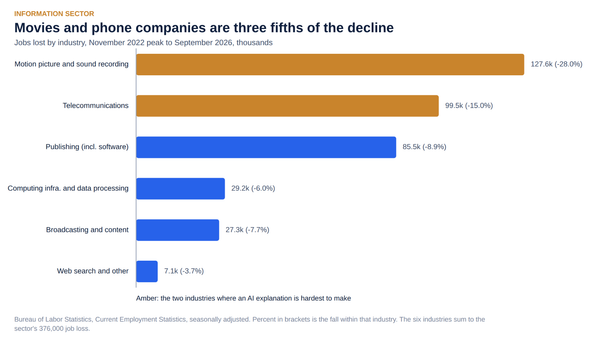
Here's what's actually happening: The unemployment rate looks stable because people are exiting the labor force rather than showing up as unemployed. When workers give up searching, they disappear from the unemployment count. Of the 6.0 million people outside the labor force who say they currently want a job, none register in the 4.3 percent figure. The labor market isn't clearing — it's shrinking. Meanwhile, the sector-level data reveals that virtually all net annual job creation has concentrated in one place: health care and social assistance added 680,500 jobs over the past year (+2.9 percent). Manufacturing shed 75,000 (-0.6 percent). Transportation and warehousing lost 121,200 (-1.8 percent). Total nonfarm payrolls are essentially flat year-over-year.
Why it matters for you:
- Your candidate pool is smaller than it looks. A 4.3 percent unemployment rate implies roughly 7.2 million available workers — but the more relevant number is the 6.0 million who want work and have stopped looking. These individuals are harder to reach through standard job postings and won't apply to your open roles without active sourcing. If your recruiting strategy is passive — post and wait — you're fishing in an increasingly small pond.
- Sector concentration has a compensation implication. Health care hiring grew nearly 3 percent while manufacturing and logistics contracted. If your business competes for workers in non-health-care sectors, you're pulling from a shrinking supply. The workers who remain employed in flat or declining sectors have limited options but also limited urgency to move — meaning compensation premiums alone won't motivate them. Stability signaling, development opportunities, and team quality matter more in tight, flat markets.
- Marginal workers are a real pipeline — but require different outreach. 1.9 million marginally attached workers wanted jobs and looked sometime in the past 12 months but stopped in the last four weeks. This isn't laziness — it's discouragement. These candidates re-enter quickly when employers signal genuine opportunity. Referral programs, community partnerships, and workforce re-entry programs can activate this population in ways standard job boards can't.
Source: Bureau of Labor Statistics, The Employment Situation — March 2026 (April 3, 2026)
Watch this: The participation rate has now fallen 0.6 points since January — from 62.5 percent to 61.9 percent in three months. If that trend continues, the denominator for unemployment calculations keeps shrinking while the rate holds "stable." The real story won't be the unemployment number; it'll be the labor force size. A workforce that appears tight by headline metrics may actually be withdrawing.
The contrarian play: Most managers are calibrating hiring difficulty to the unemployment rate. That's the wrong metric right now. The actual constraint is that the available labor pool is contracting and heavily concentrated in health care. If you're hiring outside that sector, your sourcing strategy should look more like targeted recruitment than open posting — and your retention economics should reflect that replacing any given employee means competing for a smaller supply than six months ago.