Sarah Winters had done everything right.
She'd spent eleven weeks sourcing for an open analytics position on her team — a ten-person group inside a 400-person B2B software company in Columbus. She used structured interviews. She required a technical assessment. She called three references personally. She convened a five-person interview panel and debriefed them against a rubric. The hire she landed — Jonah Park — came in at a 4.2 on the company's candidate scoring rubric, had a strong track record at his previous employer, and got genuine enthusiasm from four of the five interviewers.
Six months later, Sarah was reviewing Q3 performance data that looked almost identical to Q2. Output was roughly flat. The team's average turnaround time on analysis projects hadn't shifted. Two of her longer-tenured team members, Marcus and Priya, had become slightly less focused — nothing she could name specifically, just a general dimming she attributed to post-summer drift. Jonah himself was performing at roughly the predicted level: solid, reliable, no concerns. The team had simply not improved.
Sarah's working hypothesis was sourcing. The pipeline wasn't surfacing strong enough candidates. She invested in a better job description, expanded her LinkedIn sourcing, worked with a recruiter for the first time. The next hire, seven months later, was stronger by every metric she tracked: a 4.5 on the rubric, more directly relevant experience, an especially strong endorsement from a senior person at her previous company.
Six months after that, the team's output had actually ticked down slightly.
What Sarah was running into wasn't a hiring problem. It was a composition problem. She kept optimizing the inputs while the environment those inputs entered was doing something she'd never measured.
The Individual Illusion
The entire architecture of modern talent management is built around the individual. Job descriptions describe the individual. Compensation benchmarks the individual. Performance reviews rate the individual. Candidate scorecards assess the individual. The frameworks are increasingly sophisticated — structured interviews, validated assessments, work samples, competency mappings — and the field has made genuine progress on the question of how to predict whether a given person will perform well in a given role.
What it hasn't built, with anything approaching the same rigor, is a model for what that person will do to the people already there.
This isn't a small gap. The research on peer effects in the workplace — the study of how coworkers directly shape each other's performance — is among the most consistent and replicated bodies of work in organizational economics. The findings span grocery stores, call centers, software firms, patent offices, and professional services firms. They hold across industries, firm sizes, and roles. And they point to the same conclusion: who your people work alongside is one of the most powerful determinants of how much they produce, how much they learn, and whether they stay.
Organizations don't hire teams. They hire individuals and place them in teams. That observation, from a 2005 paper in Personnel Psychology, captures the fundamental accounting error at the center of most talent strategies. The unit of optimization is the individual. The unit of production is the team. And between those two things — between the individual evaluation and the team context — lies a performance variable that most organizations have never tried to measure, let alone manage.
What the Research Actually Shows
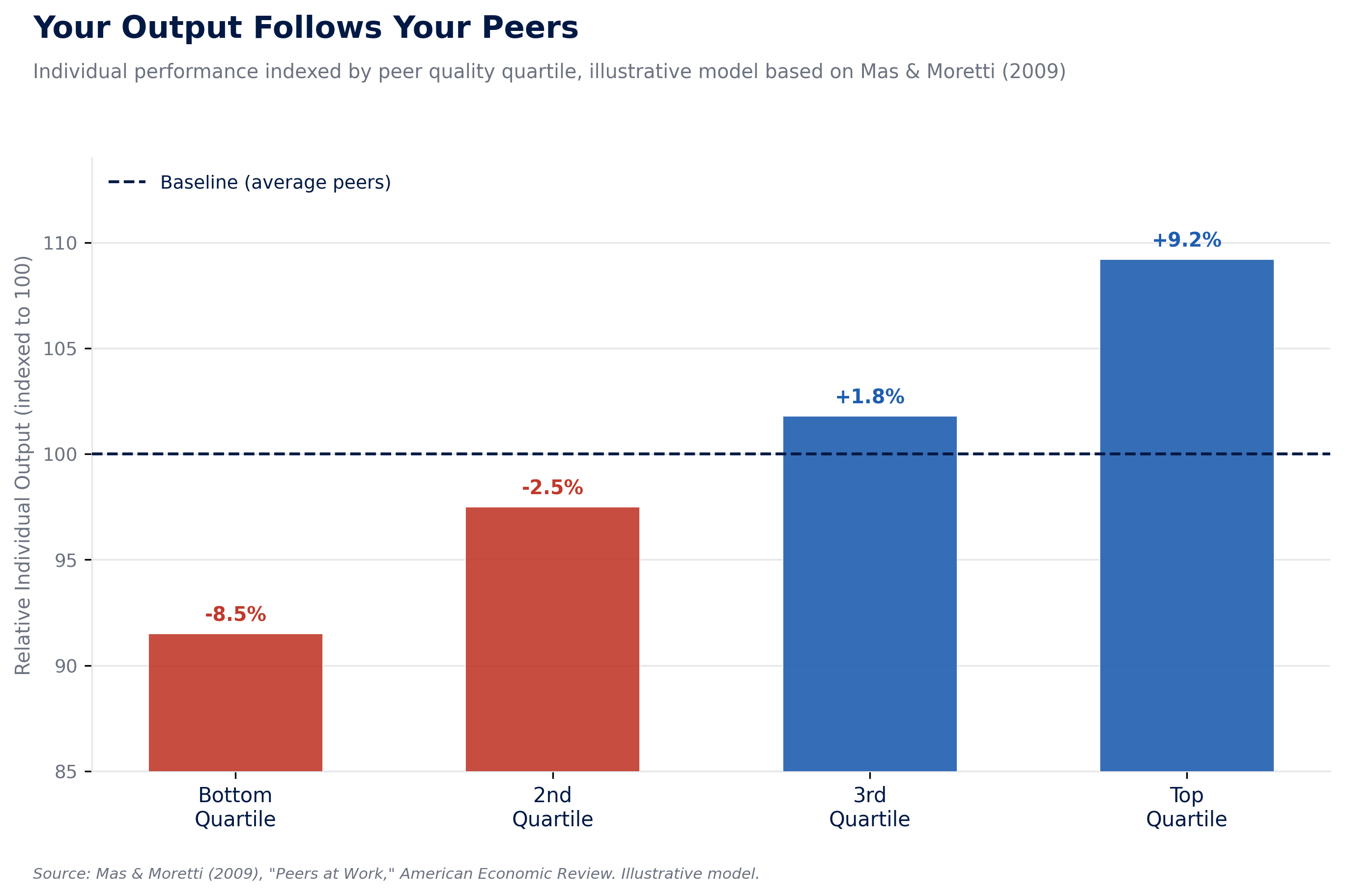
The foundational study in this literature is a 2009 paper by economists Alexandre Mas and Enrico Moretti published in the American Economic Review. Their setting was a supermarket chain — an environment with objective, high-frequency productivity data: scanner throughput per hour for individual checkout workers. Because of how the company scheduled shifts, the timing of when workers arrived and departed was essentially random, which let Mas and Moretti isolate the effect of who was working near whom on any given shift.
The result was stark. A 10% increase in co-worker permanent productivity was associated with a 1.7% increase in an individual worker's effort. And the effect was directional: a worker's output rose when they were visible to a high-performing peer, but not when the high performer was behind them or in a different lane. Social pressure, not just proximity, was driving the result. People work harder when they can be seen by someone they know is working hard.
Subsequent research extended the finding. Falk and Ichino ran a lab experiment with workers stuffing envelopes in pairs and found that a 10% increase in a peer's output increased an individual's effort by about 1.4%. The effect was consistent and significant even in a controlled setting with no wage competition. Observing someone working harder made people work harder.
Then there's the bad apple research. Will Felps and colleagues spent years studying what a single underperforming or toxic team member does to the group around them. Their findings became well-known in management circles through Bob Sutton's citation of them: a single bad apple — categorized as a jerk, a slacker, or a depressive pessimist — can reduce team performance by 30 to 40%. That number tends to get quoted and then dismissed as hyperbole. It isn't. The mechanism is straightforward: negative behaviors are contagious in a way that positive behaviors aren't. Slacking by one person increases the perceived acceptability of slacking. Hostility from one person changes the psychological safety of the group. Constant pessimism from one person shapes the ambient emotional register that everyone else processes their work through.
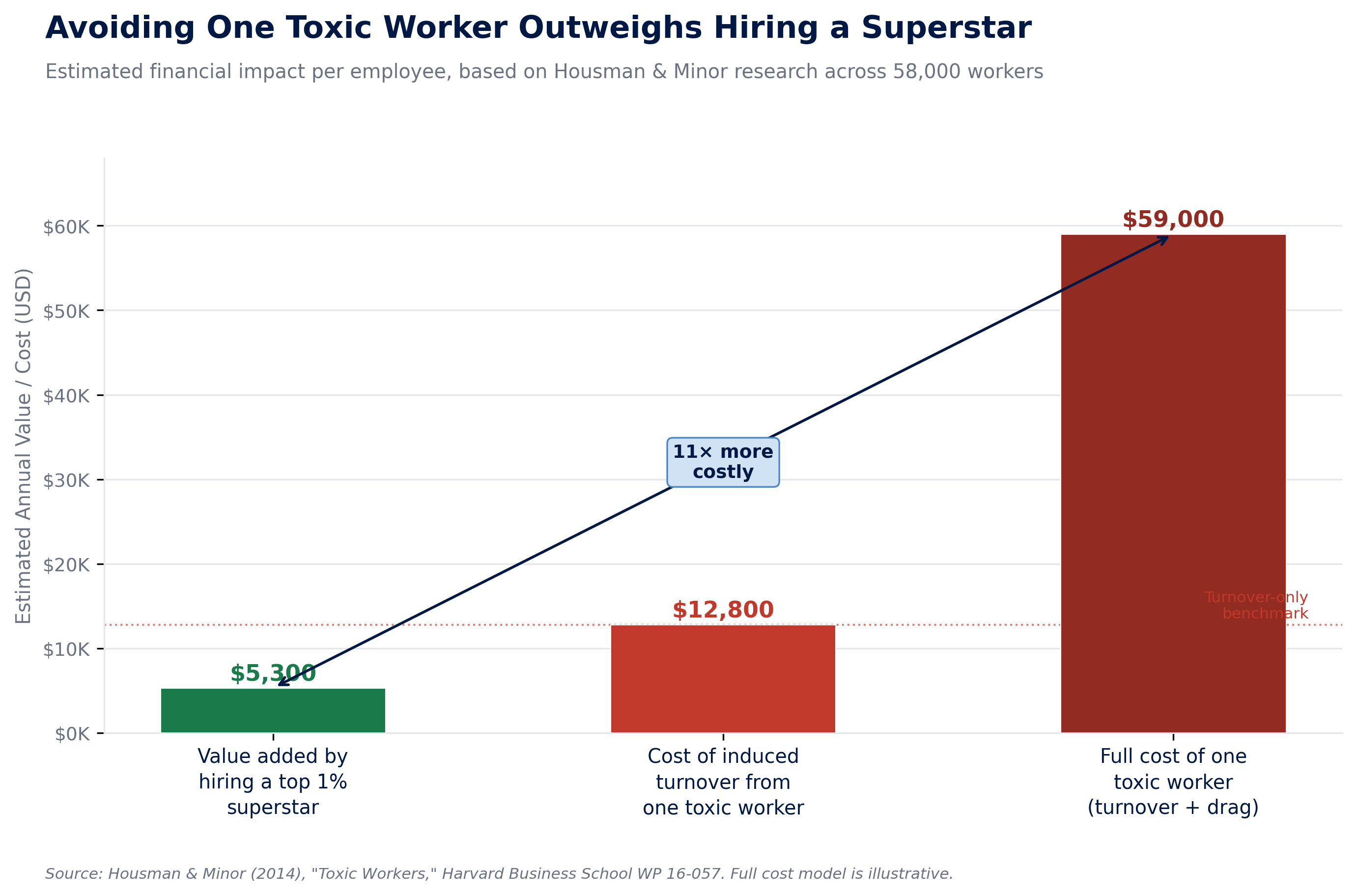
The most practically relevant research in this space, though, comes from Michael Housman and Dylan Minor in a pair of Harvard Business School working papers from 2014 and 2016. Their dataset covered more than 58,000 hourly service workers across eleven firms — large enough to find effects that weren't statistical noise. Their first paper focused on toxic workers and produced a number that should disturb anyone managing a team: the cost of replacing a single toxic worker — just the induced turnover cost from the colleagues who leave because of them — averaged $12,800. The value added by hiring a top 1% superstar performer averaged $5,300 in additional output.
Avoiding a toxic hire was worth more than twice the value of landing a superstar.
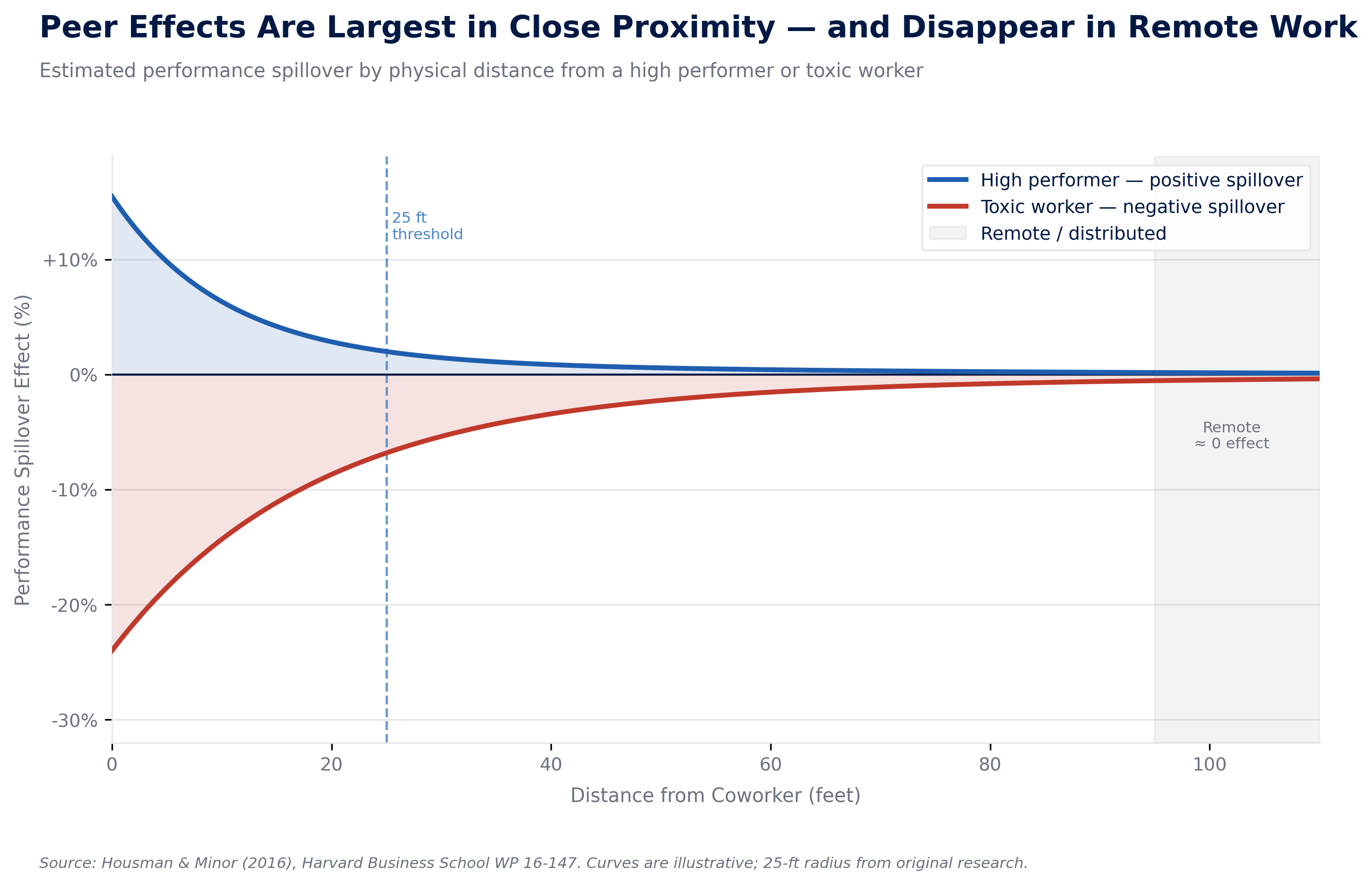
The second paper went further. Housman and Minor analyzed the effect of physical proximity on spillover at a large technology firm, using two years of detailed performance data on more than 2,000 employees. Workers seated within 25 feet of a high performer saw their own productivity rise by between 3% and 16%. Strategically pairing workers with complementary strengths — placing someone who was fast but error-prone next to someone who was slower but precise — generated performance improvements of up to 15% across the organization. For a 2,000-person firm, they calculated, that translated to approximately $1 million in additional annual profit. Not from hiring. Not from training. From where people sat.
The toxic spillover effect was roughly twice the magnitude of the positive one. And while positive spillover from a high performer concentrated in close proximity, negative spillover from a toxic worker spread more diffusely — affecting colleagues across a wider radius, moving through the team more like a virus than a signal.
Why It Works: The Three Mechanisms
Peer effects in the workplace operate through three distinct channels, and they're worth separating because they have different time horizons and respond to different management interventions.
The first is social norms. People calibrate their effort to the observable standard around them. This doesn't require conscious awareness or deliberate mimicry — it's an automatic social process. In Mas and Moretti's supermarket data, workers sped up when a high performer arrived on their shift and slowed back down after that person left. The adjustment happened within minutes. It wasn't about learning from the high performer or being inspired by their example. It was simply that the presence of someone visibly working hard raised the implicit standard for what counted as acceptable effort. The reverse holds equally: when the people around you are visibly doing less, the threshold for adequate performance quietly adjusts downward. This is why teams with even one chronically disengaged member often see engagement drift across the group over time, and why managers consistently underestimate how much a single low performer is costing everyone else.
The second mechanism is knowledge transfer. In any knowledge-work setting, people learn from watching and working alongside people who are more capable than them. This channel is slower than social norms — it builds over weeks and months rather than minutes — but its effects are more durable. Research on teachers, for instance, has found that working near a more effective colleague improves a teacher's own effectiveness over time, and that the effect persists even after the colleague moves on. The implication for team composition is significant: early-career and developing employees aren't just producing output, they're absorbing the behavioral and technical models of the people closest to them. Who you put next to a new hire is, in effect, deciding what curriculum they learn from.
The third mechanism is tone-setting. This is the hardest to quantify and the most powerful at the team level. Every team has an ambient emotional register — a baseline level of psychological safety, intellectual engagement, and interpersonal warmth — and that register is not determined by averaging the dispositions of everyone on the team. It's determined disproportionately by the most disruptive or most draining members. A single chronically cynical person can reshape the conversational character of an entire team meeting. A single aggressive or dismissive colleague can reduce the risk tolerance of everyone around them. Google's Project Aristotle research, which studied 180 teams to identify the factors that most predicted effectiveness, found that who was on the team mattered substantially less than how people interacted. The most powerful predictor of team effectiveness was psychological safety. What determines psychological safety? In large part, the people who most reliably undermine it.
Positive tone-setting is real too, but it's fragile. High performers who model curiosity, rigor, and constructive challenge do lift their teams. The problem is that this effect requires people to feel safe enough to emulate it — and that safety is contingent on the absence of the tone-killers. You can't add psychological safety with a great hire if you already have someone on the team who's draining it.
The Asymmetry Problem
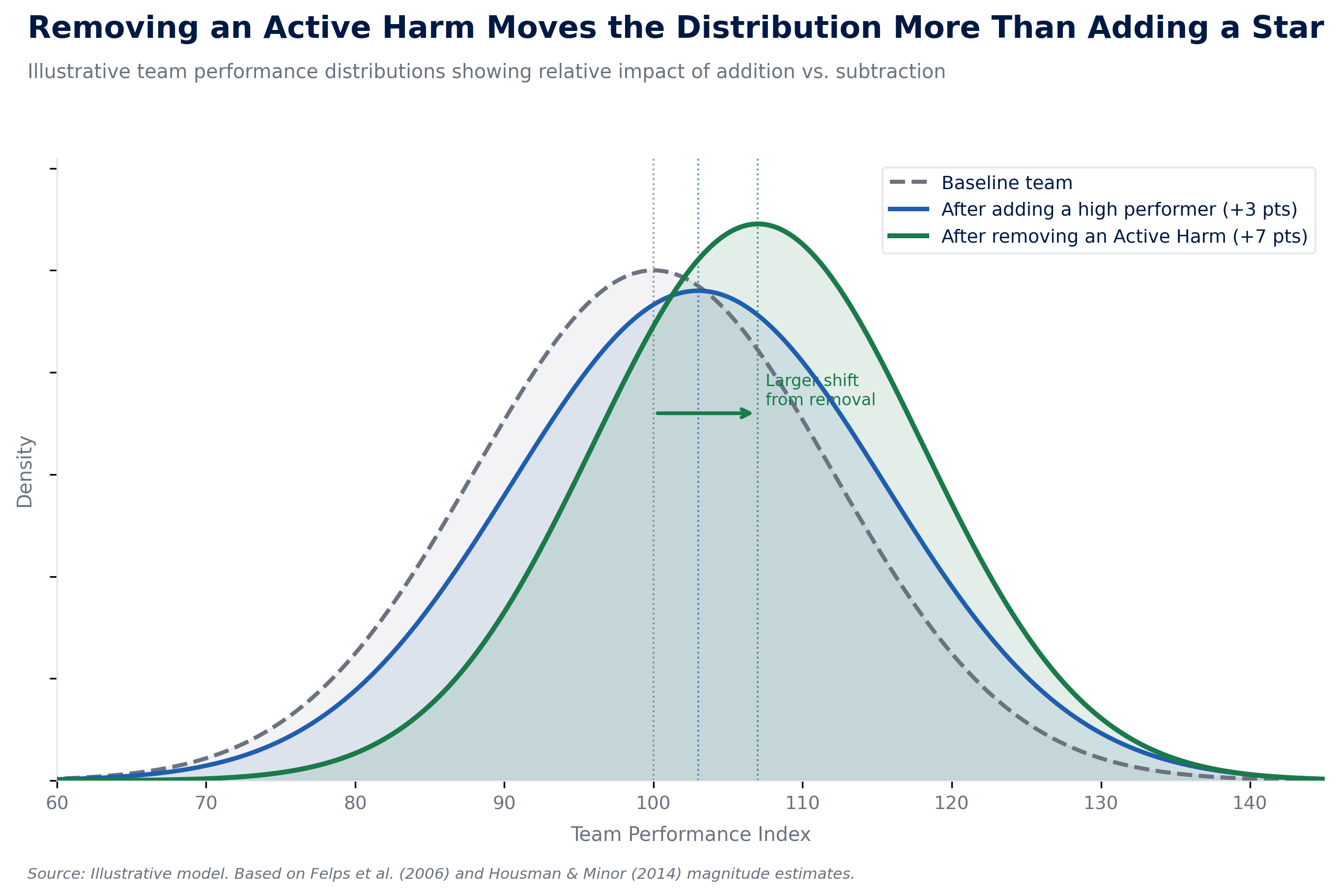
The most actionable finding in the peer effects literature is also the most counterintuitive: the damage done by a low performer or toxic team member consistently exceeds the value added by a high performer or star hire. This asymmetry isn't marginal. It's roughly 2-to-1 in the research, and probably higher in practice because the full cost of a negative peer environment — reduced psychological safety, lower knowledge transfer, dampened engagement — doesn't show up cleanly in any performance metric.
There are two reasons the asymmetry exists. The first is neurological. Negative social signals are processed more quickly and more intensely than positive ones — what psychologists call negativity bias. The presence of a threatening or hostile team member activates threat responses that consume cognitive resources, increase cortisol, and reduce the quality of judgment and attention. A single person who makes meetings feel adversarial or makes feedback feel dangerous can meaningfully impair the cognitive output of everyone in the room. High performers don't produce a comparably powerful positive neurological effect on their colleagues. Being inspired is slower and more effortful than being threatened.
The second reason is behavioral contagion. Negative behaviors spread more reliably than positive ones because they're easier to adopt. Slacking is easier to replicate than excellence. Cynicism is easier to absorb than engagement. Hostility is easier to mirror than warmth. Felps's research found that teams with a single toxic member didn't just experience a reduction in their average output — they became measurably more similar to the toxic member over time, adopting their behavioral patterns in ways that were visible to outside observers. The bad apple effect isn't metaphorical. It's a literal behavioral contagion process, and it compounds.
The management implication is stark, and most managers get it exactly backwards. The standard talent management posture is: hire better people to improve team performance. Add stars. Improve the talent mix upward. The logic is intuitive and not wrong, but it's less efficient than the alternative that most managers avoid: remove the active drags before adding new performers. Removing a single negative peer effect from a team often does more for performance than adding a star, costs less, and produces the effect faster. Yet managers consistently spend more time filling headcount than they spend addressing the existing team member who's quietly costing them a third of their team's potential output.
There's a practical reason for this. The cost of a toxic or chronically low-performing team member is dispersed and invisible. It shows up as slightly lower output from Marcus. Slightly reduced engagement from Priya. A team that never quite achieves the psychological safety that would let them challenge each other's ideas. None of these appear on anyone's ledger. The cost of an open headcount, by contrast, is visible, named, and tracked. Job requisitions are monitored. Time-to-fill is reported. This asymmetry in visibility produces a systematic bias toward addition over subtraction — and it's exactly backwards relative to what the peer effects research suggests about where the value actually is.
The Proximity Dimension
Physical space turns out to matter more than most managers realize, in ways that are both surprising and practically useful.
Housman and Minor's proximity research found that the peer effects from a high performer concentrated sharply within approximately 25 feet. At greater distances, the positive spillover fell toward zero. The effect wasn't about working on the same project or even being on the same team — it was about physical proximity itself, which creates the conditions for visible effort, incidental learning conversations, and the casual social pressure that drives norm calibration.
The bad news about this proximity effect is that it vanishes quickly. Workers who benefited from sitting near a high performer didn't maintain the performance gains after that person moved desks or departed. The effect was ongoing and required continued proximity to sustain. This means that seating decisions, workspace design, and the geography of your team's working environment are active performance management levers — not administrative details.
The more important proximity finding, though, is the asymmetry in how positive and negative effects travel through space. Positive spillover from a high performer was local. Negative spillover from a toxic worker was not. Toxic behavioral contagion spread through the team more broadly — affecting not just immediate neighbors but the wider team environment. This asymmetry has significant implications for how managers think about problem-solving: moving a toxic employee to the corner of the floor won't eliminate the damage. The tone they've set, the safety they've reduced, and the behavioral norms they've shifted travel through meeting rooms, Slack channels, and the watercooler conversations that are harder to map.
Then there's remote work.
The peer effects literature largely relies on in-person settings — supermarkets, call centers, tech offices where workers are seated within visible distance of each other. The mechanisms (social pressure, visible effort, incidental learning) all operate at least partially through physical presence. This raises a question that hasn't been fully resolved by the research: what happens to peer effects in remote and hybrid environments?
The available evidence suggests they diminish substantially. A 2023 NBER working paper by Emanuel, Harrington, and Pallais on the "power of proximity" found that in-person work creates meaningful mentoring and learning benefits that remote work doesn't replicate — and that these benefits are largest for less experienced workers. Research from the US Patent Office found that knowledge spillovers between co-workers reduced significantly when workers shifted to remote work. The social pressure mechanism, which requires visible effort, is largely absent on Zoom.
This means that hybrid and remote teams are likely experiencing meaningful peer effect attenuation without knowing it. The high performers who were naturally lifting their neighbors in the office are now producing output in isolation. The knowledge transfer that happened through proximity has been reduced to scheduled one-on-ones and Slack threads. Managers who moved to hybrid work and found their team's cohesion and development velocity slowing aren't imagining things — they're experiencing the peer effect gap.
The silver lining is the other side of the asymmetry: toxic workers' blast radius also contracts in remote environments. It's easier to manage around a difficult team member when the team isn't forced to share physical space with them daily. Remote work, in this sense, has unintentionally insulated some teams from their most disruptive members while also muffling the signal from their best ones.
The Composition Gap in Hiring
Here is the specific way that most hiring processes fail to account for any of this.
When a manager assembles a five-person interview panel and runs a structured interview process, every question is oriented toward the same question: Is this candidate good? Can they do the job? Will they hit the performance bar? The rubrics are individual. The debrief is individual. The hiring decision is individual. Nobody in the room is systematically asking: What will this person do to the team that's already here?
This is a structural gap, not a failure of effort. Hiring frameworks weren't built with peer effects in mind. The scorecard was designed to evaluate the individual. The references tell you about the individual's past performance — which, as research on the attribution error makes clear, is partly a story about the environment they were in rather than just the person themselves. The five interviewers assess whether the candidate has the skills, the experience, and the cultural fit. The question of whether sitting this specific person next to Priya will accelerate Priya's development or slow it down never gets asked.
There are a few specific composition questions that matter and that most hiring processes ignore entirely.
The first is complementarity. Housman and Minor's research found that the most powerful seating arrangements were symbiotic — a worker who was fast but error-prone paired with a worker who was slower but precise, each borrowing the other's strength in their area of weakness. This doesn't require complicated analysis. It requires asking, for every candidate: Where are this person's strengths relative to the people they'll be working alongside? Do they fill a gap, or do they double up on an existing strength?
The second is norm reinforcement vs. norm erosion. Every team has behavioral norms — about response times, about quality standards, about how much unsupervised initiative is expected. A new hire who models norms above the team's current level reinforces and raises them. A new hire who models norms below the team's level will, through the social calibration process, pull them down. This is rarely evaluated in hiring. "Culture fit" is typically assessed as whether the candidate will be comfortable in the culture, not what the candidate will do to it.
The third, and most overlooked, is active harm risk. A small fraction of every workforce — Housman and Minor estimated around 2% in their dataset — is genuinely toxic in the technical sense: creating significant negative spillover for everyone around them. The marginal cost of avoiding one such hire is enormous. Yet most candidate evaluation processes are optimized to identify upside, not to flag downside. References are almost universally positive. Interviewers are calibrating enthusiasm. The conditions that would surface a genuinely toxic candidate — behavioral pattern testing, reference questions specifically designed to probe team impact, structured evaluation of candidates' own commentary about conflict and performance management — are rarely part of standard practice.
The research suggests a different frame entirely. If you're hiring into a team, the first question shouldn't be "who is the best candidate?" It should be "what does this team need from its next addition, and who among these candidates will do the most net good — including what they'll do to the people already here?"
Diagnosing Your Team
Before you can act on the peer effects research, you need a model for assessing where your team actually sits. The relevant framework has two dimensions: individual performance and peer effect direction.
Individual performance is what most managers already track. The peer effect dimension is harder — and most managers are not currently measuring it at all — but it's more tractable than it sounds. The question you're trying to answer is: Does this person's presence raise or lower the performance of the people around them? This isn't a personality judgment. It's an observational question about behavioral effect.
Signals of positive peer effect include: other team members voluntarily seeking out this person's input or feedback; new team members accelerating their development unusually quickly when placed near or paired with this person; the quality or pace of adjacent team members' work visibly improving over the same period in which this person joined; meeting conversations becoming more substantive when this person is present.
Signals of negative peer effect include: team members who perform well on independent work but noticeably worse in collaborative settings; a pattern where output slows when a particular person is in the room; high performers quietly requesting transfers or flagging discomfort without naming a specific issue; new hires whose enthusiasm visibly dims in the months after joining the team.
The most important signal, and the one most consistently missed, is the exit pattern. When good people leave your team, the reason they give in exit interviews is usually not the real reason. The research on this is unambiguous: people substantially under-report interpersonal friction and manager-related issues in exit conversations because they don't want to burn bridges. What they do reveal through their behavior is which team members' departure they coincide with, and what they say to trusted colleagues in the weeks before they leave. If you are tracking the timing of voluntary departures relative to team composition changes, you are measuring peer effects even without a formal framework.
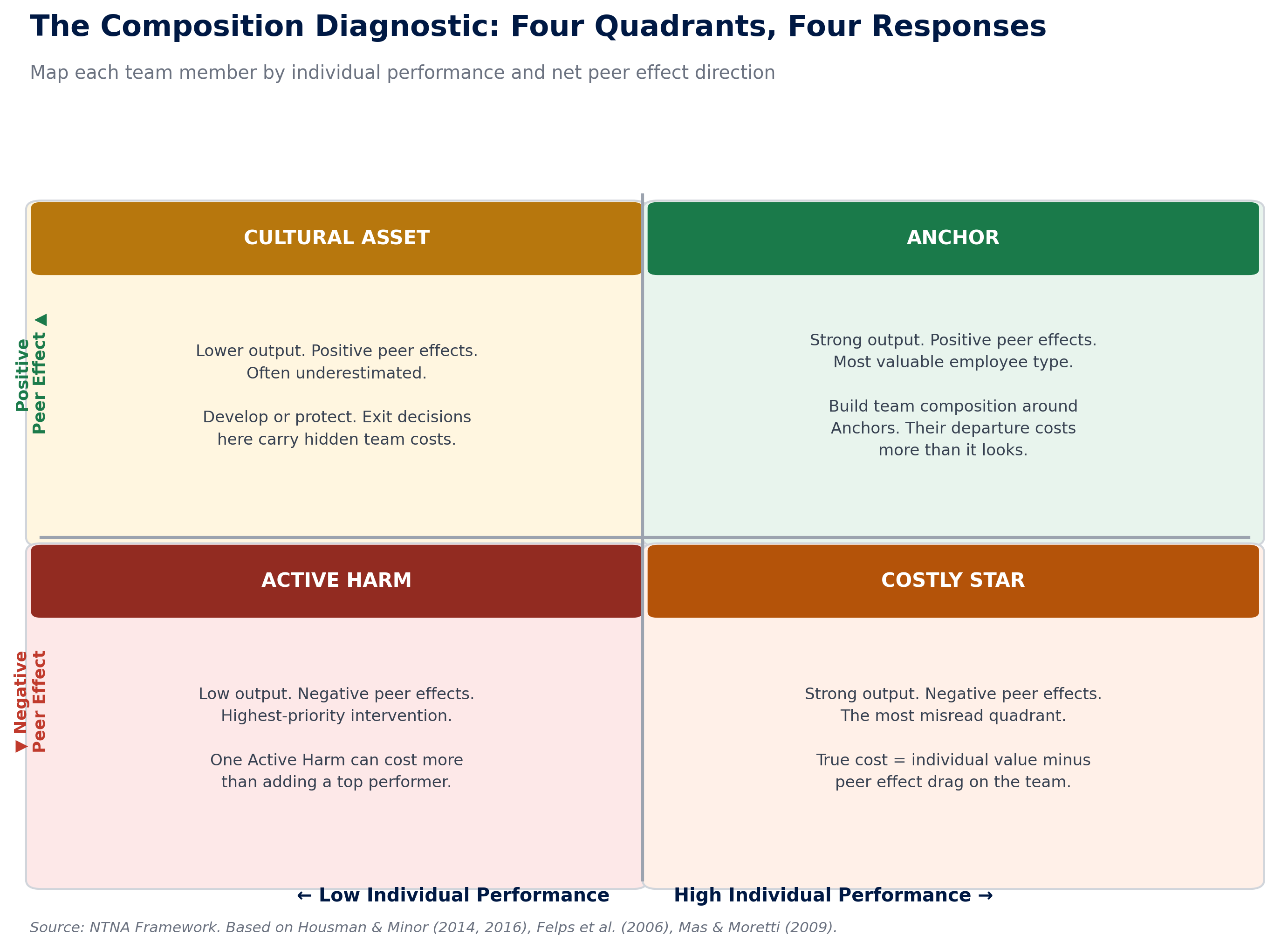
The framework produces four quadrants, each requiring a different response.
Anchors are high performers with positive peer effects. They produce strong individual output and make the people around them better. They are the most underappreciated people on most teams. Managers typically focus their attention on output — who hits their numbers — and miss the adjacent value these people create for everyone else. Anchors should be treated as team design inputs. When you're making a seating decision, a team restructuring, or a pairing choice for a new hire, the question is: where does the Anchor create the most complementary lift? Losing an Anchor is more expensive than it looks on a performance summary, because the individual contribution is visible but the peer contribution disappears from the data entirely.
Costly Stars are high performers with negative peer effects. They produce strong individual output and reduce the performance of people around them. This is the most operationally difficult quadrant because the visibility problem runs in the wrong direction: the individual output is easy to see and defend, the drag it creates on others is invisible. Jack Welch described these workers explicitly in his model — performers who hit their numbers but aren't good corporate citizens — and argued that the courage to remove them even at apparent individual output cost is one of the clearest signals of a mature performance culture. Whether removal is the right call depends on magnitude and trajectory, but the accounting has to include both sides. A Costly Star carrying a $300K revenue number and quietly costing $400K in peer effect drag is not the asset they appear to be.
Cultural Assets are lower performers with positive peer effects. They contribute to the team's norms, psychological safety, and capability development in ways that show up in their colleagues' output but not directly in their own. This quadrant often includes long-tenured, institutionally knowledgeable team members who have plateaued on their own output but still function as connective tissue for everyone around them. Managers who optimize purely for individual output will exit these people — and then be surprised when the team regresses in ways they can't explain.
Active Harms are lower performers with negative peer effects. This quadrant should be the highest management priority. These team members are underproducing individually and reducing everyone else's output simultaneously. The compound cost is substantial, and unlike the Costly Star, there is no offsetting individual contribution to weigh against the damage. The peer effects research suggests that the most impactful thing a manager can do for a team's performance is not the next great hire. It's removing Active Harm from the composition before the next hire arrives.
The Economic Model
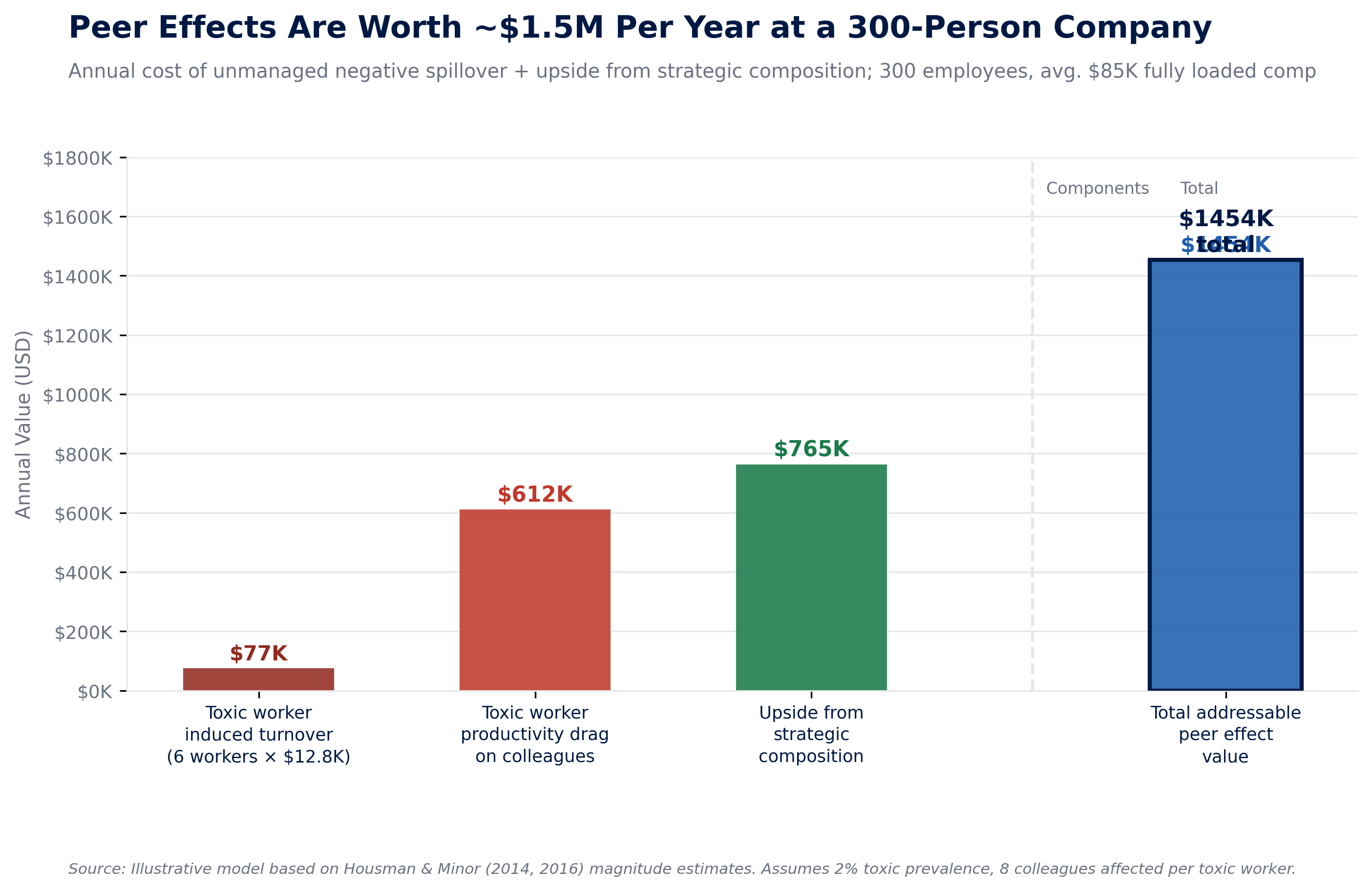
To put numbers to this, consider a mid-market company with 300 employees organized across approximately 25 functional teams averaging 12 members each. Average fully loaded compensation runs around $85,000 per person, putting total personnel cost at roughly $25.5 million.
Start with the negative side. At the approximately 2% toxic worker prevalence that Housman and Minor found in their dataset of 58,000 workers, this company has around 6 people in the Active Harm quadrant. Housman and Minor calculated the induced turnover cost per toxic worker — just the cost of replacing the colleagues who leave because of the toxic person's presence — at $12,800. Across 6 toxic workers, that's $76,800 in direct induced turnover costs, before any accounting for the productivity drag on their nearest colleagues.
That productivity drag is the larger number. If each of the 6 toxic workers has meaningful proximity to 8 colleagues, and those colleagues experience an average performance reduction of 15% — the lower end of what the research suggests — the annual productivity cost is approximately 6 × 8 × $85,000 × 15% = $612,000. Total quantifiable cost from the bottom 2% of the composition: roughly $689,000 per year. That number doesn't include litigation risk, reduced innovation, compounded turnover as high performers exit to escape the environment, or the management time diverted to managing around the problem rather than developing the team.
Now look at the upside. If the top quartile of the company — 75 people — are Anchors or high performers with positive peer effects, and those people are currently deployed against their teams in ways that don't optimize for peer effect, the potential value from strategic composition is significant. Housman and Minor's research found that pairing workers with complementary strengths could generate up to 15% performance improvement at the organizational level. Even assuming 40% of that improvement is achievable with realistic composition management, applied to the 150 employees whose output is most directly shaped by their Anchor neighbors, the value is approximately 150 × $85,000 × 6% = $765,000 in annual performance.
The total addressable peer effect value for a 300-person company — the gap between current composition and optimized composition — is in the range of $1.4 to $1.7 million annually. That's larger than most companies' entire L&D budget. It requires no new headcount, no new systems, and in many cases no additional investment at all. It requires managing a variable that most talent leaders have never put on a spreadsheet.
What Good Looks Like
The managers who navigate peer effects well aren't doing something complicated. They're doing a small number of things that most managers skip entirely.
The composition audit. Before they open a headcount requisition, they audit the current team composition against the 2×2. Who are the Anchors? Who are the Active Harms? What does the team need compositionally — not just skill-wise, but in terms of the behavioral norms the next hire will either reinforce or erode? This takes two hours and changes the frame of the entire hiring process. You're not looking for the best individual candidate in the abstract. You're looking for the best addition to this specific composition.
The peer effect question in hiring. At least one reference question should be oriented toward team impact rather than individual output: "How did the people around her change over the time she was on the team?" "Was he someone others went to for input, or did the team generally work around him?" "What was the ambient energy of the team when she was in the room?" These questions surface information that standard output-focused references completely miss.
Deliberate pairing. In the weeks after a new hire joins, where they land compositionally matters enormously. The first three months of a new hire's tenure is when their norms are most malleable and their learning rate is highest. Putting them in close working proximity with an Anchor accelerates everything — their development, their understanding of standards, their sense of what performance looks like on this team. Managers who think about pairing deliberately, rather than assigning new hires to whatever desk is open, are compressing the onboarding timeline and investing in the new hire's peer-effect inputs rather than just their formal development plan.
Taking the asymmetry seriously. The most important behavioral change in this framework is rebalancing the mental accounting. Managers spend an enormous amount of time thinking about how to add value through hiring and an insufficient amount of time thinking about how to recover value by addressing Active Harms. The research is unambiguous on the relative magnitude. One removal of an Active Harm will often do more for team performance than one addition of a good hire. Treating these two levers as roughly equivalent in priority is the minimum adjustment. Treating removal as the higher-priority lever — which is what the data suggests — requires a different kind of management courage.
Designing peer effect into hybrid work. If your team is hybrid, you're almost certainly experiencing peer effect attenuation that you can't see directly. The two interventions that recover some of what's been lost: making sure that in-person days are designed around proximity to Anchors rather than just presence in the office, and deliberately building lightweight mechanisms for incidental knowledge transfer (shared workspaces on in-person days, informal pairing for collaborative work) rather than relying on structured meetings that generate scheduled peer contact but not the ambient, visible-effort kind that drives social norms.
Back to Sarah Winters. Six months after her second hire underperformed expectations, she finally had a conversation that changed how she understood the problem. She was debriefing with a peer manager over coffee when she started describing her frustration, and her peer asked a question she hadn't considered: "What's Marcus been like since the reorg?"
Marcus had been on the team for four years. He was technically solid — not exceptional, but competent. In the months before the reorg, Sarah would have described him as an eight out of ten. In the months after, she would have described him as a six. She'd attributed the change to the reorg stress. She hadn't asked whether Marcus was the source of the stress rather than its recipient.
She went back and looked at the timing. Marcus's engagement had started declining about two months before the reorg — when a new project had put him in daily proximity to a senior team member named David, who had been quietly struggling and quietly resentful about it for over a year. David's patterns — low initiative, public skepticism about leadership decisions, a habit of catastrophizing in team settings — had been in the team's background noise for so long that Sarah had stopped registering them. Marcus, newer to the team and more impressionable, had been absorbing them for months.
She made two changes. She restructured a project assignment to reduce Marcus and David's daily working proximity. And she finally had the direct conversation with David she'd been avoiding — not about his attitude, which is impossible to address, but about three specific behavioral patterns that were affecting the team, with specific consequences if they continued.
The team's output improved meaningfully in Q1. Not because she hired better people. Because she managed the composition she already had.
The Bottom Line
Your performance management system is built around individuals. Your output is produced by teams. In between those two facts sits the peer effect — the systematic, substantial, and almost entirely unmeasured influence that each team member exerts on every other.
The research is unambiguous on several points. Individual output responds to the quality and behavior of nearby peers, in both directions, through social norms, knowledge transfer, and tone-setting. The damage from negative peer effects is roughly twice the value of equivalent positive effects. Physical proximity amplifies both, which means remote work has disrupted your team's peer effect infrastructure in ways you've probably attributed to something else. And the standard hiring process evaluates candidates as if they exist in isolation, optimizing for the individual addition while ignoring the composition effect entirely.
The practical implication isn't complicated. Audit your composition before you open your next requisition. Treat team design as an active management lever, not a residual output of individual hiring decisions. Address your Active Harms before you add stars. And recognize that the most expensive person on your team might not be the one with the highest salary. It might be the one whose presence is costing you 30% of everyone else.