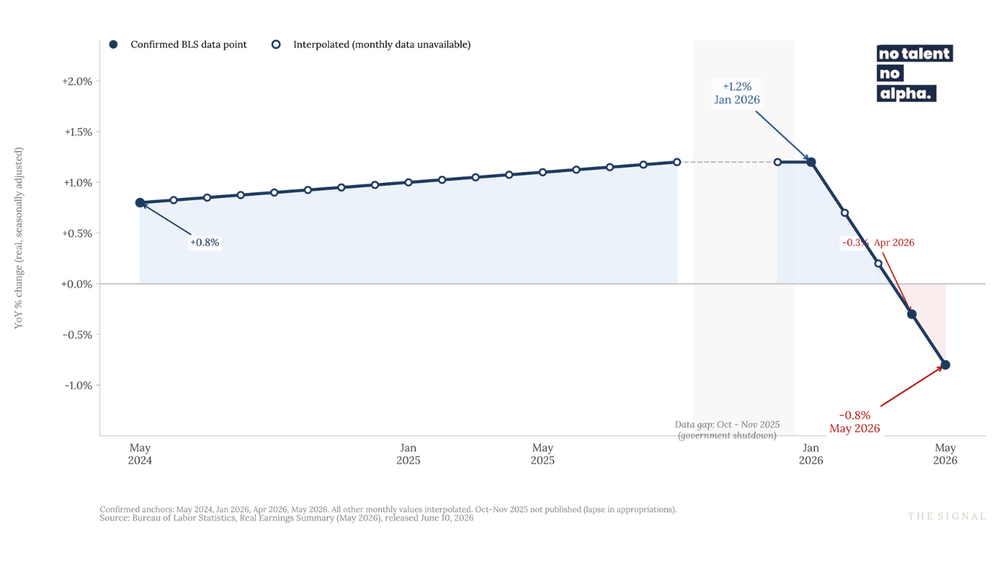
According to the Bureau of Labor Statistics' Real Earnings Summary for May 2026, released June 10, real average hourly earnings for all employees fell 0.8 percent from May 2025 to May 2026, seasonally adjusted. Nominal average hourly earnings rose 3.4 percent over the year to $37.53. But the Consumer Price Index rose 4.2 percent over the same period — outpacing wages for the second consecutive month. Real average weekly earnings fell 0.2 percent. The average workweek held flat at 34.3 hours. Workers aren't falling behind because wages are stagnant. They're falling behind because inflation accelerated past wage growth.
Here's what's actually happening: Inflation reversed course faster than compensation plans adjusted. In January 2026, real wages were still modestly positive — nominal gains were outpacing prices. By April, the gap flipped: real earnings down 0.3 percent year-over-year. May's reading of negative 0.8 percent is a further deterioration. The culprit isn't wage weakness — 3.4 percent nominal growth is historically solid. It's an energy-driven inflation surge, with the energy index up 17.9 percent year-over-year in April, dragging overall CPI to 4.2 percent. Workers aren't being paid less. They're buying less with what they earn.
Why it matters for you:
- Your comp decisions are being graded in real terms, not nominal ones. When you point to a 3.4 percent raise as evidence of good faith, your workers are running the same math the BLS just published: that raise didn't keep pace with inflation. Workers don't think in percentage points — they think in grocery bills, gas prices, and rent. The disconnect between "we gave you 3.4 percent" and "you're buying 0.8 percent less" shows up in engagement surveys months later, not the next morning.
- Lower earners are absorbing a disproportionate hit. Energy prices, up 17.9 percent year-over-year, represent a far larger share of the budget for hourly and lower-wage workers than for salaried managers or technical staff. A flat 3.4 percent nominal raise lands very differently on your frontline and shift supervisors than it does on your directors. A comp strategy built on uniform percentage raises applies a consistent nominal remedy to a highly uneven inflation experience.
- Workers can't compensate by working more hours. Real weekly earnings fell 0.2 percent even though the workweek held at 34.3 hours — there's no hours cushion. Workers who want to protect their purchasing power can't do it by picking up extra shifts. Their options are to absorb the loss, ask for a raise, or look elsewhere. In a low-quit environment, most will absorb it — for now.
Source: Bureau of Labor Statistics, Real Earnings Summary (May 2026), released June 10, 2026
Watch this: May CPI came in at 4.2 percent, accelerating from April's 3.8 percent. If energy prices stay elevated through summer driving season, the real wage gap could widen further before the July 14 Real Earnings release. That's the next data point that tells whether this squeeze is a temporary energy spike or a durable shift.
The contrarian play: Most organizations are entering mid-year reviews anchored to nominal wage growth as evidence of competitive comp. The manager who explicitly acknowledges the real wage math — who says "your raise didn't keep pace with inflation and here's how we're thinking about that" — is conducting a different and more credible conversation than peers who present 3.4 percent as a win. That honesty is rare enough to function as a retention differentiator.