According to The Conference Board's Employment Trends Index for April 2026, the composite rose to 105.77 from a downwardly revised 105.52 in March — its first clear break from a year of steady decline. Seven of the index's eight components improved. The share of consumers who say jobs are "hard to get" fell 1.5 points to 19.8 percent, its lowest reading of the year. Initial jobless claims dropped to roughly 203,300, a near-historic low. Temporary-help hiring contributed positively for a fourth straight month. On its face, the labor market is steadying.
Here's what's actually happening: The components doing the lifting are demand-side sentiment and lagging confidence measures — how workers feel about finding a job, how few people are filing new claims. Those are real, but they describe the recent past and the mood, not forward hiring capacity. Buried in the same release is the one component that measures employer-side friction directly: the share of small firms reporting positions they cannot fill right now. That figure rose to its highest level since June 2025. A composite can climb because workers feel better and layoffs stay low while the actual ability to staff roles is tightening underneath it. That is precisely the configuration in this report.
Why it matters for you:
- The "market is improving" read will mislead your hiring plan. A rising ETI invites the conclusion that candidate availability is loosening. The unfilled-positions component says employers — especially smaller ones — are finding it harder, not easier, to staff open roles. If you set 2026 hiring timelines off the headline index, you will under-budget time-to-fill for exactly the roles that are getting harder to close. Plan against the component, not the composite.
- Small-firm staffing strain is a leading signal for your sector. Small employers feel labor-supply tightness first because they lack the comp flexibility and employer brand to outbid for scarce workers. When their unfilled-positions reading climbs while everything else looks calm, it is an early read on where mid-size and larger employers land two quarters out. Treat the small-firm signal as a forward indicator for your own roles, not someone else's problem.
- Low claims are not the same as easy hiring. Falling jobless claims tell you employers aren't cutting, which managers reflexively read as labor-market health. But a low-fire market with rising unfilled positions is a market where the people you need aren't moving and aren't available — not one where talent is easy to acquire. Stop using "claims are low, the market's fine" as the basis for slow-walking offers or holding retention spend.
Source: The Conference Board, Employment Trends Index — April 2026 (Released May 11, 2026)
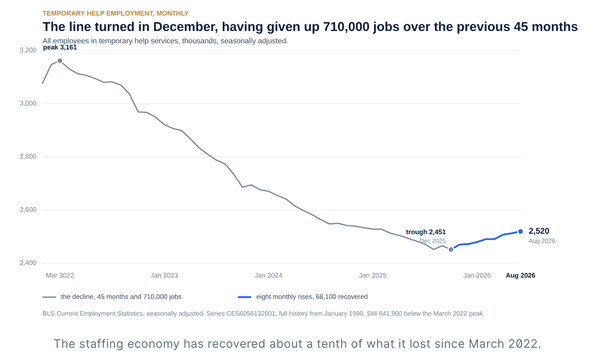
Watch this: Track the unfilled-positions component and the temp-help component against the headline index. Temp-help hiring rising for four consecutive months is historically an early-cycle signal that permanent hiring follows. If that continues while small-firm unfilled positions keep climbing, the labor market that looks "stable" in the composite will reveal itself as supply-constrained — tight, not loose — well before the index turns to say so.
The contrarian play: While competitors read the ETI's rise as the all-clear and defer hiring and comp decisions into the second half of 2026, treat the divergence between the soft components and the unfilled-positions signal as a narrow timing window. The market reads as loose right now; the employer-side data says it is quietly tightening. Move on critical hires and key-employee retention while the consensus still says "wait" — the managers who act on the component instead of the headline will be staffed before the squeeze becomes obvious to everyone pricing off the index.