Two teams. Same function. Same budget. Same headcount of eight.
Team A has been together for four years. Everyone knows each other's strengths and quirks. Meetings are short because nobody needs context. They hit every commitment. Their manager calls them a high-performing team in every quarterly review, and she means it. Engagement scores are in the top decile of the company. Voluntary attrition is near zero. The team has the kind of reputation other teams reference when explaining what "good" looks like.
Team B is messier. Two people left in the last year, two were hired, one was promoted in from another team. Their manager spends real time on coordination, on context-setting in meetings, on patching mismatched expectations between veterans who assume things and newcomers who don't. He hates the noise. The team's engagement score is mid-pack. The manager has been told, more than once, that he should "stabilize" the team.
By every traditional metric a CHRO or VP would look at — engagement, attrition, predictability, manager confidence — Team A is the model. Team B is the problem to fix.
Eighteen months from now, the picture flips. Team A's output growth has flatlined. They're producing the same kinds of solutions to the same kinds of problems, with diminishing returns. Their best ideas were three years ago. The strongest performers on Team B have produced the two most important pieces of work the function shipped last year — both built on approaches Team A had explicitly considered and rejected. By the time leadership looks at the comparison, Team B is doing roughly what Team A was doing in its peak years, and Team A is now stuck.
This isn't a story about culture or leadership. The managers haven't changed. The mandates haven't changed. The budgets haven't changed. It's a story about composition.
Tenure mix — the ratio of newcomers to veterans on a team — is one of the most consequential variables in team performance, and one of the least designed. It drifts. Teams hire in sprints and then stop. They lose people in waves. Layoffs cut deeper into recent hires than tenured employees. By the time anyone notices the mix has shifted, the team has been on the wrong part of the curve for a year. The damage is invisible because the team's most-cited metric — execution against commitments — actually gets better as composition gets worse, right up until the moment performance collapses.
Most managers can tell you the average tenure on their team. Very few can tell you the distribution. Fewer still know what distribution they're aiming for. And almost nobody treats it as a variable they should manage actively, on the same footing as hiring or retention. That's the gap this piece is about.
What stable teams actually do
The research on tenure and team performance is unusually clear, and unusually old. Ralph Katz's 1982 study of fifty R&D project groups at a major industrial laboratory — still one of the cleanest natural experiments on the question — showed that team performance rises through roughly the first eighteen months a group works together, plateaus through year three, and then declines noticeably by year five. The mechanism is communication: as teams stabilize, they communicate less with external information sources, become more confident in their own internal narratives, and gradually stop hearing dissent. Katz called the resulting pattern Not Invented Here syndrome. The label stuck. The finding has been replicated dozens of times across industries since.
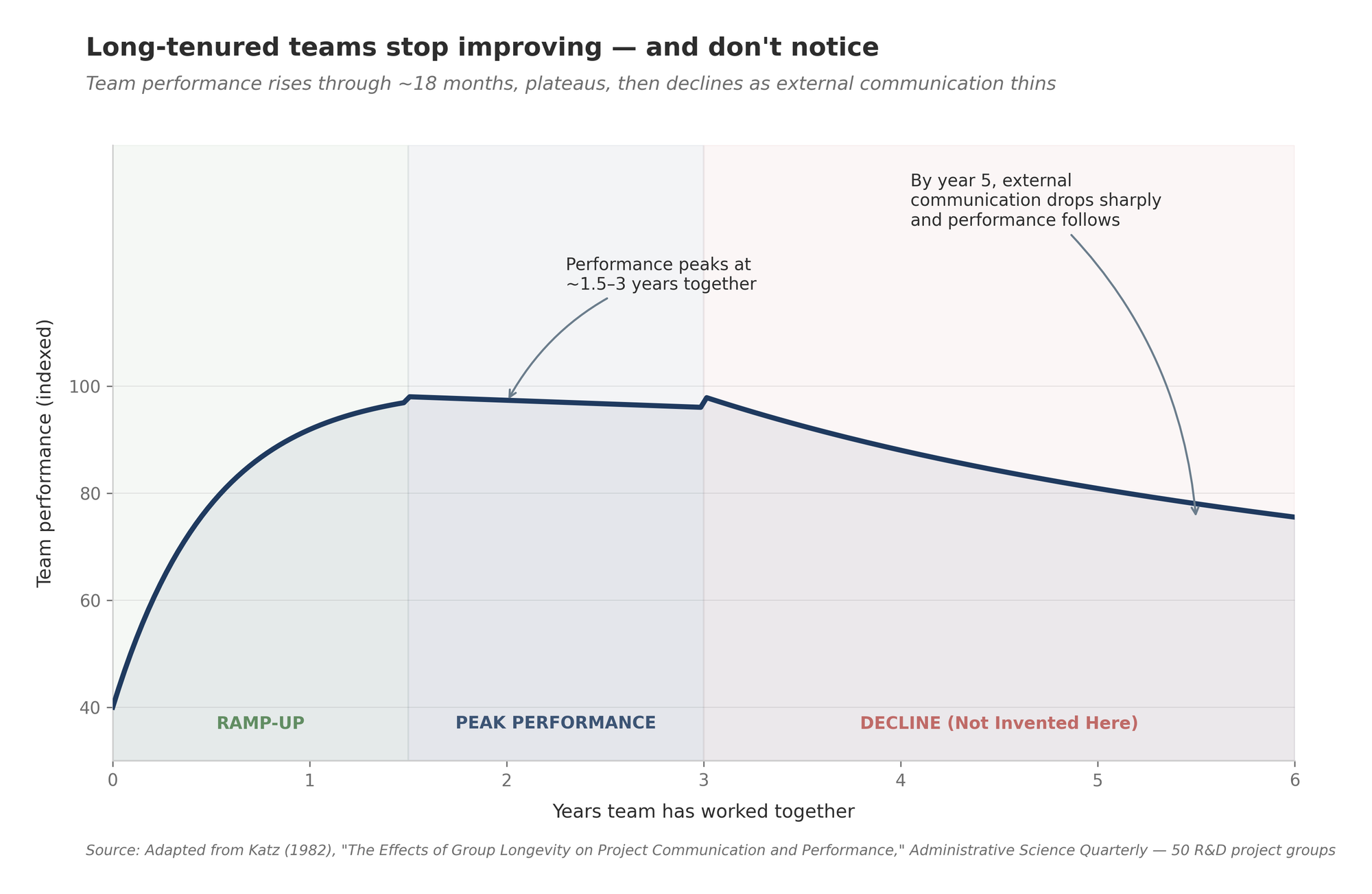
What's important isn't that long-tenured teams underperform. Some do, some don't. What's important is that they reliably stop improving, and most managers don't notice because the team is still hitting its commitments. Execution stays strong. Innovation, by definition, is what you'd be doing differently, and a team that's stopped doing things differently produces no signal that anything is wrong. There's no incident report. No customer complaint. No miss on a metric. Just a slow flattening of the curve that you only see when you compare it to a team running on a healthier mix.
This is the first failure mode of tenure mix: the over-veteran team that confuses stability with health. It feels great from the inside. The work is predictable. The disagreements are mild. The manager spends less time on people and more time on output. From the outside — from the perspective of customers, of competitors, of new ideas that the team didn't think of — something is quietly going wrong. The team's frame on its problem space hasn't updated in two years. Their assumptions about what's possible have ossified. They're solving the right problem the same way they always have, while the problem has moved.
The mechanism Katz documented is worth understanding precisely, because the cure follows from the cause. Long-tenured teams don't underperform because they get lazy or complacent. They underperform because they stop communicating with the outside. The R&D groups in Katz's study weren't producing worse code or worse hypotheses on their own work. They were producing the same code and same hypotheses they'd been producing — while gradually losing touch with what was happening at other labs, with new techniques their peers were trying, with shifts in the underlying science. They became information-poor without realizing they had become information-poor. The internal communication remained rich; the external communication thinned.
This is what happens to over-veteran teams in any function. The product team that hasn't talked to a real customer in six months still feels confident about customer needs. The sales team that hasn't been to a conference in two years still feels confident about competitive positioning. The engineering team that hasn't onboarded anyone new in three years still feels confident about their architectural choices. In each case, the team isn't wrong because it stopped trying. It's wrong because its inputs got narrow and it didn't notice. The output of the team — measured against its own internal scoring — looks fine. Measured against what the team could be doing with broader inputs, it's a few quarters behind.
Katz's data showed this decline starting around the eighteen-month mark and becoming pronounced by year five. The decline wasn't catastrophic. It was a slow, steady drift in performance accompanied by a sharp drop in the rate of external communication. The teams hadn't gotten worse at their jobs. They'd gotten worse at noticing what their jobs had become.
The distribution is bimodal
Before getting to the second failure mode, it's worth looking at what the actual workforce looks like, because most thinking about tenure starts from a misleading anchor.
The standard reference statistic is median tenure: 3.9 years, per the Bureau of Labor Statistics' January 2024 release. That number does some serious damage in HR conversations because it suggests a kind of central tendency that doesn't exist. The actual distribution of US workforce tenure is heavily bimodal. About 22% of workers have been with their current employer for less than a year. About 26% have been there for ten years or more. The middle — workers between one and ten years — is spread thin.
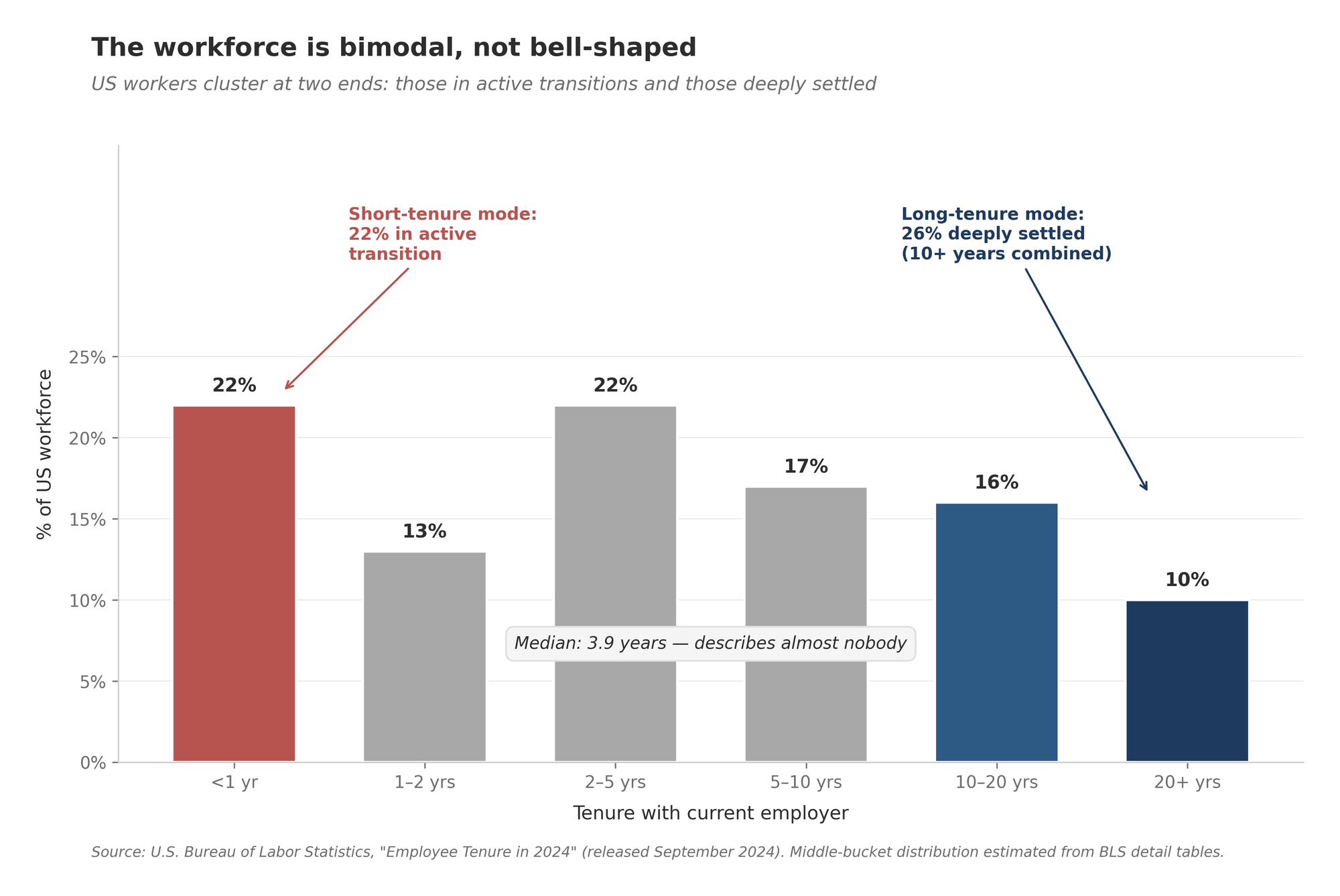
The implication for team composition is that you're not selecting from a normal distribution. You're selecting from two populations: short-tenured workers in active transitions, and long-tenured workers who are deeply settled. The "five-year-tenure professional" who serves as the implicit reference point in most retention frameworks isn't a typical employee. They're a relatively rare middle-population specimen, and they're heavily over-represented at certain levels (mid-career professionals in stable functions) and under-represented at others (leisure and hospitality has median tenure of 2.1 years; mining and oil-and-gas is at 5.7).
This matters for team composition because it means a team's tenure distribution can produce an "average" tenure of four years through wildly different compositions. A team of eight where two people have been there fifteen years and six have been there a few months produces the same average as a team where everyone has been there four years. The teams will behave nothing like each other. One will function. The other won't.
The bimodality also matters because it shapes the kind of hires available. When you're hiring externally, you're almost always hiring from the under-one-year pool — people in active job transitions. You're rarely poaching someone with seven years at their current company; the data on tenure says those people mostly stay put. So the "fresh perspective" that enters your team through external hiring comes from the short-tenured population. The "stability" that comes from veterans comes from the long-tenured population. The middle barely exists as a hiring market. This is part of why team composition drifts: the two populations have different inflow and outflow dynamics, and the equilibrium they produce isn't necessarily the productive equilibrium.
Average tenure is the wrong metric for team composition. The shape of the distribution is what matters, and most managers aren't looking at it.
The chaos at the other end
The second failure mode is what happens when a team tips too far toward newcomers. This one is more visible — you can feel it — but its costs are usually under-counted.
Onboarding research consistently puts the ramp-up time for professional roles at around twenty weeks to full productivity, with executive and senior technical roles closer to twenty-six weeks and often longer. MIT Sloan's review of the academic literature suggested averages of eight weeks for clerical jobs, twenty weeks for professionals, and more than twenty-six weeks for executives. Gallup's data suggests new employees in complex roles take around twelve months to fully meet productivity standards. Mellon Financial's analysis estimated that the lost productivity from new-hire learning curves runs between 1% and 2.5% of total revenues across a typical company — a number that has roughly held up in subsequent replications.
If a single newcomer represents a partial productivity drag for five to six months, two newcomers on a team of eight represent a meaningfully larger drag because the costs compound. Veterans get pulled into onboarding. Coordination meetings get longer because more people need context. Decisions that should be one conversation become three because the same questions get asked by different people. The team's effective capacity drops by more than the sum of the individual ramps. The arithmetic isn't additive — it's superlinear, because the coordination overhead lives in the interactions between people, not in the people themselves.
Now scale this up. A team of eight that adds three newcomers in a single quarter isn't running at five-eighths capacity. It's running at something closer to half, sometimes less, because the surviving veterans are spending a meaningful share of their week explaining context that used to be implicit. The team feels chaotic from the inside — and it is — but the manager who tries to fix the chaos by hiring more people only makes it worse. Each additional newcomer adds more questions per remaining veteran. The ratio is the problem, not the headcount.
A few specific failure patterns are worth naming because they recur. The first is the answered-question repetition: the same question gets asked by three different newcomers in three different weeks, and the veteran who answers it the third time is annoyed in a way that erodes the team's psychological safety. The second is the meeting bloat: meetings that used to be three people and forty-five minutes become six people and ninety minutes, because everyone needs to be in the room to understand context. The third is the decision regression: decisions that were made and settled six months ago get re-opened because newcomers are encountering the original problem for the first time and don't know it was already analyzed. The fourth is the institutional-knowledge bottleneck: one or two veterans become single points of failure for all the things the newcomers don't know, and their calendars fill with explanatory conversations rather than original work.
This is the over-newcomer team: high energy, high churn of ideas, lots of motion. It looks dynamic. It often is dynamic. But it spends a disproportionate share of its bandwidth on coordination and re-litigation of decisions that veterans would have made implicitly. Knowledge that should be tacit becomes explicit, and the cost of making it explicit is high.
Worse, this team is fragile. If you lose a veteran from an over-newcomer team, the team falls off a cliff. The veteran was the load-bearing piece. Replacing them with another newcomer doesn't restore the team — it makes it more fragile. The over-newcomer team can survive losing newcomers. It cannot survive losing veterans. And paradoxically, veterans in this position often choose to leave, because their week has shifted from doing the work they were hired to do toward serving as a help desk for newer colleagues. Their job has effectively changed without anyone naming the change. Veterans who joined to build product end up onboarding instead, and they recalibrate accordingly.
The shape of the curve
So one failure mode is over-veteran (the team stops improving and doesn't notice). The other is over-newcomer (the team spends more on coordination than it earns from fresh perspective). What's the right mix between them?
The research here is more nuanced than the failure-mode descriptions suggest. A series of studies on team tenure heterogeneity — most notably Chi, Huang, and Lin's analysis of the relationship between organizational tenure diversity and team innovation — show an inverted-U pattern. As tenure diversity increases from zero (everyone has the same tenure) up to a moderate level, team innovation rises. Past that moderate level, innovation declines again. The peak of the curve is somewhere in the middle, not at either extreme. A separate analysis of 68,933 R&D teams in the electrical engineering industry found the same inverted-U on team familiarity and innovation. The pattern is robust across industries, team types, and measurement approaches.
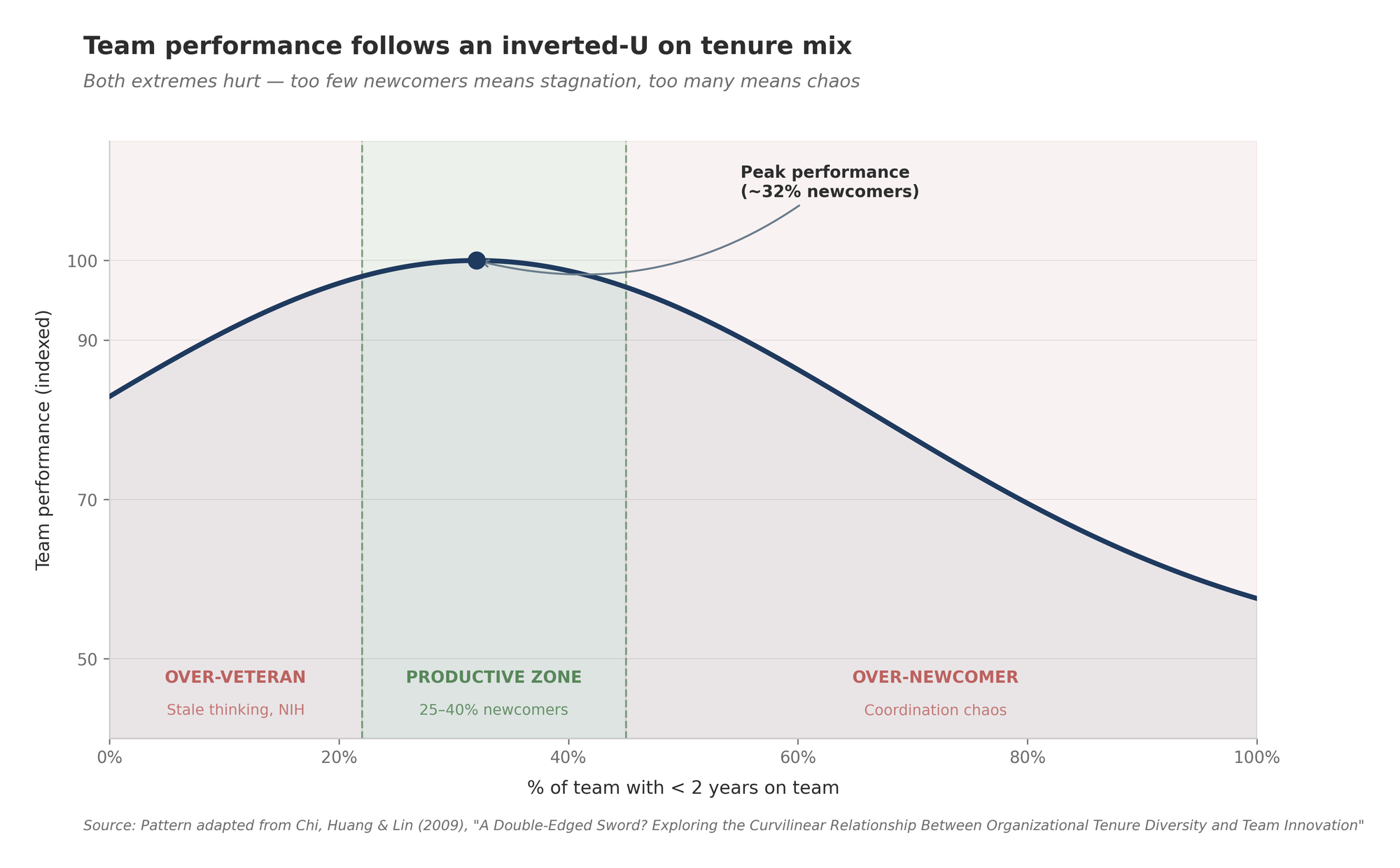
The reason for the curve is intuitive. Pure homogeneity in tenure means everyone shares the same context, the same assumptions, and the same blind spots. Pure heterogeneity in tenure means nobody shares context, and the team can't move because every decision requires reestablishing shared understanding. The sweet spot involves enough shared context to move fast and enough difference in tenure to keep the team's framing fresh.
In practice, this typically corresponds to a mix where roughly 25-40% of the team has been on the team for less than two years, and the remaining 60-75% has been there longer. The veterans provide the institutional knowledge, the relationships, and the execution speed. The newcomers provide the questions, the external perspectives, and — critically — the permission for the team to question its own assumptions.
That last point is important and often missed. The value of a newcomer isn't just the perspectives they bring. It's the legitimacy they create for anyone to question the status quo. On an all-veteran team, raising a "why do we do it this way" question is socially expensive — you're criticizing decisions you participated in making. On a team with newcomers, the question is expected. Newcomers are supposed to ask why. Veterans can ride on the back of newcomer questions to revisit assumptions they themselves had stopped questioning. Adding a newcomer to a team isn't just adding their output. It's recreating the conditions under which the team examines itself.
The mechanism here is well-documented. Recent research on newcomer voice in the Journal of Vocational Behavior found that newcomers' challenge-oriented behavior is one of the strongest predictors of team adaptation, but that this only works when the team is structured to absorb it — which most teams aren't. The newcomer challenge is a fragile asset. It works if you have it. It dissipates within twelve to eighteen months as the newcomer assimilates into the team's existing assumptions. Which means the question isn't just whether you have newcomers. It's whether you have a continuous flow of newcomers, structured so that the challenge function keeps refreshing rather than fading.
The exact ratio matters less than the principle. A team of ten with three people under two years and seven veterans is roughly in the productive zone. A team of ten with one newcomer and nine veterans is over-veteran. A team of ten with six newcomers is over-newcomer, regardless of how strong the individual newcomers are. The mix is the thing.
It's also worth noting what the mix isn't. It isn't age diversity (though they're correlated). It isn't background diversity (though they're correlated). It isn't even seniority diversity. A team of ten with a junior associate, three managers, two directors, and four ICs can still be entirely composed of seven-year veterans and produce all the failure modes of an over-veteran team. Tenure mix is its own variable. It needs its own diagnosis.
How teams drift
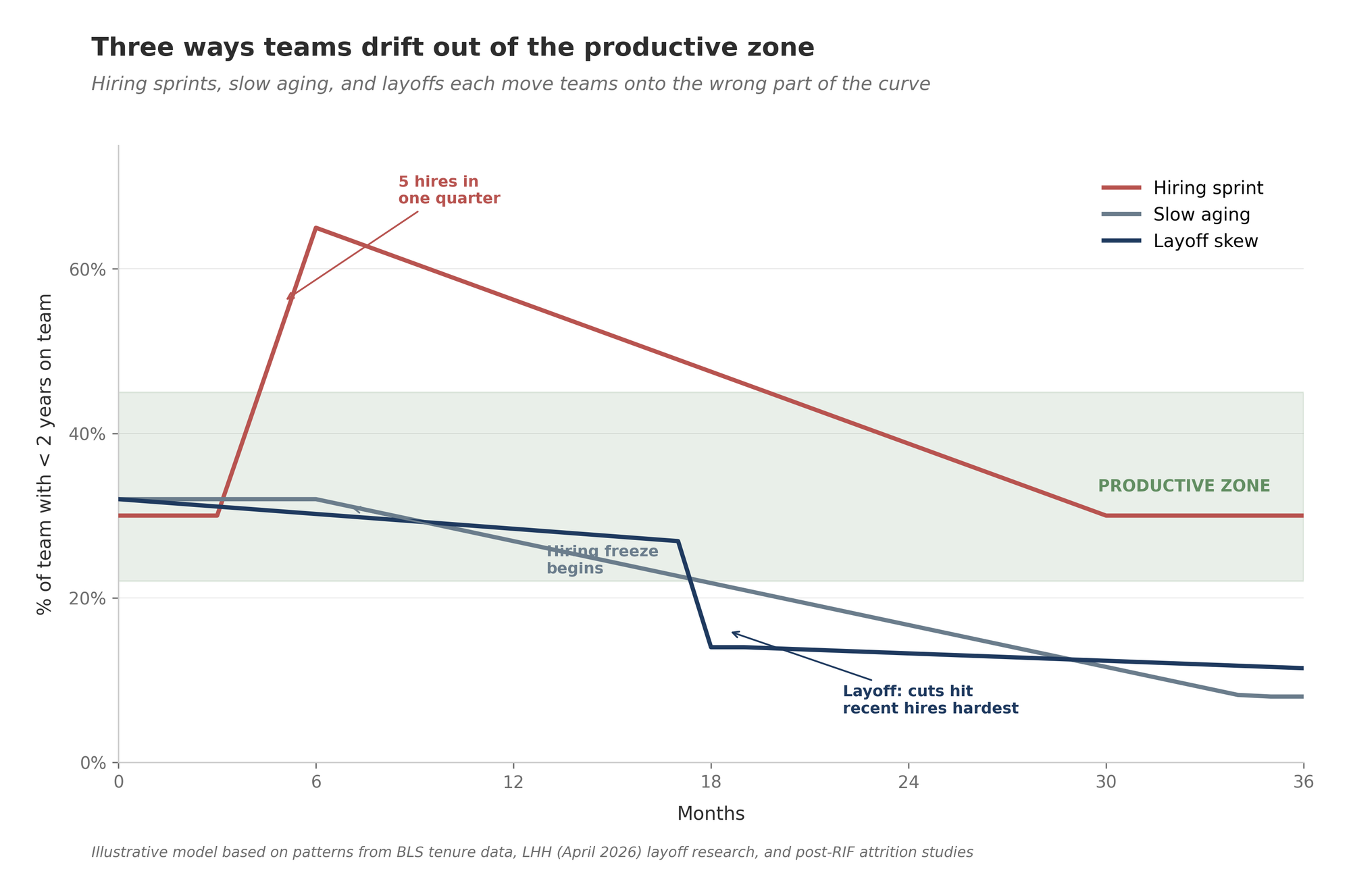
If the productive zone is so well-defined, why don't more teams sit in it? The answer is that nobody designs team composition. It happens to teams. Three drift patterns explain most of what goes wrong.
The first is the hiring sprint. A team gets funded for growth, posts five reqs, and fills them in a quarter. Overnight, the team's tenure distribution shifts dramatically. The first three months look fine because the newcomers are still in honeymoon energy. The next nine months are brutal. The team is in the over-newcomer zone and doesn't get back to productive composition until the newcomers cross the two-year mark — assuming none of them leave first, which a meaningful share will, because over-newcomer teams have higher attrition among newcomers themselves, who experience the chaos as a sign that they made the wrong choice. The hiring sprint is the most visible drift pattern. It's also the one managers most reliably misdiagnose, because it shows up as "we need to onboard better" when what's actually wrong is the ratio.
The second is the slow aging. A team hires steadily, then enters a quiet period — a hiring freeze, a budget cut, a year of internal focus. No new people arrive. Existing people stay. The team's tenure profile shifts month by month toward the right side of the distribution. By month thirty, the team has crossed into over-veteran territory and nobody can pinpoint when it happened. There was no triggering event. The team just got older. This drift is the most insidious because there's no event to attribute the change to. The manager who joined an over-veteran team a year ago experiences it as how the team has always been. The manager who has run the team for five years experiences it as the team becoming what it always was on its way to becoming. Neither sees a problem until output growth has been flat for several quarters.
The third — and the one most relevant to 2026 — is the layoff skew. Reductions in force almost never preserve tenure distribution. Some use last-in-first-out criteria explicitly. Others use skill-based criteria that correlate with tenure (newer technologies, recently created roles, recent hires not yet vested). Either way, RIFs tend to remove a disproportionate share of recent hires while preserving long-tenured employees. After a layoff, a team that was balanced becomes veteran-heavy, often dramatically so.
The 2026 environment is producing this third pattern at scale. LHH's April 2026 research found that 87% of HR leaders have conducted or are planning layoffs in the next twelve months. Resume.org's January 2026 survey put the share of companies expecting layoffs at 55%. The post-layoff attrition spike is well-documented: industry analysis suggests that a company laying off 10% of its workforce typically loses an additional 5% of its top performers within six months as voluntary departures. These departing top performers are usually not the most recent hires. They're veterans, choosing to leave.
The combined effect is that a typical team in 2026 has lost some of its recent hires through the layoff, lost some of its veterans through the post-layoff exit spike, and is now operating with a smaller, older, more homogeneous tenure profile. The remaining veterans are the ones who stayed — which selects for people with structural reasons to stay (vesting cliffs, golden handcuffs, geographic constraints, late-career risk aversion) rather than for the most engaged or most adaptable veterans. Hiring freezes mean no new blood is coming in to rebalance the mix. The teams that emerged from the past eighteen months of restructuring are systematically drifted toward over-veteran, with a worse veteran population than they had before.
Most of them will sit there for another year or two before anyone notices what's happened to their output growth. By the time the diagnosis happens, the remediation cost is much higher than it would be today, because the team will have lost its sense of what good looks like, will have ossified into the patterns of post-layoff survival, and will treat any introduction of newcomers as a threat to the fragile equilibrium that has kept them stable through the restructuring.
Diagnosing your team
The good news is that the diagnosis is cheap. The bad news is that almost nobody runs it.
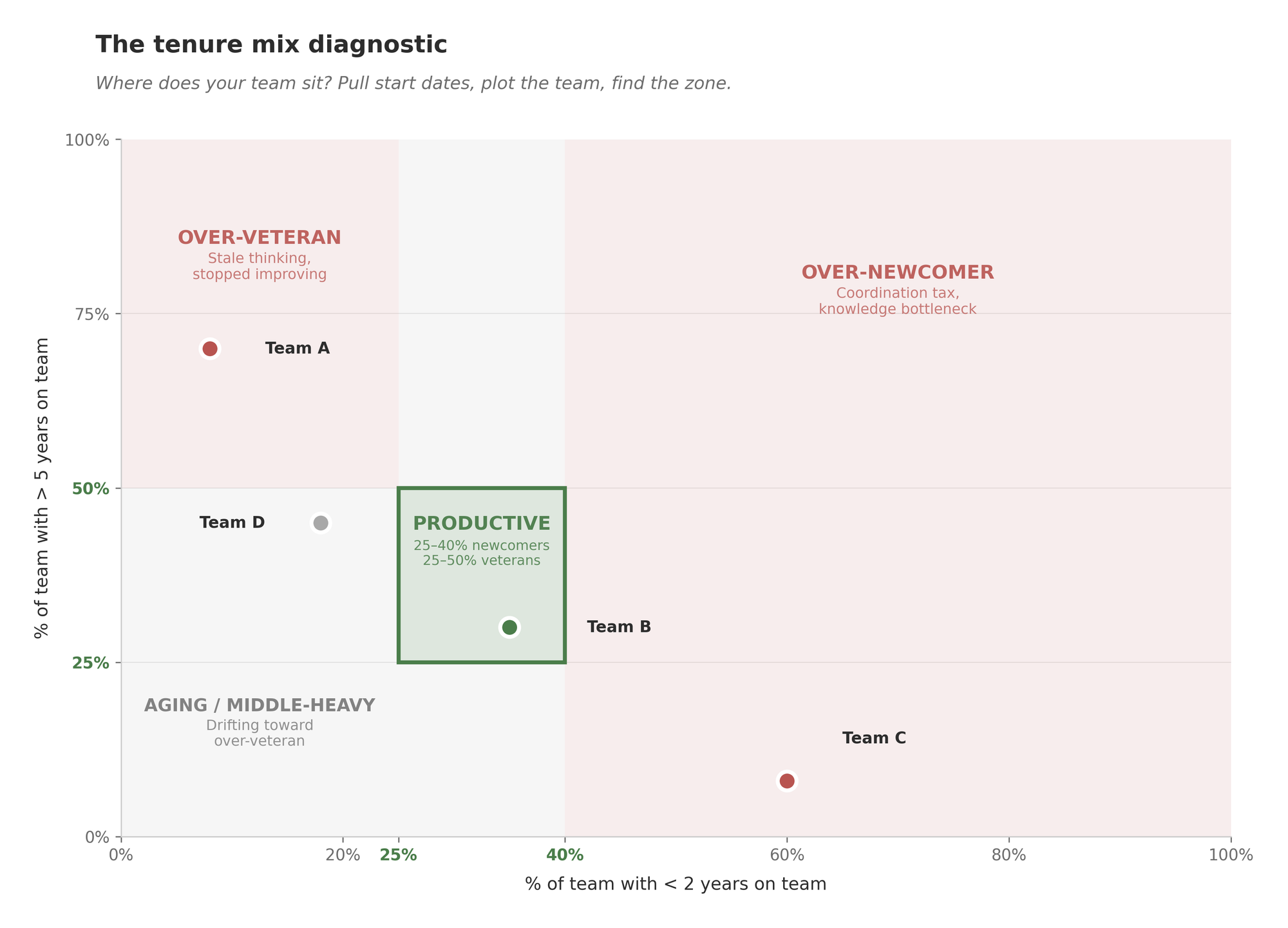
Pull the start dates for everyone on your team. Sort them. Look at the distribution. Two questions answer most of what you need to know:
What percentage of the team has been on this team — not in the company, on this team — for less than two years?
What percentage has been on this team for more than five years?
The productive zone, for most knowledge-work teams, sits in roughly the following range: 25-40% under two years, 25-50% over five years, with the rest in the middle. Outside this range, you're in one of the two failure modes, and you can place yourself precisely.
A few clarifications worth making. First, "on the team" matters more than "in the company." A ten-year veteran of the company who joined this team six months ago is a newcomer for the purposes of this diagnosis. They don't have the team's context, they don't share its narrative, and they bring the same fresh-perspective benefits a true new hire brings. Internal moves do count for rebalancing tenure mix, just less than they should — most companies under-weight them as a remediation lever. A lateral move into the team from another part of the company is a free newcomer for tenure-mix purposes: they ramp faster than an external hire, they come pre-vetted on culture and reliability, and they bring different context that breaks the team's information monoculture.
Second, the under-two-years and over-five-years thresholds are heuristics, not constants. Roles with longer learning curves shift both thresholds out. Specialized engineering, regulated industries, and roles requiring extensive customer relationships might use three years and seven years as the relevant cutoffs. Roles with shorter learning curves — generalist functions, fast-moving operational work — might use one year and three years. The shape of the framework is invariant; the exact numbers move with the work.
Third, the diagnostic shows you composition, not health. A team in the productive zone might still be poorly led, badly resourced, or solving the wrong problem. A team outside the zone might be doing fine in the moment because of unusual leadership or unusual circumstances. The mix isn't sufficient. It's a necessary input to sustained performance, and one that most managers don't measure.
Fourth, the diagnosis is most useful when run periodically. A team in the productive zone today can drift out of it in twelve months. The right cadence is quarterly review of team composition for any team of meaningful size — not as a formal HR exercise but as part of the manager's own portfolio management of their team. The question "what does my team look like a year from now if nothing changes" is one most managers can't answer, and it's one of the most consequential questions they should be able to answer.
A related point: tenure-mix diagnosis should happen before staffing decisions, not after. Most managers run mix analysis (when they run it at all) retrospectively, asking why a team is struggling. The high-leverage version runs the analysis prospectively, asking how an upcoming hire, departure, or restructure will move the team on the curve. The information is the same. The timing is what makes it useful.
What to do, depending on where you are
If you're over-veteran — the most common 2026 situation — the remediation has three layers, in increasing order of difficulty.
The easiest is strategic newcomer addition. This isn't about waiting for someone to leave so you can backfill. It's about creating capacity for a newcomer even when the team is "full," because the team isn't actually performing at the level the headcount suggests. Internal lateral moves are the cheapest form: someone from another part of the company who can join the team and bring outside-the-team perspective. They onboard faster than an external hire and come pre-vetted. The cost of taking on a lateral move is almost entirely the seat — which an over-veteran team can usually justify giving up because the marginal veteran is producing less than they look like they're producing. A specific tactic that works: when someone elsewhere in the organization is being considered for a stretch role, suggest your team. The veterans push back because the team is "full." That pushback is itself diagnostic. A team that resists newcomers is usually over-veteran.
The middle layer is boundary spanning. Rotate veterans out for tours on other teams. Bring veterans in from other teams. Pair the team with adjacent functions on stretch projects. Send people to customer sites, conferences, partner sessions, regulator meetings. The Katz finding wasn't that long-tenured teams were doomed — it was that long-tenured teams stopped communicating externally. Anything that breaks the internal communication monoculture restores some of the lost performance. This is expensive in time and disruption, and it's almost always undervalued because the immediate cost (the veteran's calendar) is visible while the return (fresh information flowing back into the team) is diffuse. Companies that take boundary spanning seriously — formal rotation programs, sabbaticals, cross-functional secondments — see compounding returns. Companies that treat boundary spanning as a perk see no return because the program doesn't reach the teams that most need it.
The hardest layer is questioning the underlying stability itself. Some long-tenured teams have stayed together because nothing was challenging enough to break them. Others have stayed together because they've been protected from challenge. A team that hasn't lost a person in three years, hasn't been reorganized, hasn't taken on substantially new work — that team's "stability" is a tell, not a feature. The most uncomfortable remediation is to introduce real friction: new mandate, new metric, new accountability. Veterans on these teams often respond by leaving, which sounds like a problem but is usually the system working correctly. The team that emerges is smaller and more variable, but it starts improving again. The veterans who leave under these conditions were rarely going to be net contributors to a team that needed to adapt. They were optimizing for the team that existed, not the team that the work required.
If you're over-newcomer, the moves are different and almost the opposite of what most managers reach for.
Don't add more newcomers, even if you have open reqs. An over-newcomer team isn't suffering from a headcount shortage. It's suffering from a knowledge shortage. Adding another ramping employee makes the knowledge shortage worse, not better. Hold the reqs. Wait for the existing newcomers to cross the productivity threshold. This is hard advice to follow because every signal in the organization will be pushing toward fill: open positions are visible, hiring activity feels productive, and "we have headcount and we're not using it" attracts unwanted attention from finance. But the right move is to leave the reqs open and let the team stabilize first.
Use contracted experts to bridge institutional knowledge where you can. A focused engagement with someone who's been in the function for fifteen years — at a different company, but in the relevant domain — can sometimes do more for an over-newcomer team than another full-time hire would. The cost looks high per hour. The cost is far lower than another six-month ramp on a permanent seat, and the expert brings external perspective that an internal veteran wouldn't. This works especially well for over-newcomer teams in specialized functions: the team needs someone who can answer "how is this usually done" with authority, but doesn't need that someone to be a permanent member of the team.
Slow the work down deliberately. The coordination tax on an over-newcomer team is real, but it's invisible until you account for it. Treat the team as if it had fewer people than it does. If the team is "eight people with five new ones," plan as if it were five people, not eight. The team will deliver more by under-committing for two quarters than by trying to deliver against eight-person commitments. The over-newcomer team almost always over-promises and under-delivers; the remediation is to under-promise and let the team meet commitments, which rebuilds its sense of competence as the ramps complete.
Most importantly, protect your veterans. The single fastest way to break an over-newcomer team is to lose its remaining veterans. Whatever retention investment the team needs to keep its long-tenured members, make it. If a key veteran is showing flight risk on an over-newcomer team, that's a five-alarm fire, not a routine performance conversation. The team is one veteran exit away from incoherence. Especially watch for the pattern where veterans burn out from onboarding fatigue — the team has structurally turned them into help-desk workers, and they didn't sign up for that. Acknowledge it. Pay for it. Compensate the calendar time it costs them. Give them visible credit for the team's stability.
And in either direction, model the resulting mix before you make staffing decisions. Especially before a layoff. RIF criteria that look fair on paper — tenure-based, performance-based, skill-based — almost always produce predictable skews in tenure distribution. The teams that come out of a layoff with healthy tenure mixes are the ones whose leaders modeled the post-layoff composition during the planning phase and adjusted criteria accordingly. The teams that come out with destructive skews are the ones whose leaders didn't realize they had a tenure-mix decision to make. The cost of running the model in advance is roughly an hour of work per affected team. The cost of skipping it is a year or more of compromised output.
When the rule doesn't apply
The mix framework isn't universal. There are categories of work where it bends or breaks.
The clearest exception is highly specialized work where individual ramps are measured in years, not months. Specialized engineering disciplines, surgical teams, certain forms of advanced research — these have such long ramps that a team running 30% newcomers would functionally be running with 30% net-negative contributors for an extended period. The over-newcomer failure mode is more punishing here, and the optimal mix shifts toward veteran-heavier than the general rule suggests. Cell biology labs, neurosurgery teams, and senior derivatives traders are not running 30% newcomers, and they shouldn't be. The newcomer benefit on fresh perspective is real but the cost of incomplete ramps is severe.
The second exception is heavily regulated environments where institutional knowledge has compliance value. Compliance, legal, certain financial functions, parts of clinical operations — these benefit from longer tenure because errors are expensive and prevention is mostly experiential. The cost of an over-veteran failure (stale thinking) is real, but it's bounded. The cost of an over-newcomer failure (compliance breach, regulatory action, license risk) can be unbounded. Asymmetric costs justify an asymmetric mix. A compliance team running 40% under two years is a serious risk to the company in a way that a product team running the same mix is not.
The third is mature, stable processes where execution speed dominates innovation value. A back-office processing team handling high-volume, well-defined work doesn't need fresh perspective in the same way a product team does. The team can run veteran-heavy almost indefinitely without much penalty, because the value of "we've always done it this way" is high when the way is good and the way isn't changing. The rule is much stricter for teams whose value comes from solving novel problems and much looser for teams whose value comes from executing known ones.
The fourth is new team formation. A team that's been together for six months is going to be majority-newcomer by definition. The failure modes don't apply yet. The framework is about ongoing composition, not formation. The relevant question for a new team isn't where they sit on the curve today — it's what their composition will look like in eighteen months when the team has crossed into its productive zone. Plan the second-year hiring before you finish the first-year hiring.
The fifth is teams undergoing acquisition integration. When two teams merge, all the institutional knowledge is bifurcated. Everyone is, in a meaningful sense, a newcomer to the merged team even if individuals have years of tenure with one of the predecessor teams. The over-newcomer pattern applies, but the remediation is different — you can't onboard around bifurcated context the way you can onboard a new hire. You have to either pick one side's context to be authoritative (which loses half the team's institutional knowledge) or invest in genuine integration (which takes years and most acquirers don't do).
The general pattern: the more the team's value depends on adapting to a changing problem space, the more the mix matters. The more the team's value depends on executing a stable process, the less the mix matters. Most knowledge-work teams in mid-market companies sit firmly in the first category and operate as if they were in the second.
The economic case
It's worth being concrete about what poor tenure mix costs. The numbers depend on assumptions, but a realistic scenario suggests the magnitude.
Consider a 500-person mid-market company with sixty teams of varying sizes, average compensation per head of $140,000 fully loaded. Total headcount cost: $70M annually. Suppose 60% of teams sit outside the productive tenure-mix zone — a conservative estimate given the 2026 layoff cycle. Most of these teams are over-veteran, with output growth that has flatlined; a smaller share are over-newcomer, with output running below what their headcount suggests.
Conservatively, assume the over-veteran teams are operating at 90% of the output they would produce in the productive zone — a 10% innovation drag spread across stale thinking, missed adaptations, and customer needs being met more slowly than they could be. Assume the over-newcomer teams are operating at 75% — the more visible failure mode, with coordination cost eating into capacity. These percentages are illustrative, but they're consistent with the research base: Mellon's estimate alone puts the new-hire productivity drag at 1-2.5% of total revenues, before any of the second-order effects.
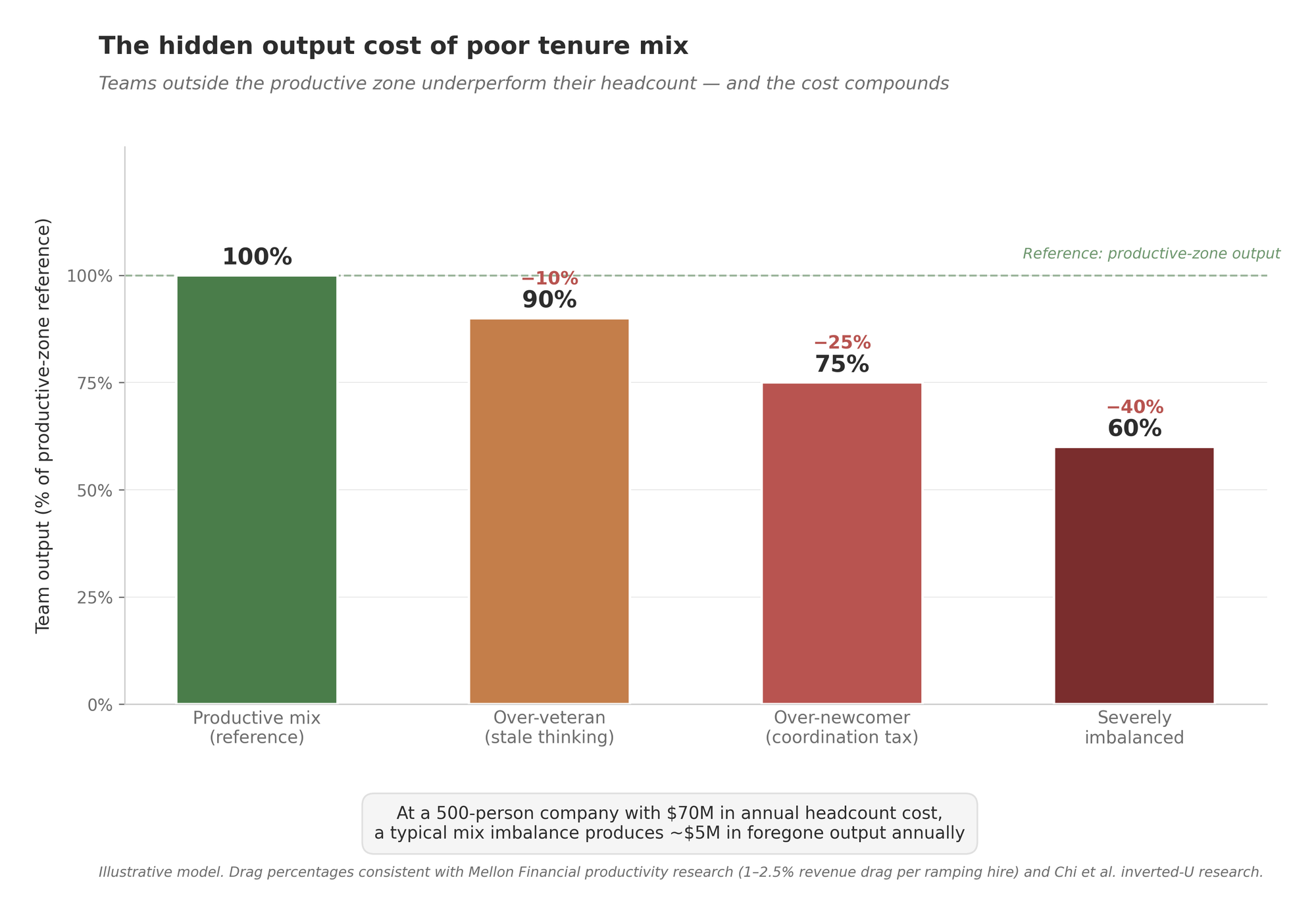
The implied output loss is substantial. If two-thirds of the affected teams are over-veteran and one-third are over-newcomer, the weighted output drag is roughly 12% across the affected teams, which represents 60% of total team capacity. That works out to a 7% drag on total knowledge-work output. For a company with $70M in headcount cost, that's roughly $5M annually in foregone output — meaning every additional dollar of productive capacity that headcount could be producing if the mix were right.
Those numbers are illustrative, not measured. The point isn't that the figure is exactly $5M. The point is that the order of magnitude is large, the cost is invisible on every dashboard, and the remediation — modeling the mix before staffing decisions, holding reqs in over-newcomer teams, deliberately injecting newcomers into over-veteran teams — is essentially free.
Put differently: tenure-mix management is one of the few people-management levers where the cost of intervention is low and the cost of inaction compounds. Most people-management interventions are expensive (compensation increases, training programs, hiring drives) and produce modest returns. Composition management is cheap and produces material returns. It's mostly neglected because it's not anyone's explicit job, and because the metric that would expose the problem — team output growth, separated from team execution against commitments — isn't on most dashboards.
It's worth being explicit about why this is so. Output growth is hard to measure team by team. Commitment execution is easy to measure team by team. Organizations optimize for what they measure. They reward teams for execution against commitments — which over-veteran teams do reliably well — and they don't reward teams for the kind of forward-looking adaptive output that distinguishes a productive-mix team from an over-veteran one. The signal that would catch the problem isn't being measured. The signal that's being measured doesn't catch the problem.
This isn't just a measurement gap; it's a strategic one. Companies that develop the discipline of measuring composition alongside execution capture the upside that less-disciplined companies leave on the table. There's no special technology required. The data lives in the HRIS. The analysis is straightforward. The blocker is attention.
What changes in 2026
Two structural forces in the current environment make tenure mix more important than it's been in a decade.
The first is the post-layoff composition damage. Almost every team that has been through a 2024-2026 restructuring has emerged with a skewed mix, almost always toward over-veteran. The hiring freezes that follow these restructurings prevent rebalancing. The result is a workforce sitting on the wrong part of the curve at scale. Companies will spend the next twenty-four months wondering why their product cycles have slowed, why their customer feedback feels stale, why their best people are leaving without obvious cause. The mix is a meaningful share of the answer. It's not the only answer — strategy matters, leadership matters, market conditions matter — but it's an answer that hides in plain sight, and one that has remediation paths most companies haven't started exploring.
The second is the AI-augmented productivity narrative that's encouraging leaders to maintain or expand headcount on the theory that AI tooling multiplies individual capacity. The reasoning has merit at the individual level. At the team level, AI tooling doesn't fix tenure-mix problems — and in some cases it makes them worse. An over-veteran team using AI to accelerate its existing workflows accelerates the wrong things. An over-newcomer team using AI to fill institutional knowledge gaps replaces tacit knowledge with documented knowledge, which sounds good but loses the network effects of veterans-knowing-veterans that actually drive team coordination. The team that writes everything down and shares it via AI tooling is, in some meaningful sense, the team that has decided it has no veterans — and the predictable performance pattern of teams without veterans should be the warning sign.
A third factor worth flagging: hybrid and remote work patterns have made tenure mix harder to read informally. In an office, you can feel when a team has tipped over-veteran (the meetings have a certain settled quality, the same people make the same kinds of jokes) or tipped over-newcomer (the meetings have a certain orientation quality, lots of clarifying questions). In a remote or hybrid team, these signals are degraded. The managers who relied on ambient awareness of their team's composition have less to rely on. The discipline of explicit measurement matters more in this environment than it did when teams sat together five days a week.
Both of these forces point in the same direction: leaders who treat composition as a designed variable will pull ahead, and leaders who treat it as something that happens to them will fall behind. The gap will be visible in eighteen to twenty-four months, by which point the remediation cost will be much higher than it would be today.
The bottom line
Tenure mix is the team-composition variable nobody designs. Most managers focus on who they hire and who they keep. Almost none focus on the resulting distribution, and most don't have the data to see it if they wanted to.
The research is clear enough. Teams in the productive zone — roughly 25-40% under-two-year newcomers, 25-50% over-five-year veterans, the rest in between — outperform teams at either extreme on innovation, adaptability, and sustained output growth. They look messier than over-veteran teams and more stable than over-newcomer teams. Their stability comes from the mix, not from the absence of churn.
The two failure modes are both bad, but they're bad in opposite ways. Over-veteran teams stop improving and don't realize it. Over-newcomer teams know they're struggling but reach for the wrong fixes. The remediation for each is mostly free if done early, mostly expensive if done late.
The drift toward over-veteran in the 2026 environment is the dominant pattern across mid-market companies right now. The teams that emerge from this period in good shape will be the ones whose leaders treated tenure composition as a portfolio to rebalance, not a number to leave alone. Average tenure isn't the metric. The shape of the distribution is. Pull the numbers. Look at the shape. Adjust the mix.
The team that looks the most stable on paper is usually the one quietly losing the most output. The team that looks the messiest is usually the one with the best mix.