Marcus had been the best account executive at the company for three consecutive years. Not the best among a mediocre group — genuinely exceptional. Clients requested him by name. He could close deals in industries his colleagues couldn't crack, read buying signals that others missed, and had an intuitive feel for when to push and when to wait. His manager's manager knew his name. When the regional sales manager role opened, there was never really a debate.
Fourteen months later, Marcus was being managed out.
His team's numbers were mediocre. He'd lost two high performers to internal transfers — both cited a lack of direction. He was still technically strong, still occasionally jumping into deals to help close them, but the work of developing, coaching, and coordinating a team of eight had revealed something nobody had thought to look for before promoting him: Marcus was brilliant at selling and had essentially no capacity for the parts of management that aren't selling. He wasn't bad at his job. He was in the wrong room entirely.
The company made this mistake with full information. They knew how Marcus performed. They knew what the role required — at least, they thought they did. They were wrong about the overlap, and by the time that became undeniable, they'd spent fourteen months losing quietly in ways that never showed up in any single meeting.
This is the thing about promotion failures. They're rarely dramatic. Nobody blows up on day one. There's usually a honeymoon period, then gradual drift, then a dawning recognition that something isn't working, then a period of hoping it resolves on its own, then a costly intervention or an expensive departure. The whole cycle takes long enough that nobody connects it back to the original promotion decision — and so the same logic gets applied to the next hire, and the next one, and the pattern holds.
The Wrong Room Problem is organizational in nature. It's not about whether someone is talented. It's about whether their talent set maps to the room they've been put in.
Why organizations keep making this mistake
The mechanics of how most companies decide who to promote are pretty consistent: identify the highest performer in a role, assess whether they seem "ready for the next level," consider whether the timing is right, and promote them. This process has intuitive appeal — rewarding excellence is how you signal what you value, and high performers presumably have the drive and judgment to succeed in more complex environments.
The problem is that this logic treats promotion as a recognition of past performance rather than a prediction of future performance in a structurally different job. Those are not the same exercise.
Researchers at Northwestern and Minnesota put this to an empirical test in a study of 214 firms and more than 53,000 sales workers. Their finding was blunt: firms systematically promote the best individual performers, and those promotions consistently produce worse managers. Not occasionally worse. Worse as a statistical pattern, across firms, across industries. The skills that made someone a great individual contributor — in sales, specifically, the ability to close, to compete, to rely on personal relationships — were negatively correlated with the skills that made a good manager of salespeople. What organizations reward in the room someone is leaving is not what they need in the room the person is entering.
This is the core of what Laurence Peter and Raymond Hull called the Peter Principle back in 1969: hierarchies systematically promote people until they reach their level of incompetence. What was written as organizational satire has, in the decades since, accumulated a body of empirical support that is difficult to argue with. The joke stopped being funny when researchers started running the numbers.
But the Peter Principle, as commonly understood, still understates the actual problem. The usual framing suggests that eventually, everyone tops out — that you keep getting promoted until you hit your ceiling. That's not quite what happens in practice. What happens is role discontinuity: the skills required at one level are genuinely, structurally different from the skills required at the next. And organizations make promotion decisions based on evidence about only one of those two levels.
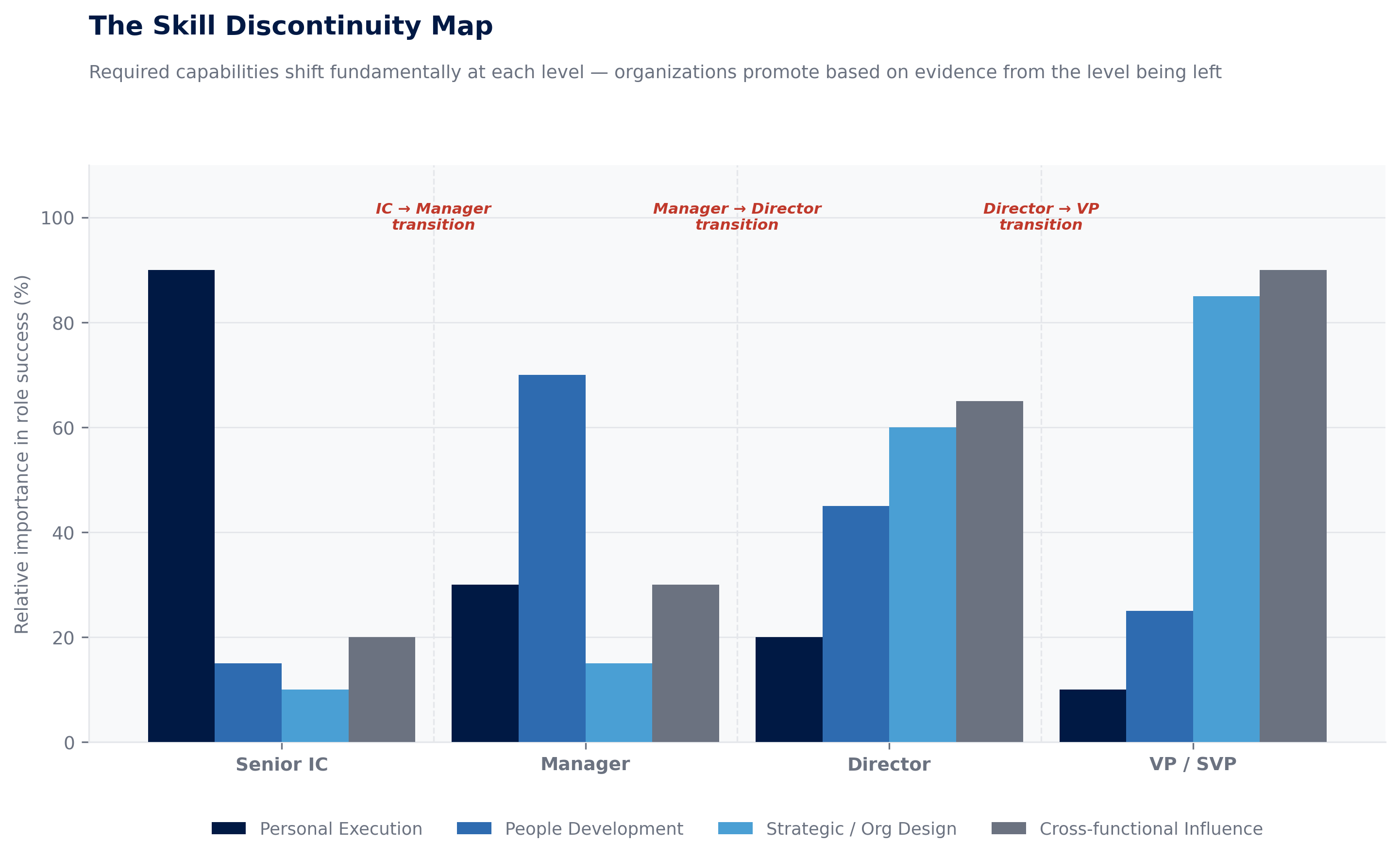
Think about what the transition from individual contributor to manager actually requires. As an IC, you are evaluated on your personal output. You develop expertise, execute work, build domain knowledge, and produce results that are directly traceable to your effort. The feedback loop is relatively tight: you do something, you can see whether it worked. Success is personal and immediate.
As a manager, none of that is your job anymore. Your job is to produce results through other people — which means diagnosing what they need, adjusting your style to match their situation, building development plans, delivering feedback that lands, running processes that coordinate work without you in every meeting, and holding standards without micromanaging. The feedback loop is long and indirect. You don't know for months whether a coaching conversation you had in January actually changed someone's trajectory. You can't see your output the way you used to. The work is fundamentally less legible.
These aren't harder versions of the same skills. They're different skills. Exceptional individual execution does not predict exceptional capacity for this work. Sometimes those things correlate. Often they don't. And organizations almost never assess the second set before making the promotion call.
The transition from manager to director introduces a new discontinuity. A manager's job is primarily about their team: developing people, running execution, managing the day-to-day. A director's job is primarily about the organization above and around their team: resource allocation, cross-functional relationships, strategic prioritization, influencing peers who don't report to them. A manager who is excellent at developing their team might be genuinely unprepared for the political navigation, ambiguity, and abstraction that director-level work requires. And again, the organization is promoting based on evidence from the previous room, not the next one.
DDI's ongoing research into leadership transitions found that more than a third of leaders describe the transition into their role as overwhelming or very stressful — and that a stressful transition has a long tail. Forty-five percent of leaders who experienced stressful transitions rated themselves as average or below average leaders compared to peers years later. The damage from a mishandled transition doesn't just affect the first few months. It compounds.
The detection gap
One of the more insidious dynamics in the Wrong Room Problem is how long it takes organizations to notice. A bad hire from outside the company tends to become visible relatively quickly — the person doesn't know the culture, doesn't have relationships, struggles in ways that are apparent. An internal promotion that isn't working is much harder to see, for several reasons.
First, the newly promoted person does know the culture. They have relationships. They can navigate the org and sound competent in ways that mask their actual performance in the new role. Second, their manager — who sponsored the promotion — has a strong interest in the decision working out and will frequently unconsciously filter early warning signs as a learning curve. Third, the newly promoted person themselves often doesn't recognize that they're in the wrong room. They experience struggle as a personal failing rather than a structural mismatch, which frequently produces more effort in exactly the wrong direction.
The result is a detection gap: the average organization takes somewhere between twelve and eighteen months to arrive at the conclusion that a promotion isn't working. CEB (now Gartner) found that 60% of new managers fail within the first 24 months — a figure so widely cited it's almost become background noise. But the diagnostic implication gets less attention: if failure is that common and takes that long to become undeniable, organizations are losing more than a year of productive output from a role before they act. During that window, they're also losing output from the team the person manages.
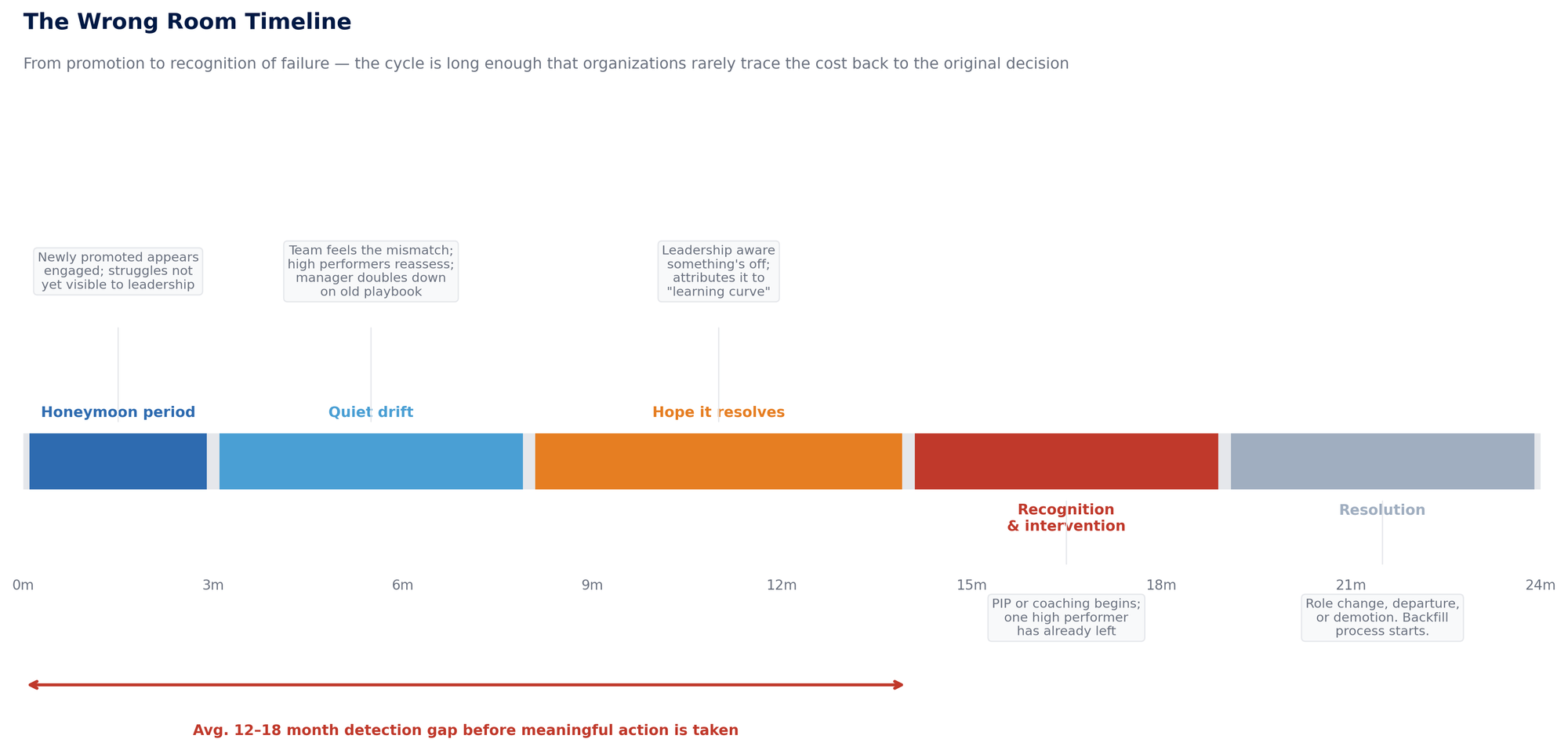
The team dimension is where the Wrong Room Problem gets significantly more expensive than it first appears. When a newly promoted manager is struggling — not visibly failing, just quietly mismatched — their team is the first to know. High performers on the team, who have options, start recalibrating. The development conversations they used to get from a strong leader aren't happening. The feedback is inconsistent or absent. The direction is unclear. They don't file a formal complaint. They start updating LinkedIn.
This is the part of the cost model that most organizations have never calculated.
The economics of the wrong room
Let's build the model concretely. Consider a 400-person company in a growth phase, with roughly 30 people managers across individual contributor, manager, senior manager, and director levels. Assume the organization makes promotion decisions at a similar rate to industry norms — roughly 10 to 15 manager-level promotions per year, including internal moves up from IC and between management levels.
Research from CEB/Gartner consistently puts the failure rate for new managers at around 60% within 24 months. Even if we apply a more conservative interpretation — call it 40% of promotions that produce meaningful underperformance — you're looking at 4 to 6 management roles per year occupied by someone in the wrong room.
The direct cost of a failed promotion includes the salary of the mismatched person during the underperformance window (typically 12 to 18 months at elevated compensation since they were just promoted), the cost of eventually replacing them (SHRM estimates replacement costs at 50% to 200% of annual salary depending on seniority), and the cost of the disruption itself — transition management, backfill, knowledge loss. For a manager-level role at $120,000 base, the direct cost of a failed promotion runs $80,000 to $150,000 per incident, conservatively.
But the direct cost is the smaller number.
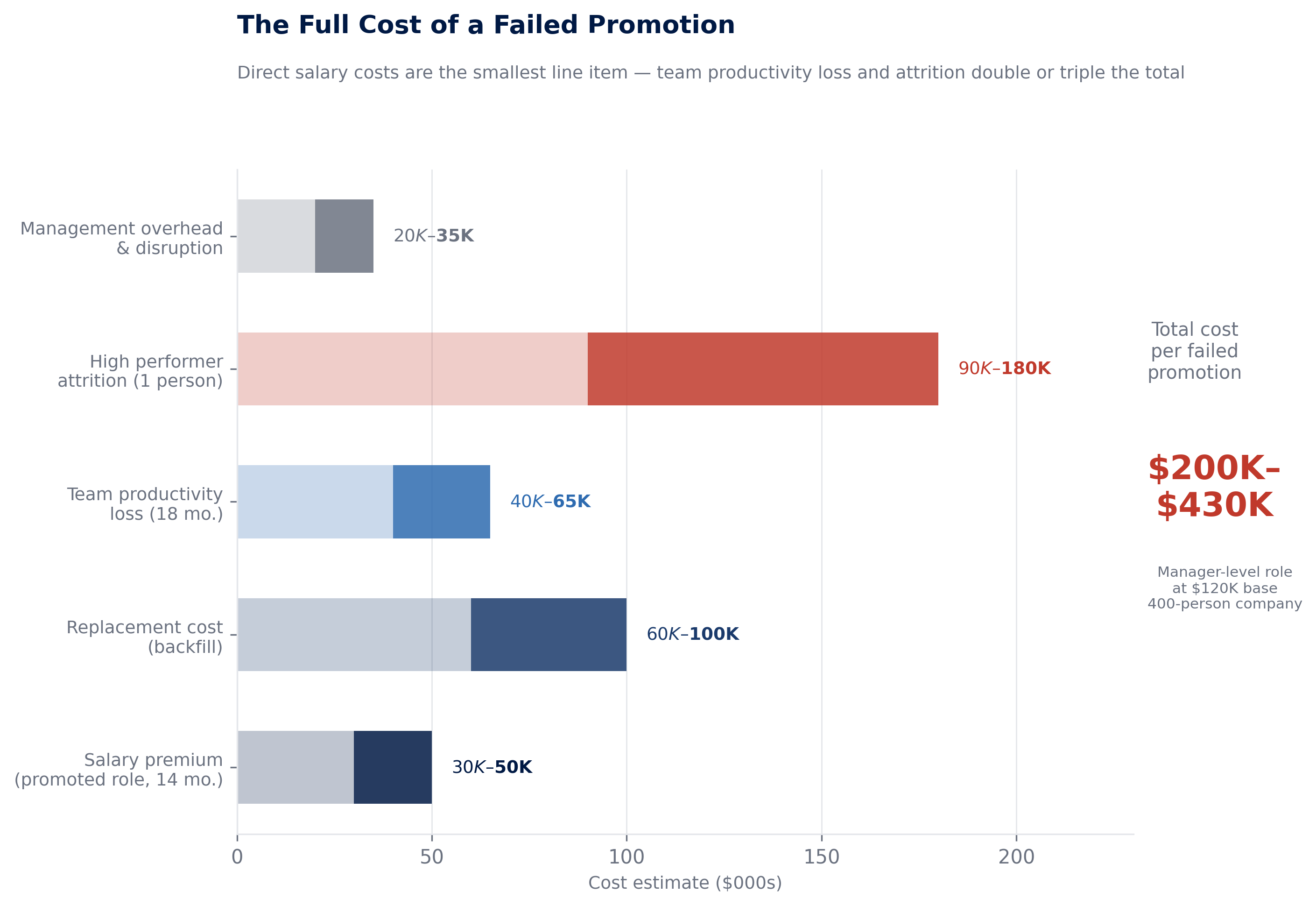
The team impact runs on a parallel track. A mismatched manager typically oversees 6 to 10 people. Research from Gallup's 2025 State of the Global Workplace report confirms that managers account for 70% of the variance in team engagement. A struggling manager, even one who isn't visibly failing, produces measurable drops in team engagement — and disengaged employees cost organizations roughly 34% of their annual salary in lost productivity. For a team of 8 averaging $90,000, a 20-percentage-point engagement drop — conservative for a team with a mismatched manager — produces roughly $50,000 in productivity loss annually.
Then there's attrition. High performers who leave because their new manager can't develop them cost between 100% and 200% of their annual salary to replace, per SHRM data. If a single mismatched manager loses one high performer in the 18-month window — a near-certainty in practice — add another $90,000 to $180,000 to the tab.
Fully loaded, a single failed promotion at the manager level conservatively costs a mid-market company $200,000 to $400,000 when team impact and attrition are included. For an organization making 5 mismatched promotions per year, you're looking at $1 to $2 million in annual carrying cost — buried in headcount, turnover, and engagement numbers that nobody has connected back to their source.
What the levels actually require
The reason this pattern persists is that most organizations have never made the skill discontinuity explicit. They have job descriptions for each level. They have competency frameworks — often elaborate ones, with color-coded rubrics that managers are supposed to reference. What they almost never have is a clear map of how the required skills actually shift between levels, and what evidence suggests readiness for those shifts.
The IC-to-manager transition is the most studied version of this problem, but the logic applies at every level.
When someone moves from individual contributor to manager, the fundamental shift is from personal execution to team coordination. The most critical new capabilities are not advanced versions of what they did before — they're categorical additions: diagnosing the performance of others, adjusting their own behavior to develop different people differently, tolerating the ambiguity of results that are indirect. The IC skill set doesn't transfer. It mostly becomes irrelevant to the job, except when the manager needs to jump in and model something for their team.
Lattice and other talent framework researchers have documented what this looks like in competency terms: at the IC level, functional depth is the primary driver of value. At the manager level, functional depth is expected but no longer the differentiating factor — what matters is the ability to build it in others while also running an operational system. These are different cognitive and interpersonal demands, and someone who excels at the first set doesn't necessarily have any of the second.
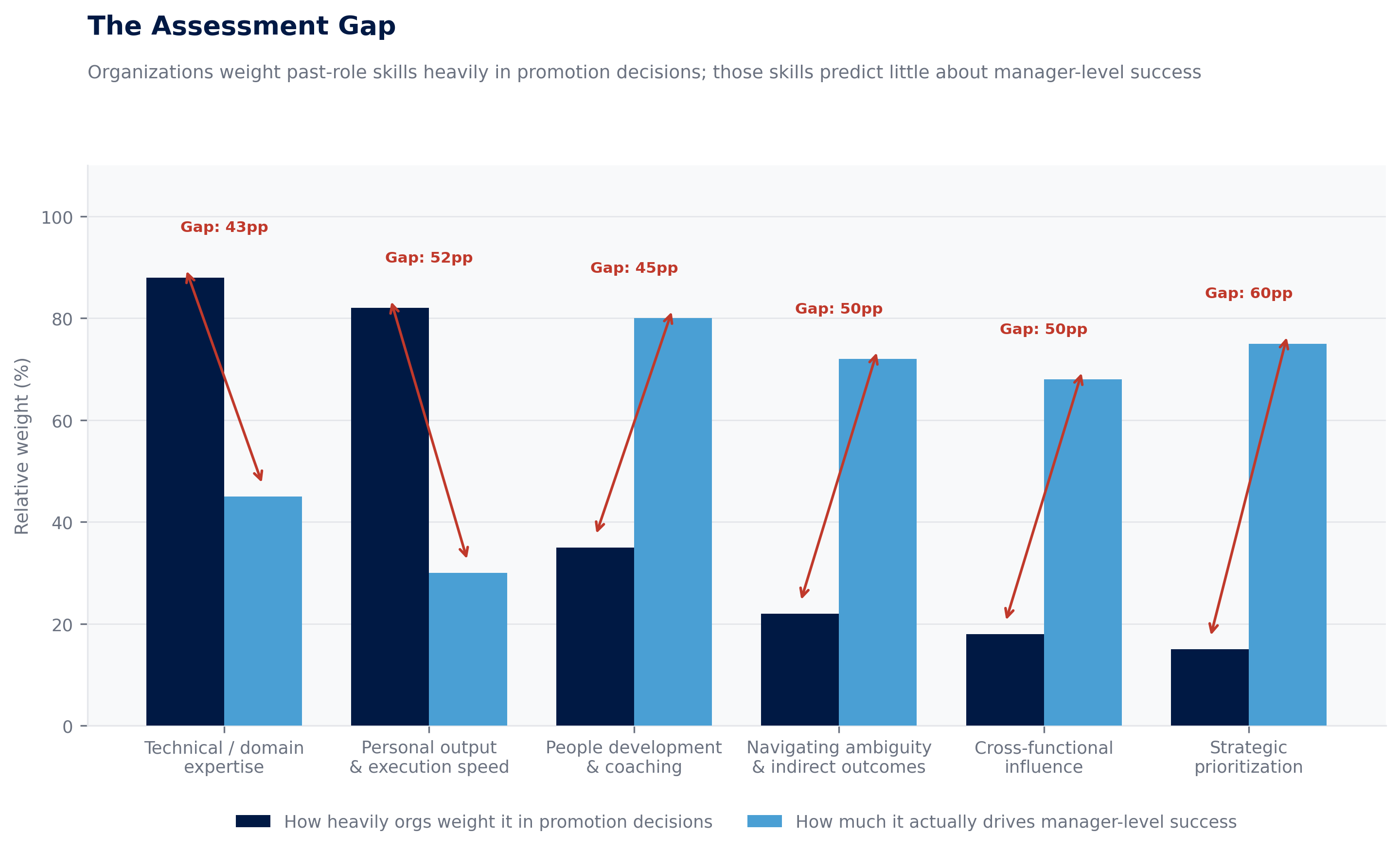
The manager-to-director transition carries its own discontinuity. A manager's work is primarily inward-facing: their team, their processes, their decisions. A director's work is primarily outward-facing and systemic: influencing peers and stakeholders without authority, making resource allocation decisions with incomplete information, setting a vision that guides work they won't be directly involved in. The best managers — the ones who are excellent at developing their teams, clear in their feedback, operationally sharp — sometimes struggle significantly at this transition because everything they've been rewarded for optimizing is now a secondary concern.
McKinsey research on talent allocation found that in most organizations, 20% to 30% of leaders in critical roles have gaps that are meaningful enough to warrant concern, but are still the best available internal option. That framing is instructive. The question isn't whether someone is absolutely ready; it's whether the organization has done enough diagnostic work to know what specific gaps exist and whether those gaps are addressable before the promotion.
The director-to-VP transition introduces another set of discontinuities: from functional execution to enterprise strategy, from team management to organizational design, from managing up to representing a function at the table where resource battles happen. Each rung of the ladder changes the room. The organization keeps using evidence from the previous room to make decisions about the next one.
Why the IC star is the highest-risk promotion
There's a specific dynamic worth naming directly: the highest-performing individual contributor is frequently the person most at risk of a failed first-line manager promotion. Not because they're less talented. Because the qualities that made them exceptional in their individual role are the ones most likely to conflict with what the management role requires.
The best ICs tend to be high-ownership, high-execution people who built their success on their own output. When they become managers, their instinct is to take over. They solve problems rather than coaching through them. They take back work rather than watching someone struggle with something they could do in twenty minutes. They set standards based on their own performance, which is, by definition, the highest bar on the team. And then they get frustrated when the team doesn't match it.
This is not a character flaw. It's a rational response to a situation where their previous playbook is no longer appropriate and nobody has told them what the new one looks like. The NBER working paper by Benson, Li, and Shue found that higher-performing sales representatives, when promoted to management, produced statistically significant declines in the sales performance of their subordinates — not because they were bad people, but because the skills that produced their exceptional individual performance were actively counter-productive in a management context. The best seller is often not the best sales manager precisely because of what made them the best seller.
This is the Peter Principle operating not at its classic "ceiling" endpoint, but at the first transition — and it operates most strongly on your most valuable people.
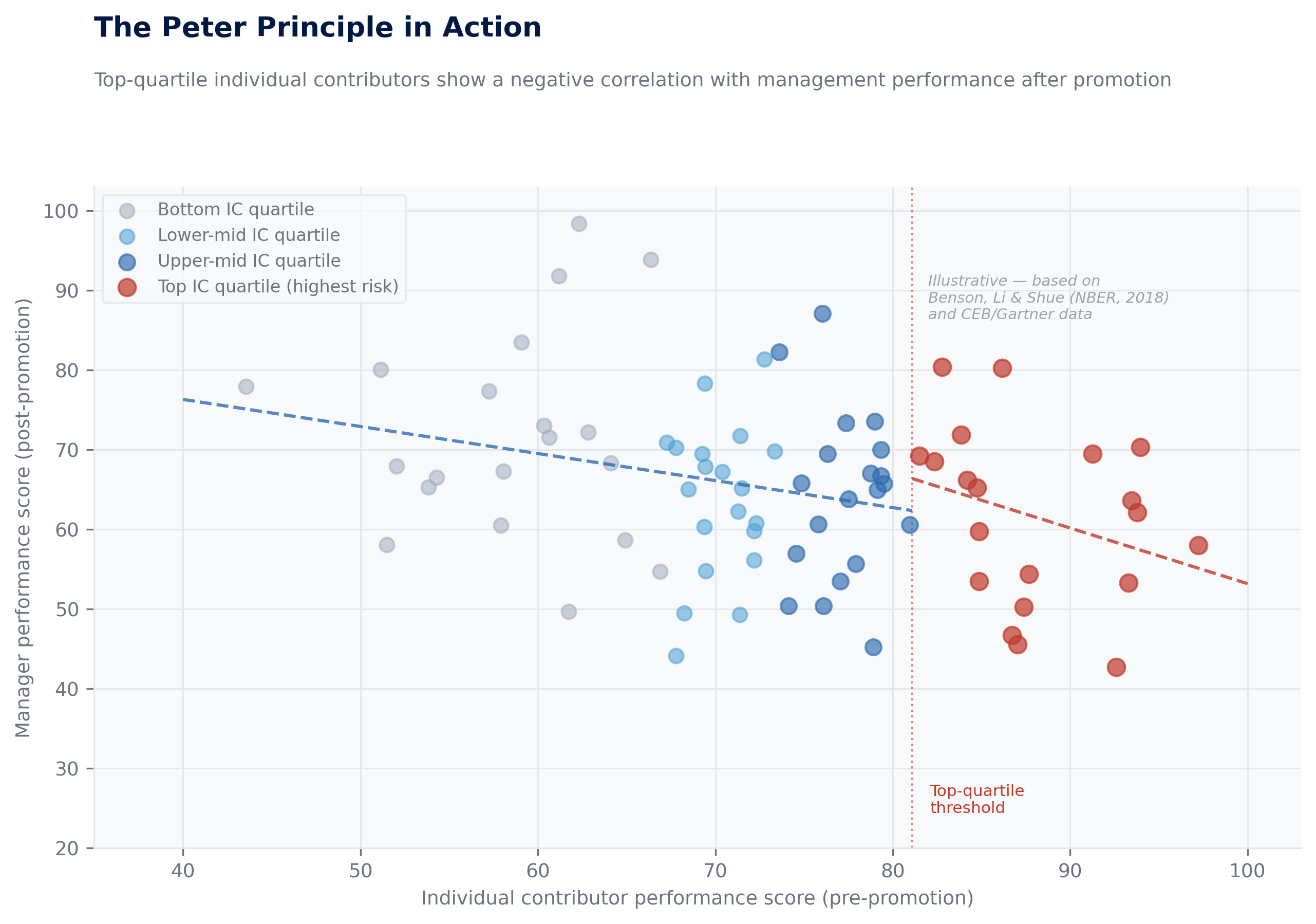
The corollary is uncomfortable but important: the second or third-best individual contributor is sometimes the better management candidate. Someone who is excellent but not exceptional at the IC role may have built their success partly through things that do transfer — coaching peers, managing up, building collaborative processes — rather than purely through personal output. This doesn't mean you should avoid promoting top performers. It means you should assess them for something other than their top-performer qualities before putting them in a room designed for an entirely different set of capabilities.
What good promotion decisions actually look like
The organizations that manage this well are doing something that sounds simple but is rarely practiced: they evaluate candidates for the role they're going to, not the role they're leaving.
This means having an explicit model of what the target level actually requires — not a generic competency framework that looks similar across levels, but a specific articulation of what success in that particular role at that level demands. What decisions will this person be making that they haven't made before? What relationships will they need to navigate? What outputs will be indirect rather than direct? Where does their current evidence base have genuine gaps?
DDI's succession research found that internal promotions are significantly more successful when leaders participate in structured development programs before promotion (3.7x improvement in outcomes), receive sequential leadership learning (3.2x), and get frequent coaching from a senior leader (2.6x). The multipliers are large enough to be hard to ignore. The organizations seeing those outcomes are investing in transition readiness before the promotion, not scrambling to provide it after.
The second element is honest assessment of the gap. Not whether the candidate is "ready" in the binary sense that most talent review conversations use, but specifically where the mismatch is and how addressable it is. Some gaps are small enough to close quickly with the right support. Some are structural — the candidate genuinely doesn't have the interpersonal wiring that the target role requires, and that's not something a training program will fix. The organizations that handle this well are able to make that distinction and act on it, rather than defaulting to "they'll grow into it."
The third element — and the one most organizations don't do — is creating real alternatives to the management track. The canonical career progression in most companies runs through management: to get more money, more title, more organizational influence, you become a manager. Engineering has largely solved this problem with the staff/principal/distinguished IC track. Outside of engineering, most organizations haven't. The result is that talented ICs who don't belong in management take the promotion anyway, because it's the only path available, and the organization loses twice: they get a mediocre manager and they lose their best individual contributor.
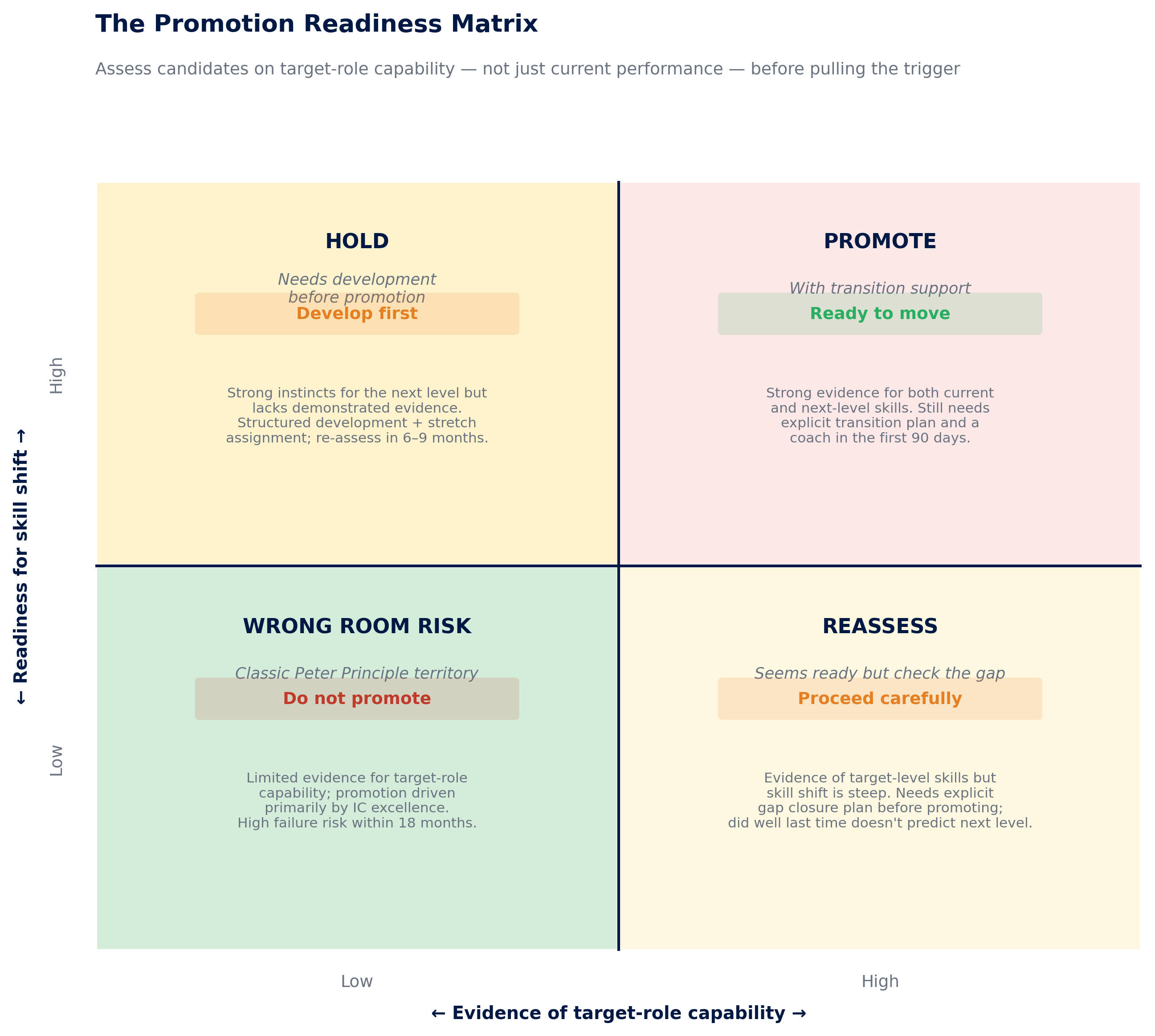
Building a genuine dual-track system — where advancement as an individual contributor produces comparable compensation, title respect, and organizational influence to management advancement — removes one of the primary structural forces driving people into the wrong room. It allows you to reward excellence without requiring a role transition that most excellent ICs are poorly positioned for.
Diagnosing your own pipeline
There are several signals in an organization's promotion history that suggest the Wrong Room Problem is operating at scale, though most companies are not looking for them.
First: churn in management roles in the 12 to 24 months post-promotion. If you track the tenure of people in newly elevated roles and find that a significant percentage leave within two years — whether through performance management, voluntary departure, or quiet demotion — you're seeing the aftermath of systematic wrong-room placements. The industry average suggests this is happening to 40% to 60% of management promotions. If your number is lower, you may simply not be measuring correctly.
Second: engagement drops on teams with recently promoted managers. If you run engagement surveys and have the ability to segment by manager tenure, compare the engagement trajectory of teams whose manager was recently promoted against teams whose manager is established. A consistent engagement dip in newly managed teams is a signal that the transition is producing worse outcomes than it should. Some dip is normal — change is disruptive. A prolonged or steep dip is something else.
Third: the pattern of who's leaving. When high performers leave teams run by recently promoted managers, the stated reason is rarely "my manager is in the wrong room." It's usually something about growth opportunities, or role scope, or compensation. These are real factors, but they often proxy for something more specific: the high performer is not getting the development, clarity, or challenge they need from a manager who is preoccupied with figuring out their own job.
Fourth: the profile of your internal promotions versus external hires at each level. Organizations with significant Wrong Room Problems often compensate — unconsciously — by going external more frequently at senior levels. If you find that external hire rates increase meaningfully as you move up the level structure, it may reflect an organization that has burned through its internal pipeline by promoting into mismatch at lower levels.
The overlooked victim
There's one more cost worth naming, and it doesn't show up in any model.
The person who gets put in the wrong room is not a villain in this story. They said yes to a promotion because the organization told them they were ready, because saying yes is what you do when you get a promotion, because the alternative — declining advancement — is culturally coded as self-limiting in most organizations. They were given no real information about how different the new room would be. They were given no development for the specific capabilities it required. And then, 14 or 18 months later, they were managed out or quietly shuffled back, often with a narrative that amounts to "it didn't work out."
What that experience does to someone's career trajectory, self-confidence, and relationship with that organization is not nothing. An organization that puts people in wrong rooms at scale is not just losing money. It's burning people. The Marcus at the beginning of this piece wasn't a bad hire. He was an exceptional person put in the wrong room by a system that never thought to ask whether the rooms were different.
The fix is not complicated, but it requires an honest reckoning with the gap between how organizations actually make promotion decisions — "who is our best performer and do they seem ready?" — and what those decisions actually require: a genuine forward-looking assessment of whether the skills this person has built are the skills the next role demands, and what it would take to close the distance.
Most organizations find that reckoning uncomfortable because it implies that some of their best people shouldn't be promoted on the current timeline, and some of their previous promotions were mistakes. Both of those things are true. Acknowledging them is the only way to stop repeating them.
The wrong room isn't a talent problem. It's a diagnostic one.
A quick diagnostic
If you want to pressure-test your organization's exposure to the Wrong Room Problem, run through these questions:
On your promotion process:
- Do your promotion decisions include explicit assessment of the capabilities required at the target level — not just confirmation that someone excels at their current level?
- Do you have a structured model of how required skills shift between each level in your hierarchy?
- Is there a meaningful alternative advancement path for ICs who don't want or shouldn't enter management?
On your pipeline:
- What percentage of managers promoted in the last two years are still in the same role and performing well?
- Do you track engagement on teams with recently promoted managers separately from teams with established managers?
- When you lose a high performer from a newly managed team, do you investigate whether the management transition was a contributing factor?
On your transition support:
- What specific preparation does a newly promoted manager receive before they take on the role — not after?
- When a promotion is made, does the promoting manager have a specific view of what gaps exist and a plan for closing them?
- Are there active mechanisms for newly promoted managers to get coaching and candid feedback in the first six months?
If most of your answers are "not really" or "we don't track that," you're running a promotion process that is essentially selecting for current performance and hoping the new room works out. For 40% to 60% of your promotions, it won't. The question is only how long it takes you to find out.
The Wrong Room Problem is one of the most consistent sources of organizational waste hiding in plain sight — expensive, widespread, and almost never attributed to its actual cause. The talent is usually there. The rooms are different. The organizations that figure out how to assess for the right room before putting people in it will compound their leadership pipeline in ways that their competitors, who keep promoting backward-looking, can't match.
Marcus didn't fail. The room failed him. And the company paid for the mistake long after Marcus moved on.