According to the Bureau of Labor Statistics' May 2026 Employment Situation, released June 5, total nonfarm payrolls rose 172,000 and the unemployment rate held at 4.3 percent — its eleventh consecutive month inside a narrow 4.3-to-4.5 percent range. The number beat forecasts and generated the familiar strong-labor-market coverage. The sector breakdown is considerably less uniform. Leisure and hospitality added 70,000 jobs, nearly five times the sector's 12-month average of 14,000 per month, with food services and drinking places alone accounting for 48,000 of those. Local government added 55,000. Together, those two sectors generated 73 percent of May's total job growth. Construction, manufacturing, retail trade, information, and professional and business services — the industries where most private-sector managers operate — collectively showed no material change.
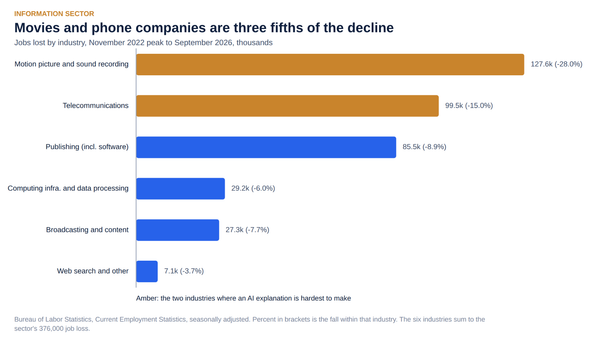
Here's what's actually happening: The headline is being held up by sectors that most employers don't compete in for the talent they actually need. Health care added 35,000 jobs, roughly in line with its 38,000-per-month long-run average — steady, but concentrated in one industry. Financial activities shed 22,000 jobs in May alone and is now down 107,000 from its May 2025 peak, a twelve-month contraction the BLS attributes to technology-driven efficiency gains and the rate environment. Average hourly earnings rose 3.4 percent year-over-year — a figure that will become a reference point in compensation conversations. The average workweek held at 34.3 hours, unchanged. Employers are not extending hours before adding headcount, which is how genuine expansion cycles typically begin.
Why it matters for you:
- The 172,000 number is not describing your labor market. This print will harden salary expectations, slow headcount approvals, and fuel the "tight labor market" framing that drives your next comp cycle. But technology, financial services, manufacturing, retail, and professional services collectively added essentially zero net jobs in May. The narrative used to justify compensation pressure in your sector is built on leisure-industry hiring and school-district payrolls — neither of which competes for the same workers you do.
- Financial services managers: treat this as structural, not cyclical. Financial activities employment is 107,000 below its May 2025 peak with no reversal visible in the data. The drivers — AI-driven efficiency gains and elevated rates compressing headcount ROI — don't resolve in a quarter. Workforce plans that assume a bounce-back are misaligned with a twelve-month contraction that has accelerated through spring. Peer compensation benchmarks are being set inside a contracting sector; build your models with that in mind.
- Candidate pricing hasn't caught up to actual supply. The analysts, engineers, and operations professionals you're most likely recruiting are coming from sectors that didn't grow in May — financial services, information, and professional and business services. That talent pool is softer and deeper than a 172,000 headline implies. Most candidates are pricing themselves against the aggregate. You can price against the sector.
Source: Bureau of Labor Statistics, The Employment Situation — May 2026 (June 5, 2026)
Watch this: Leisure and hospitality at five times its 12-month average will mean-revert. The sector's long-run trend is roughly 14,000 jobs per month, not 70,000. When June or July delivers a sharp headline miss, coverage will frame it as sudden deterioration. It isn't. It's the arithmetic of May's concentrated print unwinding. That reversion creates a brief window — candidates recalibrate expectations, internal headcount approvals ease, and the private-sector softness that's been masked all along becomes legible.
The contrarian play: Every peer manager is reading "172,000 — beat expectations" and pausing backfills or tightening comp accordingly. That logic holds if your labor market looks like May's jobs report. It doesn't. If you're in financial services, technology, professional services, or manufacturing, your sector ran essentially flat in May. The manager who understands this has a real advantage: more aggressive on recruiting — supply is softer than the headline suggests — and more credible on compensation, where your sector's actual conditions don't support the aggregate narrative.