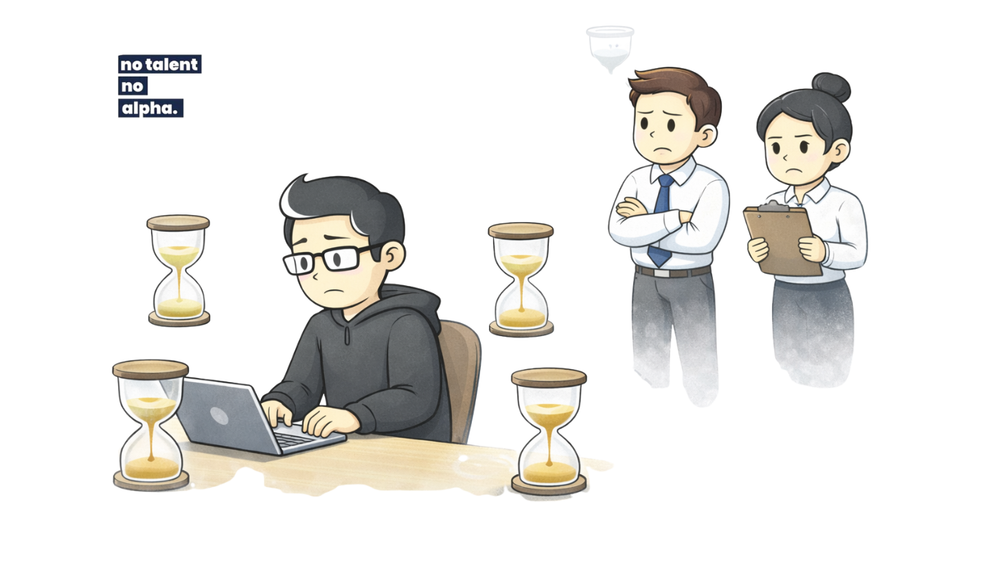
Here's the bottleneck you've become... You can build the financial model in two hours. Training someone else takes four hours, and their first version will need fixes anyway. So you do it yourself. Next month, same model, same situation. You've now spent eight hours on something that could have been off your plate after the first four-hour investment. Multiply this across every task where you're "faster," and you're trapped.
The rationalization that doesn't work is always some version of "it's quicker if I just do it." Or "they're not ready yet." Or "I need it done right." These are all true in the moment and all catastrophically expensive over time. You're not saving time. You're spending your career doing work below your pay grade while your team learns nothing.
The economic logic is brutal. Every hour you spend on delegable work costs you twice. First, the direct time cost. That's an hour you didn't spend on strategy, business development, or solving problems only you can solve. Second, the compounding cost. Your team isn't developing the capability, so you'll be doing this same work six months from now. You're not being efficient. You're being expensive.
The framework that works has three parts. Acceptable quality threshold, coaching investment, and a prohibition on taking work back.
Start with acceptable quality. Not your quality. Not perfect. Acceptable. For the financial model, ask yourself what actually matters. Is it directionally correct? Are the key assumptions defensible? Could you present it to your boss without embarrassment? That's the bar. If you need it bulletproof for a board meeting, fine—do it yourself or plan for multiple review cycles. But most work doesn't need bulletproof. It needs good enough, done without you.
Ask yourself what happens if this is 80% as good as when you do it. Often the answer is nothing, or maybe you spend 15 minutes cleaning it up. That's not a reason to keep doing it yourself. That's the tax you pay for building capability.
Second is coaching investment. When you delegate, you're not just handing off a task. You're teaching someone to think like you think. That takes time up front. Four hours to walk through the model structure, show them where the complexity lives, explain which assumptions matter and which don't. That feels expensive until you realize you're buying your time back for every future iteration.
The mistake most managers make is explaining what to do but not how to think about it. "Build a revenue model" isn't delegation. It's a setup for failure. Instead, try something like this. "Build a revenue model using our standard template, assuming 15% growth in core business and flat performance in the new segment, and flag any places where you're not confident in the data." That's specific enough to guide them but open enough that they have to think.
Here's the test. After you explain the work, ask them to walk you through their approach before they start. If they can articulate the steps and the logic, they're ready. If they can't, you haven't delegated. You've just confused them.
Third is the no-takeback rule. This is the hardest part. They'll do it wrong the first time. Maybe the second time too. You'll be tempted to grab it back, fix it yourself, and prove once again that you're the only person who can do this right. Don't.
When they deliver subpar work, your job is to coach them through the fix, not fix it for them. "Walk me through how you got to this revenue number. What assumptions did you use? Where do you think the gap is?" Make them solve their own problem with your guidance. It takes longer. It's supposed to. You're building capability, not checking a box.
The exception is when the work is catastrophically wrong and there's no time to reteach. Fine, fix it this time. But immediately schedule the debrief. "Here's what I changed and why. Next time, here's how you'll catch this yourself." Then delegate it again next month. If you keep taking it back, you've trained them that mediocre work gets rescued and they never have to improve.
The timeline that matters goes like this. First delegation takes 3-4x longer than doing it yourself. Second time takes 2x. Third time takes 1.5x. Fourth time, they're doing it without you and you've bought back hours every month forever. Most managers quit after the first attempt because it felt inefficient. They're optimizing for this week and destroying their capacity for the year.
Here's what actually kills delegation. Perfectionism disguised as standards. You don't need the font choice perfect. You don't need the exact phrasing you would have used. You need the output to achieve the objective. If you can't articulate the difference between "acceptable" and "my way," you're not managing for results. You're managing for control.
The signal that you're doing it right is visible in your calendar. You have white space. Your team is bringing you solutions instead of asking for answers. You're working on problems that didn't exist three months ago because you've cleared the old ones off your plate. If you're still doing the same tasks you did last quarter, delegation isn't happening. It's just rhetoric.
Delegation isn't about making your life easier today. It's about making yourself obsolete on this work so you can go do work that actually matters. The bottleneck isn't your team's capability. It's your willingness to let them learn by doing work that's temporarily worse than what you would produce. Stop being fast. Start being scalable.