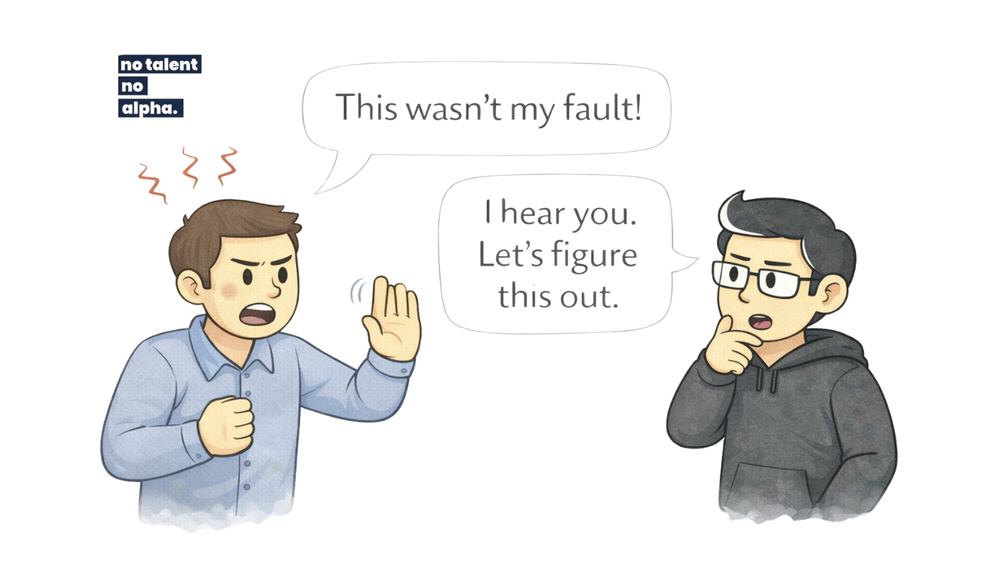
You've been putting off this conversation for three weeks. You know what you need to say. You've even rehearsed it. But every time you imagine delivering the feedback, you picture the same thing: crossed arms, a tight jaw, excuses, maybe tears — and then you end up walking away having said half of what you meant, badly, and now the situation is worse.
So you wait. Maybe it'll sort itself out.
It doesn't sort itself out.
Here's what's actually happening: most managers instinctively frame feedback as a verdict. You've observed something, formed a judgment, and you're delivering it. The defensive employee hears this as an attack on their competence or character, and they do what humans do when attacked, they fight back or shut down. The conversation breaks down before it even starts, and you leave thinking they're the problem.
Sometimes they are. But often, the structure of the conversation is the problem.
Only 10% of employees stay engaged after receiving negative feedback, according to Gallup. That's not because feedback is inherently harmful — it's because most feedback conversations are set up to fail.
The fix isn't to soften your message into meaninglessness. It's to change the architecture of how you deliver it.
Make them part of the diagnosis, not the verdict
Defensive employees react to conclusions. They do much better with questions. Before you state what you've observed, ask them to assess the situation first.
"Hey, I wanted to talk through the [project/situation] — how do you think it went?"
This does a few things. It gives them a chance to identify the problem themselves, which removes the threat. It shows you're interested in their perspective, not just delivering a sentence. And it tells you something useful: if they already know what went wrong, you're having a very different conversation than if they think everything was fine.
If they acknowledge the issue themselves, you've just eliminated 80% of the defensiveness. You're now collaborating on a solution instead of arguing about whether the problem exists.
Separate observation from interpretation
When you do need to name the issue directly, describe what you saw — not what you concluded about it. "The report was two days late and the client flagged three errors" is an observation. "You're not taking this seriously" is an interpretation. One is hard to argue with. The other is an invitation to debate.
Stick to observable facts. What happened, when, what the impact was. Leave your theory of why it happened for later, or better yet, ask them for their theory. "What got in the way?" is more productive than "this happens because you..."
Don't reward the defensiveness
This is where most managers go wrong. When the employee pushes back hard, the manager retreats. They qualify their feedback, they add caveats, they accidentally signal that the pushback worked. The employee learns: if I push hard enough, the feedback softens.
Don't chase them down a rabbit hole. If they redirect, redirect back. "I hear that — and what I need us to focus on is [the original issue]." Calm, not cold. Firm, not escalating. You're not there to win an argument, but you're also not there to abandon the point.
Then stop talking. Silence after feedback delivery is uncomfortable, and the instinct is to fill it. Resist. Give them time to actually process what you said instead of handing them a lifeline to grab onto.
The reality check
Some people are genuinely difficult to give feedback to, and no technique fixes that entirely. If someone consistently turns every piece of feedback into a performance, that pattern itself becomes the feedback conversation you eventually need to have. But most defensive employees aren't being malicious — they're anxious. Change the structure, and you'll change most of the dynamic.
The bottom line: Defensive reactions are usually a response to how feedback is delivered, not just what's being said. Make them part of the diagnosis, stick to observations, and don't let the pushback rewrite your message.