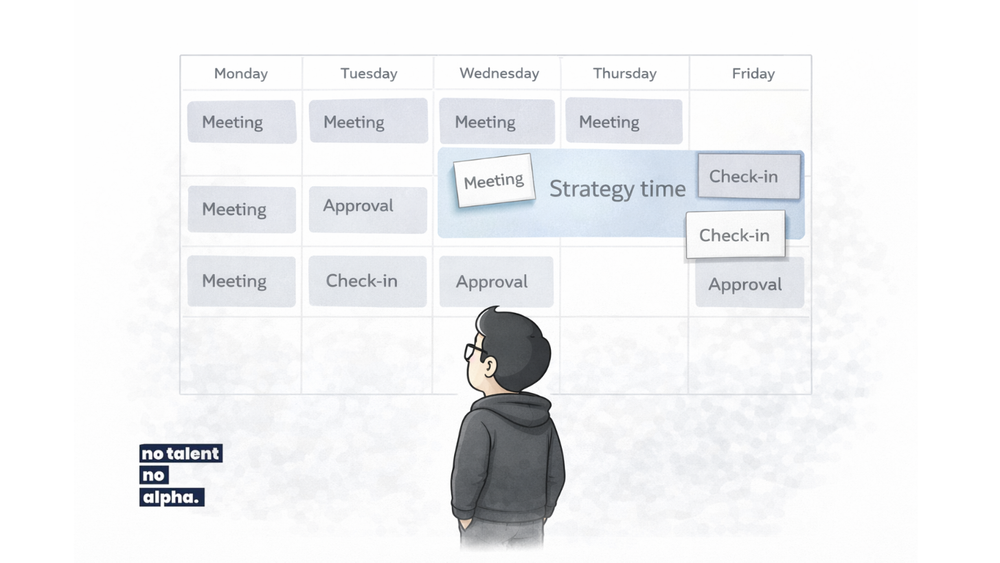
Your calendar is full of urgent operational work. Approvals, firefighting, meetings about immediate problems. You know you should be thinking strategically: planning, improving systems, developing your team. But every time you block time for it, something urgent comes up and strategy gets pushed. It's been months since you've done real strategic work.
The pattern that traps you starts innocently. Someone needs a quick approval. A small fire needs putting out. A meeting gets moved into your "strategy time" because it's the only slot that works for everyone. Each interruption is legitimate. The cumulative effect is that you never do the work that would prevent these interruptions from existing in the first place.
Here's the cost you're not seeing. Every week you spend purely on operational work is a week you didn't fix the systems creating the operational work. Your approval bottlenecks don't get solved. Your team doesn't develop the capability to handle problems without you. The fires keep burning because you're only ever putting them out, never fireproofing the building.
The framework that works requires three things: operational triage, protected time with consequences, and a forcing mechanism.
Start with operational triage. Not all urgent work is equally urgent, and not all of it requires you. Look at your last two weeks of calendar and categorize every operational task. Which ones actually needed your specific judgment or authority? Which ones got routed to you out of habit? Which ones were genuinely time-sensitive versus just presented as urgent?
Most managers discover that 40-60% of their operational work could have been decided by someone else, done later, or not done at all. A meeting about a problem that could have been an email. An approval for something under the threshold that should require your sign-off. A fire that only exists because nobody fixed the underlying process issue.
For everything that didn't need you, figure out why it came to you anyway. Unclear decision rights means people default to checking with you. Lack of confidence means they seek approval even when they have authority. Broken escalation processes mean everything feels urgent. Fix these, and you reduce the operational volume before you even start protecting time.
Second is protected time with actual consequences for interruption. Blocking time on your calendar doesn't work because you treat it as movable when something urgent appears. Instead, treat strategic time the same way you'd treat an external commitment. If someone asks to meet during it, the answer is "I have a conflict." Not "I have strategy time but I can move it."
The mistake most managers make is protecting time but not protecting the boundary. Your team learns that "blocked for strategy work" actually means "available if you really need me." Reset that expectation explicitly. "I'm blocking Tuesday mornings for planning work. Unless something is on fire or blocking revenue, I'm unavailable during that window." Then enforce it.
When someone interrupts anyway, the response matters. "Can this wait until this afternoon?" is very different from immediately engaging with their problem. Most things presented as urgent can wait three hours. By asking the question, you're training people to evaluate urgency themselves rather than defaulting everything to immediate.
Third is a forcing mechanism that makes strategic work visible and creates accountability. The reason operational work always wins is because it's visible, urgent, and comes with immediate consequences for not doing it. Strategic work has none of those properties, so it loses every time.
Make strategic work visible by committing to deliverables with deadlines. Not "I'll work on succession planning" but "I'll deliver a documented succession plan for each key role by end of month." Not "I need to think about process improvements" but "I'll present three process changes with implementation timelines at next month's leadership meeting."
The deliverable with deadline creates the same forcing function that makes operational work happen. If you commit to presenting something, the time to prepare it becomes non-negotiable. Suddenly your blocked time is protecting a deadline, not just protecting intention.
Here's what actually changes behavior: Make the cost of not doing strategic work visible. Every month you don't document your key processes is another month where knowledge lives in one person's head and creates single points of failure. Every quarter you don't work on team development is another quarter where you stay the bottleneck. Every year you don't fix your operational systems is another year of grinding through the same problems.
Track it. How many times did the same type of fire happen this quarter? How many approval requests came to you that shouldn't have? How many hours did you spend on work that could have been prevented by better systems? The pattern becomes obvious when you measure it.
The timeline that matters is about six weeks. First two weeks, you'll still be pulled into operational work constantly because the patterns are ingrained. Weeks three and four, you start to see what happens when you actually protect the time—some things wait, some things get solved by others, some things turn out not to matter. By week six, your team has adapted to your unavailability during protected hours and routes operational work differently.
The test for whether this is working is simple. At the end of each month, you should have tangible evidence of strategic work completed. A documented process. A development plan implemented. A system improved. If you're still ending months with nothing but a calendar full of operational meetings, protected time isn't actually protected.
What you're building isn't just time for strategic work. You're building the systems that reduce operational volume, the team capability that reduces dependence on you, and the boundaries that make strategic work as non-negotiable as operational work. The operational work will expand to fill all available time unless you force it not to. Stop asking for permission to do strategic work. Start treating it as the actual job and operational work as the thing you're trying to minimize.