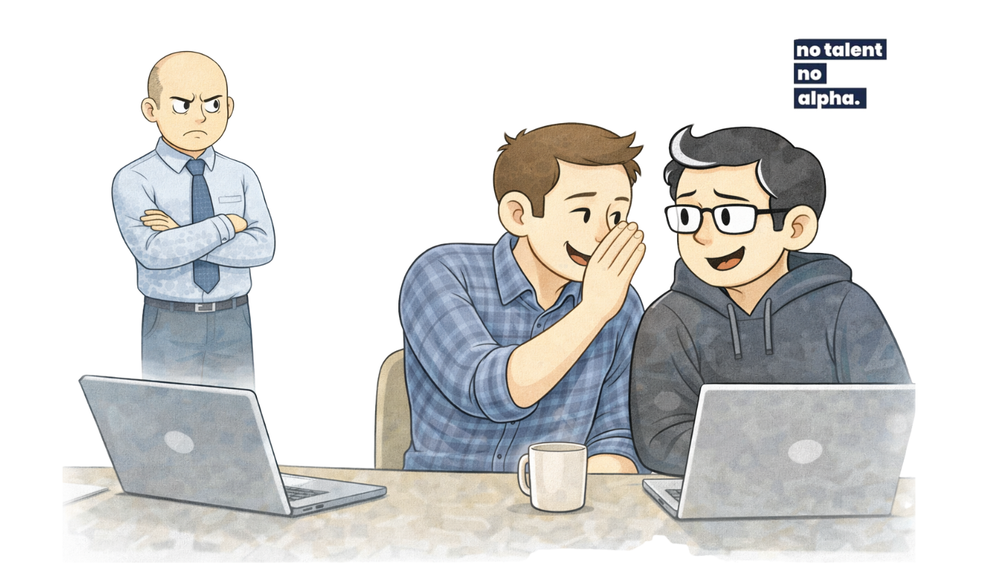
You didn't hire a friendship. You hired two people. But somewhere along the way, those two things fused together, and now you're managing both.
You know the dynamic. They arrive together, debrief together, and finish each other's sentences in team meetings. They cover for each other — sometimes transparently, sometimes not. The rest of the team has noticed. There's an invisible wall between the pair of them and everyone else, and you're not sure how to touch it without blowing something up.
The problem isn't the friendship. Gallup research consistently shows that employees with a best friend at work are seven times more likely to be fully engaged — so you're not looking at a situation you need to destroy. You're looking at a situation you need to manage, and those are different jobs.
What's actually happening when a workplace friendship becomes a management problem is usually one of three things: the pair is making decisions for each other (covering for lateness, vouching for work quality without knowing the details), they're creating an information asymmetry where their corner of the team knows things the rest doesn't, or the rest of the team is reading the dynamic as favoritism — whether or not you're actually playing favorites. Often it's all three, and they compound each other.
None of these get fixed by telling two adults that they're too close. That conversation accomplishes nothing and earns you resentment from both of them.
What you're actually managing is the professional behavior, not the personal relationship. That's the distinction you need to hold onto.
Start with the coverage problem if there is one. If one of them is routinely vouching for the other's work, arriving together, or flagging absences through the wrong channel — those are individual behavioral issues. Address them separately, with each person, as you would with any other direct report. "I noticed you approved that deadline extension on Jamie's behalf — that needs to come through me." You're not talking about the friendship. You're talking about a process.
If the issue is that the rest of the team feels excluded or reads the pair as an insider group, that's a structure problem, not a personality problem. The fix is deliberate and mechanical: vary who works on what together. Pair each of them with other team members on projects where they'd naturally default to each other. Run meetings in a way that draws out the people who aren't in that circle — directed questions, assigned ownership of agenda items, rotating who presents what. You're engineering new relationship surface area for everyone, not just isolating the pair.
The harder case is when the friendship is creating a genuine perception of favoritism on your part. This tends to happen when you've been friendly with both of them, you've let the close dynamic go unaddressed too long, or one of them reports to you directly and you've given them better assignments, more flexibility, or more airtime than others. If that's true, own it — to yourself at minimum — and course correct systematically. The rest of the team is keeping score whether you are or not.
What you should not do is try to break them up by manufacturing conflict or assigning them to work that keeps them apart entirely. That reads as punishment and creates exactly the resentment you're trying to avoid. Their friendship will outlast whatever intervention you design, and if you make the job the thing that comes between them, you lose.
The bottom line: you manage the behaviors, not the bond. If the work is getting done, the communication is clean, and the rest of the team feels fairly treated, two people who like each other isn't a management problem — it's a management asset. Your job is to make sure the friendship stays in its lane, not to make it smaller.