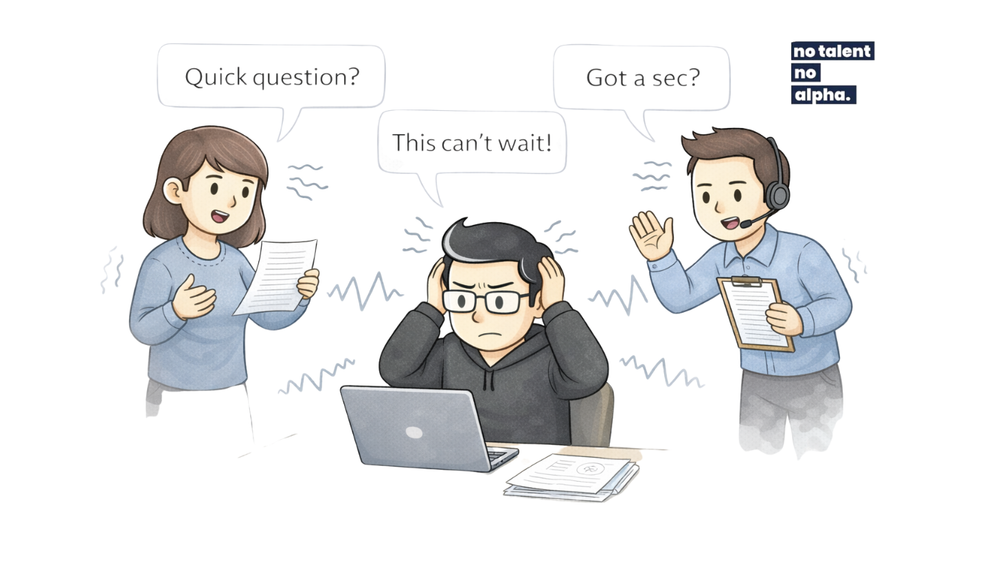
Your calendar says "focus time" but your Slack is lighting up. You close the door and someone knocks anyway. You finally get into deep work and your phone buzzes with "quick question?" Your team needs you, but you can't get your own work done.
Microsoft's 2025 Work Trend Index found that workers are interrupted every two minutes; up to 275 times per day! For managers, it's worse. Your team sees you as the answer to every question, the resolver of every conflict, the approver of every decision. But here's the thing: most interruptions fall into one of three categories, and only one actually requires your immediate attention.
The three types of interruptions:
Genuine urgent – Something is actively on fire and only you can put it out. A client crisis, a system outage, a team conflict that's escalating. These are rare. Maybe 5% of interruptions.
Could wait – Questions or decisions that feel urgent to the person asking but don't need to be resolved in the next two hours. This is 70% of interruptions.
Shouldn't be yours – Problems your team should solve without you, but they've learned it's faster to just ask. This is the other 25%.
The reason you're drowning in interruptions is that your team can't distinguish between these three categories. To them, everything feels urgent. Your availability has trained them that interruption is the default path to answers.
Here's what to implement tomorrow:
Establish interrupt hours. Pick two 30-minute windows each day where you're fully available for questions. Think of this time as "no appointment needed." Tell your team: "I'm available from 10-10:30am and 3-3:30pm every day for any questions. Outside those times, assume I'm in deep work unless it's genuinely urgent."
The first week, people will still interrupt outside these windows. When they do, respond: "Is this a genuine emergency or can it wait until my next interrupt hour at [time]?" 80% of the time, it can wait. They just didn't think to ask themselves first.
Define "genuine urgent." Your team needs clarity on what qualifies as interrupt-worthy. At your next team meeting, spend 10 minutes creating a shared definition. Examples: client escalations with financial impact, system failures affecting multiple people, safety issues, conflicts involving HR. Everything else uses the interrupt hours or goes on the agenda for your next 1-on-1.
Create a decision-making rubric. Most interruptions happen because your team doesn't know if they have authority to decide. Make a simple three-level framework:
- Level 1: Decide yourself, no approval needed (List examples: scheduling meetings, responding to routine client emails, ordering supplies under $X)
- Level 2: Decide yourself, inform me later (List examples: project approach changes within scope, team scheduling adjustments)
- Level 3: Check with me first (List examples: budget changes, client contract terms, timeline changes affecting other teams)
Put this in writing. Share it. When someone interrupts with a Level 1 or 2 question, point them back to the framework.
Build a parking lot system. Create a shared document where your team can drop non-urgent questions throughout the day. Review it during your interrupt hours and 1-on-1s. This does two things: it gives anxious team members somewhere to put their question (so they stop holding onto it), and it shows you patterns in what people need from you.
The first few days of implementing these boundaries will feel uncomfortable. Your team is used to instant access. Some will test the boundaries. Hold them.
One chronically-interrupted manager I know implemented interrupt hours and discovered that 60% of the questions people wrote down in the parking lot were answered by other team members before the next interrupt window. The questions didn't need a manager at all—they needed a moment to think or a quick peer check-in.
The bottom line: Your availability is not helping your team, it's making them dependent. The interruptions will only stop when you create clear boundaries, teach your team how to triage their own questions, and give them explicit authority to make more decisions without you.