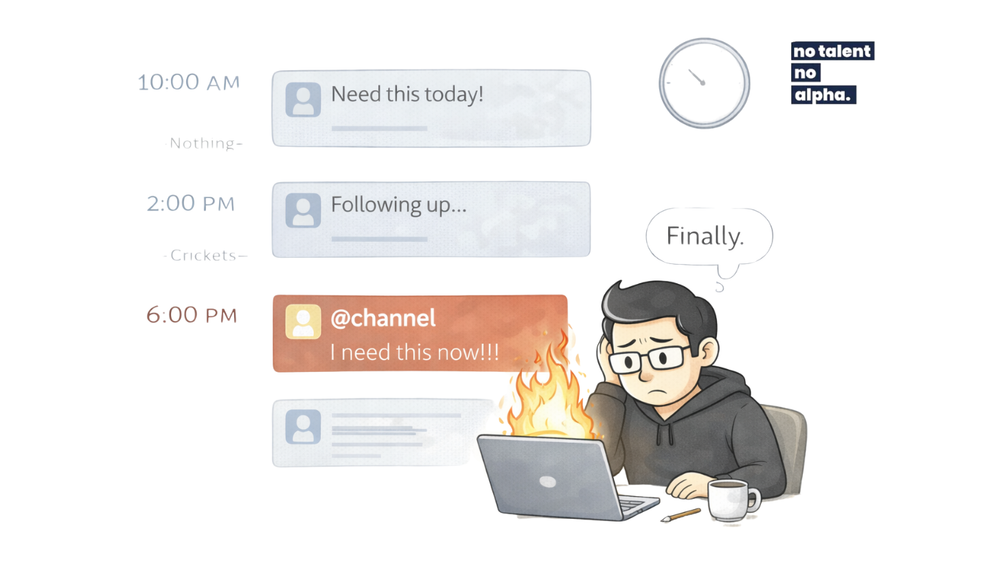
You send a message in your team channel. Nothing. You follow up. Crickets. By the time someone finally responds, it's 6 PM and the thing you needed done at 10 AM is now a fire drill.
This isn't about your team being disrespectful or lazy. It's about signal clarity. When everything looks urgent, nothing is urgent. Your team isn't ignoring you—they're drowning in channels, notifications, and competing priorities, and they genuinely don't know what needs attention now versus what can wait.
Research shows employees check Slack an average of 13 times daily, with teams sending 92 messages per user per day. That's a lot of noise. Without clear priority signals, your message gets lost in a sea of other messages that all look equally important. The problem compounds when 31% of employees report that juggling multiple communication channels is their biggest workplace challenge.
Here's what's actually happening: Your team has learned that most Slack messages don't require immediate action. They've been trained—probably by you—that "urgent" means "whenever you get to it." When you send a message without context about timing or importance, their brains default to "I'll get to this later." And later never comes.
The fix isn't sending more messages or adding more exclamation points. It's creating a system where urgency is immediately obvious and reserved for things that actually matter.
Start by defining what "urgent" actually means. Not urgent-to-you, but urgent-in-impact. If the task can wait four hours without consequences, it's not urgent. If it needs to happen in the next 30 minutes or something breaks, that's urgent. Get specific with your team about what qualifies.
Then create visual urgency signals. Use @channel or @here only for genuinely time-sensitive issues. When you reserve these for real urgency, they work. When you use them for everything, they become background noise. One manager I know limits @channel to three uses per week maximum. Her team responds in minutes because they know if she's using it, it matters.
For non-urgent communication, front-load the timing. "Need this by EOD tomorrow" tells people exactly when to prioritize it. "When you have a chance" translates to "never" in a busy channel. If you want people to see your message today but act on it next week, say that: "FYI for planning purposes - need this completed by Feb 20."
Consider using Slack's scheduled send feature for requests that don't need immediate attention. Sending a message at 11 PM signals that you expect a response at 11 PM. Scheduling it to arrive at 9 AM the next day signals appropriate timing without you having to remember.
For recurring updates or check-ins, use threads. When you start a new top-level message for every update, you train people that your messages are status updates they can skim later. When you keep related updates in one thread, you create containment. People can mute what's not relevant to them and pay attention to what is.
Here's the harder truth: If your team consistently ignores your messages, you might be messaging too much. Slack data shows that 28.1% of employees report delayed responses as a major challenge, and 21.7% say messages get buried in threads. When you're the manager who sends 15 Slack messages a day, you've taught your team that most of your messages don't matter.
Try batching. Instead of sending five separate messages throughout the day, consolidate them into one message with clear action items and deadlines. People are more likely to respond to one substantive message than five fragmentary ones.
One final consideration: Some information doesn't belong in Slack at all. Complex projects with multiple stakeholders? That's a meeting. Sensitive feedback? That's a one-on-one. Policy changes that require documentation? That's email. When you use Slack for everything, people learn to treat it like nothing.
If you've tried all this and people still aren't responding, you have a different problem. That's when you have direct conversations: "I've noticed my messages in Slack aren't getting responses. What's getting in the way?" You might learn that people don't check certain channels, or that they've muted notifications because they're overwhelmed, or that there's a process issue you can actually fix.
The goal isn't to make everyone jump when you message. It's to create a communication system where your team knows what needs their attention now versus what can wait. When you're clear about urgency, people respond. When everything feels equally important, nothing gets done.