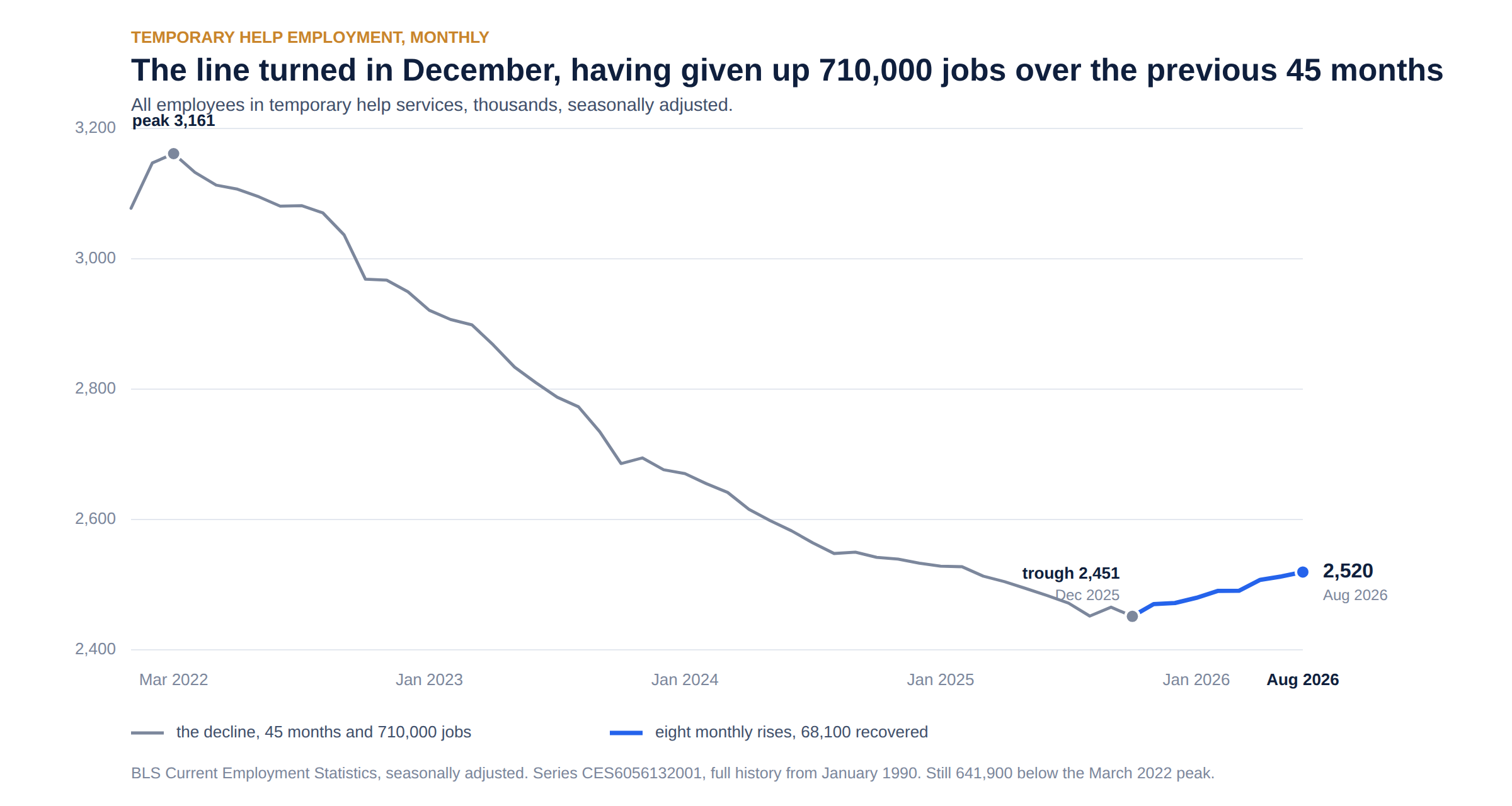
Temporary help employment bottomed out in December 2025 and has risen every month since. That matters because the same pattern has appeared sixteen times since 1990, and payroll growth has followed it almost every time. It followed again. Over those eight months of 2026 the economy went from losing 38,700 jobs a month to adding 71,300.
A recovery asks two separate questions, and different people answer them at different moments. Whether the work comes back is the first. Whether that work becomes a permanent job is the second. Temp help answers the first cleanly, because renting a worker is the cheapest way an employer can say yes to returning demand without committing to anything. It says nothing about the second, and the second is what sets how large a recovery gets.
Over these eight months the first answer was plainly yes. Demand came back and the swing was large, 110,000 jobs a month. The second answer is where this cycle parts company with its own history. Measured at exactly the same point, eight months after the signal fired, the median of the sixteen previous episodes was running at 232,000 jobs a month. This one is running at 71,300. Only two of the sixteen were slower, and they were the 2001 recession and the jobless recovery that came out of 1991.
That is worth saying now rather than later. Jobless recovery is a name economists usually apply two or three years after the fact, once it has become obvious that growth returned and hiring did not. The two slowest deliveries in this entire record are precisely the episodes that earned it. This one is behaving the same way eight months in, and the reason we can see it this early is that the conversion from demand into permanent jobs is measurable in real time.
The Test
We pulled the full series rather than a recent window, back to January 1990, 440 months. An episode here means six or more consecutive monthly increases in temp help. There have been seventeen, counting the one running now. Each is scored at the same horizon the current one has reached, eight months, using the three-month average monthly change in total payrolls. That is the only comparison that is genuinely like for like.
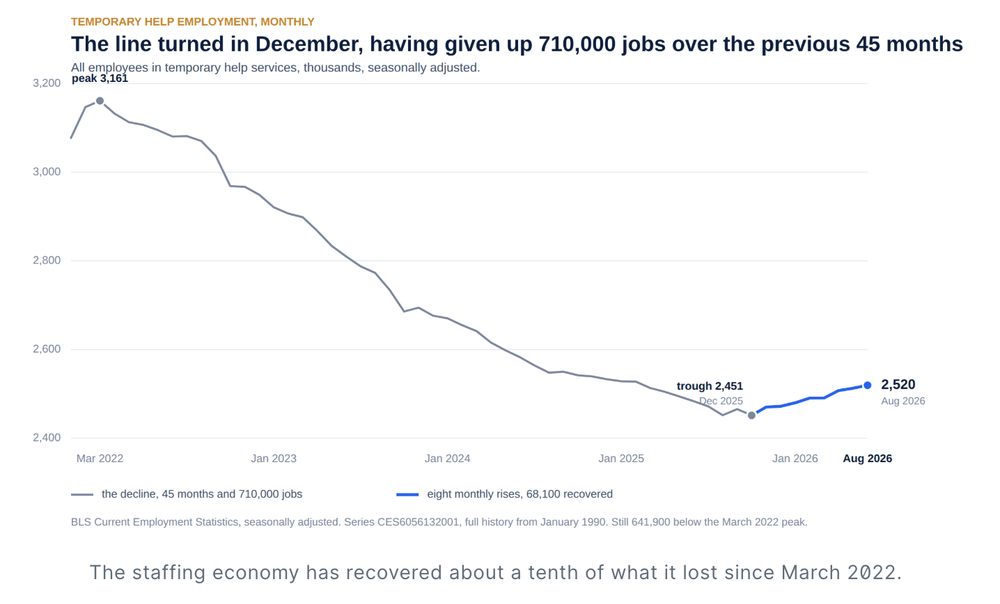
The scale of what came before the turn is worth holding in mind. Temp help peaked at 3,161,400 in March 2022 and then fell for 45 months, giving up 710,000 jobs, a decline of 22.5 percent. The eight months of increases have recovered 68,100 of that. The staffing economy has climbed back about a tenth of what it lost and remains 641,900 below where it stood in early 2022.