Layoffs in America are running below where they were in 2019. Over the same period the job base has barely grown. Both of those are true at once, and the distance between them is roughly 1.3 million jobs that stopped existing without anybody being fired from a single one of them.
Here's how to think about that: when an employer lays somebody off, a job disappears and an unemployed person appears. When an employer decides not to refill a chair that somebody left on their own, the job disappears and nobody appears at all. No claim is filed. No WARN notice goes out. The household survey has no new person to count, because the worker who walked out is already somewhere else.
Every signal built to detect job destruction is a signal that looks for that person. Remove the person and the jobs can still go, in volume, without moving any of those signals. That is why a year that quietly removed 1.3 million jobs reads from the outside like a calm one.
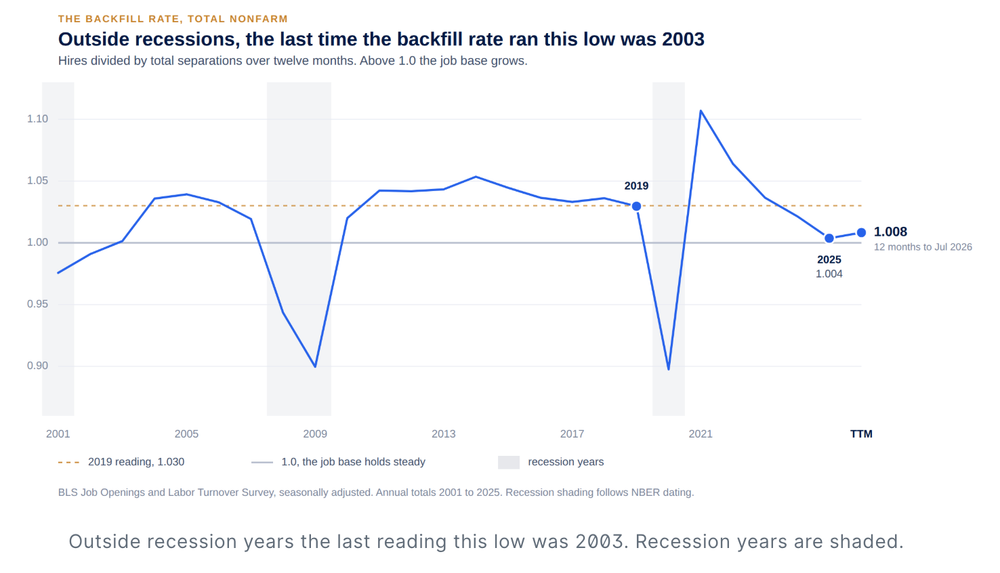
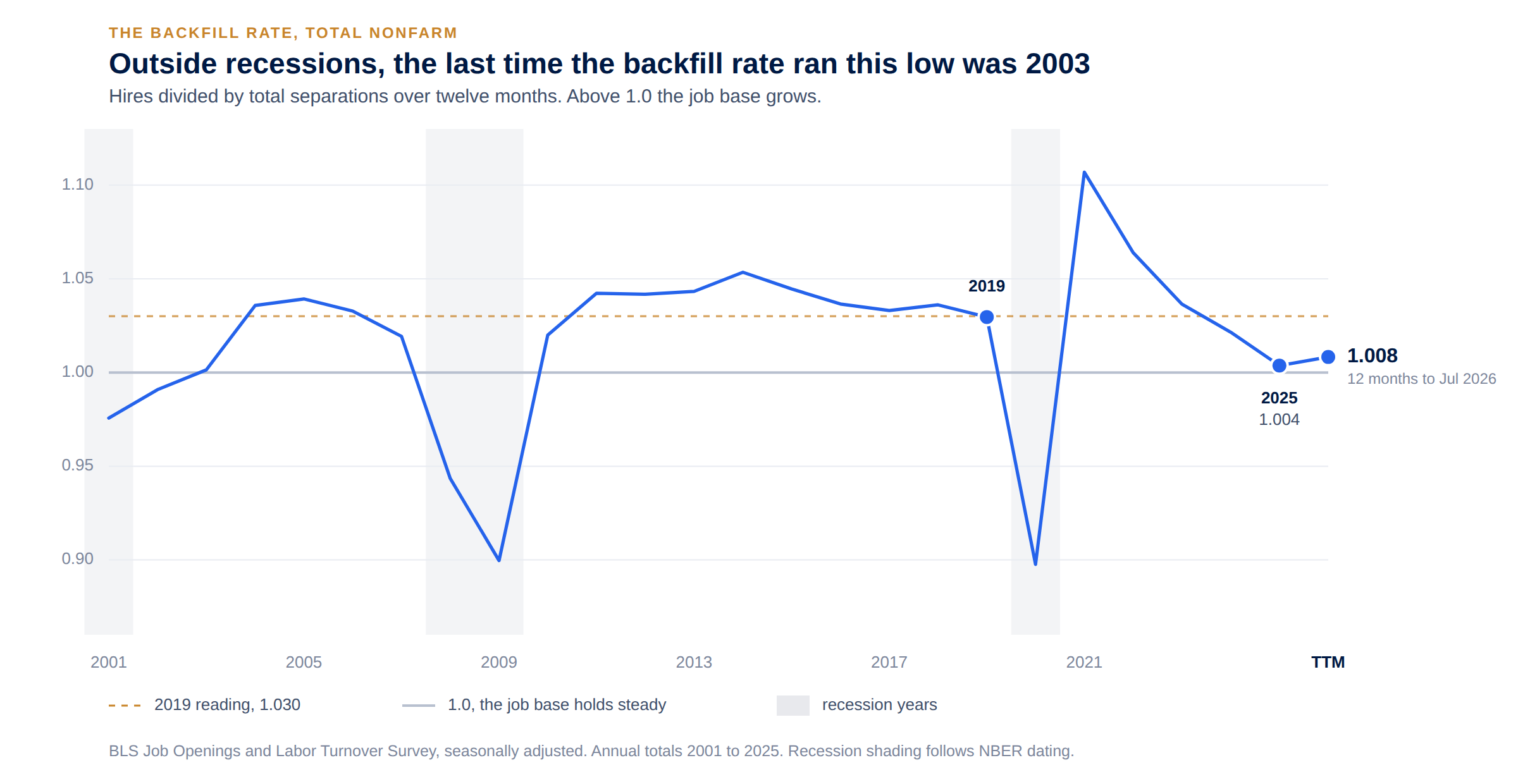
The number that shows it is not one the BLS publishes. Every month the agency reports how many people American employers hired and how many left. Divide a year of the first by a year of the second and you get the rate at which employers refill the people who walk out the door. Call it the backfill rate. For the twelve months through July it stands at 1.008, or about 101 hires for every 100 departures. In 2019 it was 1.030, which is 103 per 100. Calendar 2025 finished at 1.004, the weakest reading outside a recession year since 2003.
Two hires per hundred sounds like rounding. It is not, because the flows underneath are enormous. Sixty-two million hires. Sixty-two million separations. Run 2019's backfill behavior through today's separations and the economy would have added about 1.84 million jobs over the past year. It added 513,000.
None of that missing 1.3 million came from anywhere a layoff tracker can see. Layoffs and discharges over those twelve months came to 21.0 million, against 21.8 million in 2019. Americans are being fired less often than they were before the pandemic, not more. Those jobs ended the moment somebody resigned and the chair stayed empty. Roughly 1.3 million chairs, no announcement attached to any of them.
The reason to watch this rather than the layoff count is scale. Thirty-seven million Americans quit their jobs in the past twelve months, against net job growth of 513,000. Employers made the refill decision roughly seventy times for every single job the economy added on net. Nothing else an employer does to headcount runs at that volume, and it is the only one of those decisions that never gets announced. A layoff gets a date, a notice and a press cycle. A chair left empty gets nothing.