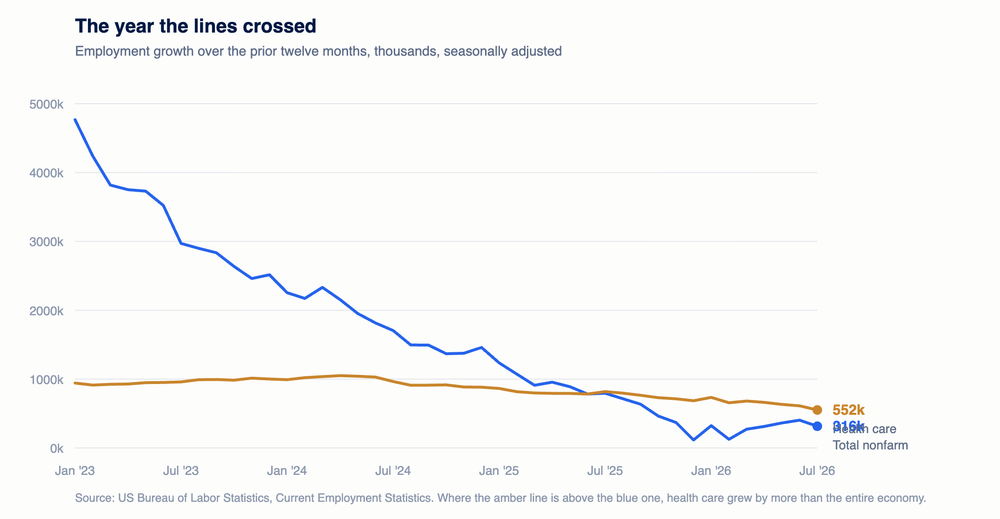
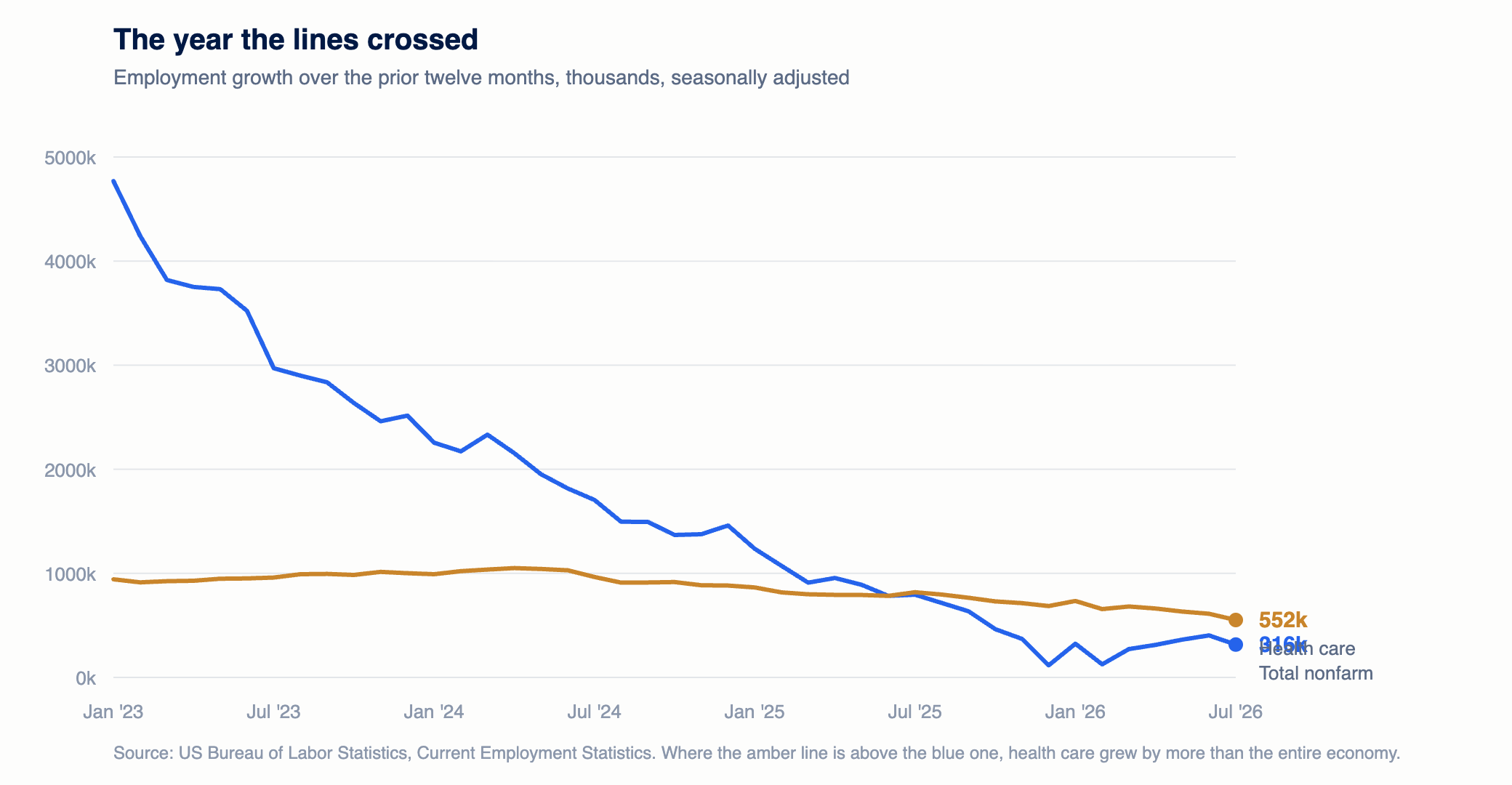
Since 1991 there have been five occasions when health care added more jobs over twelve months than the entire American economy did.
April to June 1992. May to June 2001. December 2003 to January 2004. March to April 2008. September 2010.
None lasted longer than three months. Every one of them sat at the bottom of a recession or at the start of one.
The sixth began in June 2025 and has now run for fourteen months.
The arithmetic, done properly
Total nonfarm employment in July was 158.86 million, up 316,000 from July 2025. Health care and social assistance employed 23.91 million, up 552,100.
The tempting way to write that is that everything else is down 236,100 on the year. It is arithmetically true and it is misleading, because it lumps together two things that have nothing to do with each other.
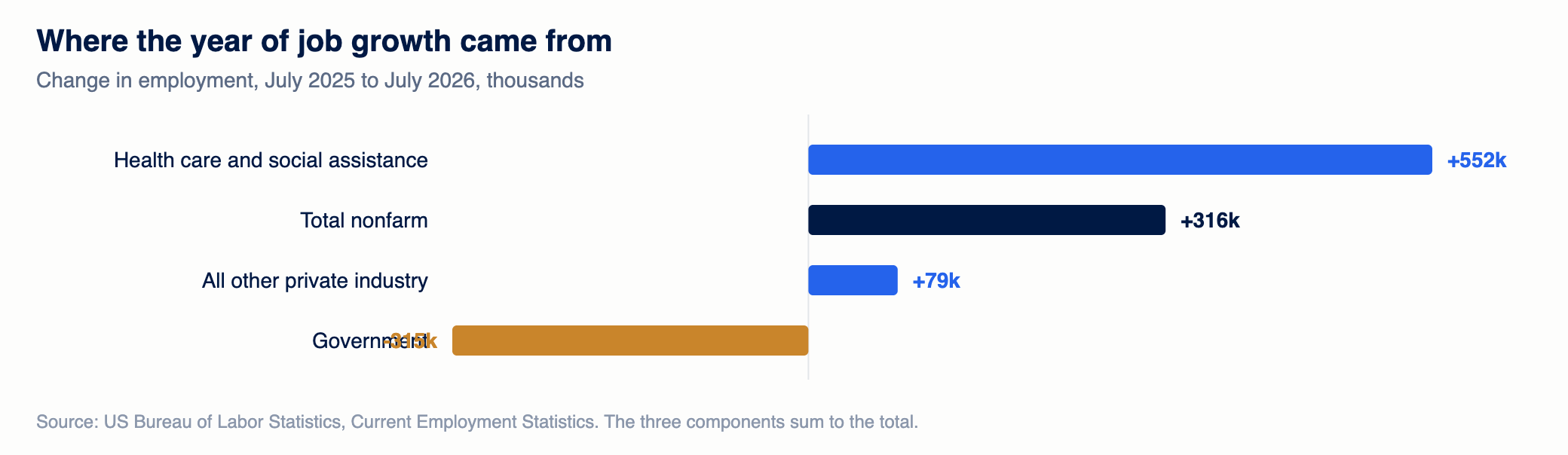
Health care and social assistance: up 552,100.
All other private industry: up 78,900.
Government: down 315,000.
Those three sum to the 316,000 total. The private economy outside health care is not shrinking. It is growing at almost exactly nothing, roughly 0.07% over a year, on a base of about 111.7 million jobs. The rest of the arithmetic is a deliberate reduction in the federal workforce, which fell 252,000, or 8.6%, in twelve months. State government lost 33,000 and local government 30,000.
That distinction matters because the two have different causes and different futures. A federal headcount reduction is a policy decision with an end point. Private employment growth of 0.07% is a market condition, and market conditions do not have end points scheduled.
It is worth putting a size on that 78,900, because a small positive number is easy to read as "roughly fine".
Private employment outside health care is about 111.7 million jobs. A year of ordinary growth at 1%, which is unremarkable and well below what the late 2010s delivered, would have produced about 1.12 million of them. The actual figure is 78,900.
So the shortfall against a modest normal year is on the order of a million jobs. Not a million jobs lost, which is a different and worse thing, but a million that were not created. That gap does not appear anywhere in the headline because health care and the federal reduction between them cancel it out into a plausible looking 316,000.
This is the reason a single national payroll number has become close to useless for planning. It is now the sum of three unrelated processes, and their signs happen to offset.
Why the precedent is the interesting part
The chart above shows what happened. Total employment growth fell from 4.77 million in the year to January 2023 to 316,000 in the year to July 2026. Health care growth fell too, from 943,000 to 552,100, but far more slowly. In June 2025 the lines crossed and they have not crossed back.
Health care employment growth is not accelerating. It is decelerating more slowly than everything else, which is a different claim and a more accurate one.
The five earlier crossings are worth taking seriously precisely because they were so short. Health care demand is demographic and largely insensitive to the business cycle. People do not defer dialysis because payrolls fell. So when the cyclical part of the economy stops adding jobs, health care keeps going and briefly accounts for all of the growth. Then the cycle turns, the rest of the economy resumes hiring, and the crossing ends after a month or two.
That is the mechanism, and it is why every prior occurrence was a recession marker. It is also why fourteen months is the thing to explain. Either the cyclical part of the economy has been in something recession-shaped for over a year without being called one, or something has changed about the relationship. Both readings are live and the data here does not settle it.