Between January 2025 and July 2026, professional and business services added 38,000 jobs. On a base of 22.5 million people that is a rounding error, about one sixth of one percent across eighteen months, and it is the kind of number that gets described as flat and then ignored.
Underneath the flat number, the sector lost 95,000 supervisory positions and gained 133,000 non-supervisory ones.
That is not a slowdown and it is not a recovery. It is a sector changing shape while its headline number stands still. On September 2nd, Uber described the same operation in a memo, at one company, and the description was clear enough that it is worth using as a way into what the national data has been doing quietly since the start of last year.
A Sector That Added 38,000 Jobs and Lost 95,000 Supervisors
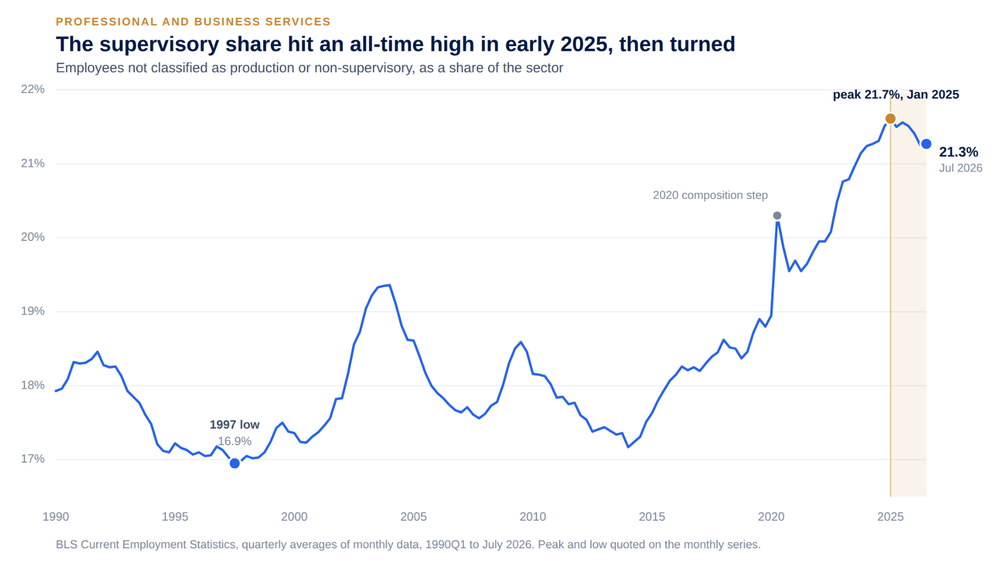
The Bureau of Labor Statistics publishes two employment counts for most industries. One is all employees. The other is production and non-supervisory employees. Subtract the second from the first and you get a supervisory count, and dividing that by the total gives a supervisory share. It is available monthly, back to January 1990, which is 439 observations.
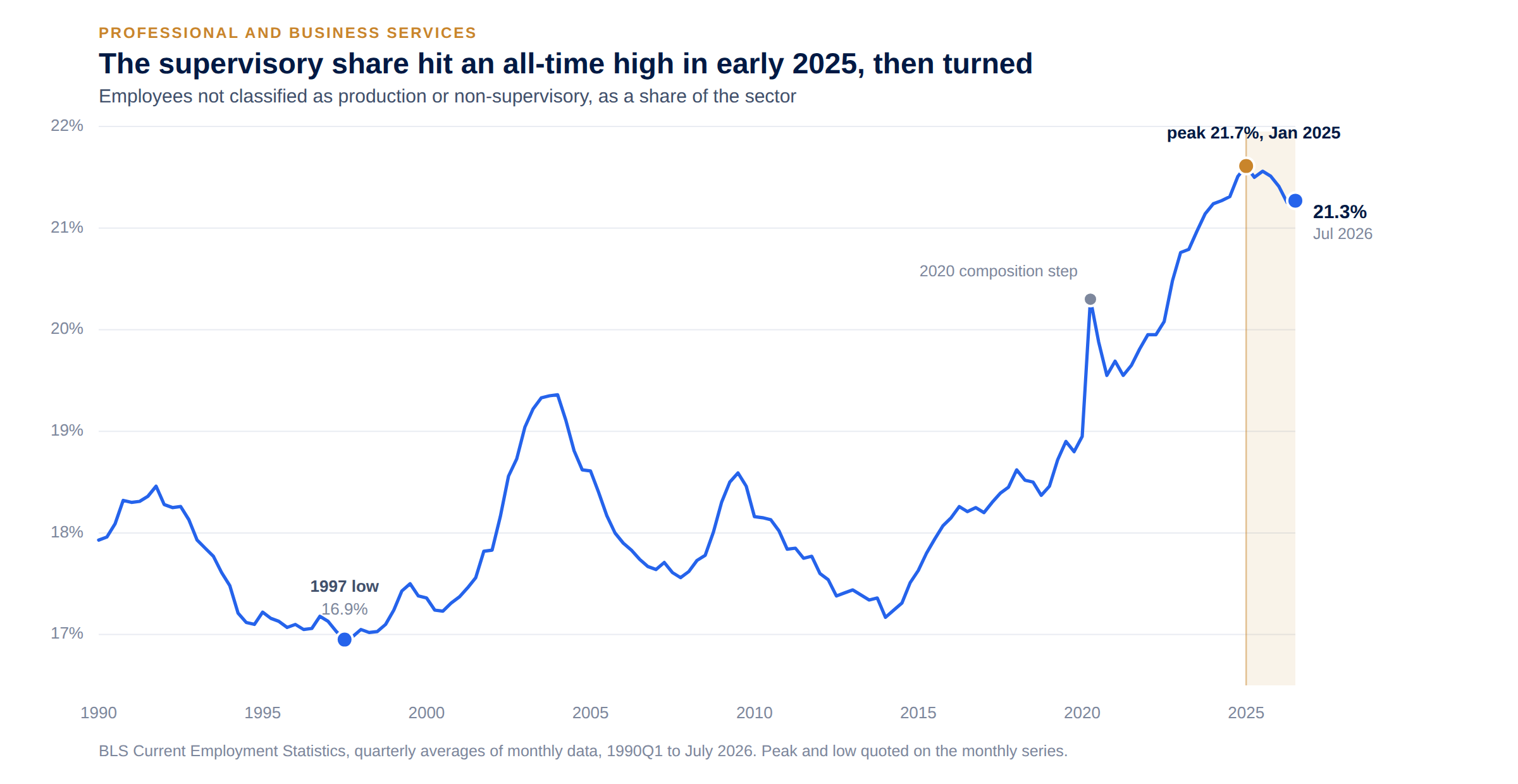
For professional and business services, the supervisory share in January 2025 was 21.73 percent. That is the highest reading in all 439 months. The low was 16.87 percent in July 1997.
In July 2026, the most recent month, the share is 21.27 percent. In levels: 22,518,000 people in the sector, of whom 17,729,000 are non-supervisory and 4,789,000 are not.
So the peak sits eighteen months behind the latest reading, and the series has come down 0.46 points over that stretch. Small, and worth being careful about, because a 0.46 point move in a monthly series is not automatically a trend. What makes it look like one is the direction of the two components. Supervisory employment fell from 4,884,000 to 4,789,000. Non-supervisory employment rose from 17,596,000 to 17,729,000. Both moved, in opposite directions, and roughly cancelled.
The buildup that preceded this is the larger fact. Take December 2019 as the last clean pre-pandemic month. Since then, supervisory employment in professional and business services is up 758,000, a rise of 18.8 percent. Non-supervisory employment is up 293,000, a rise of 1.7 percent. Supervisory roles grew about eleven times faster than the work they supervise.
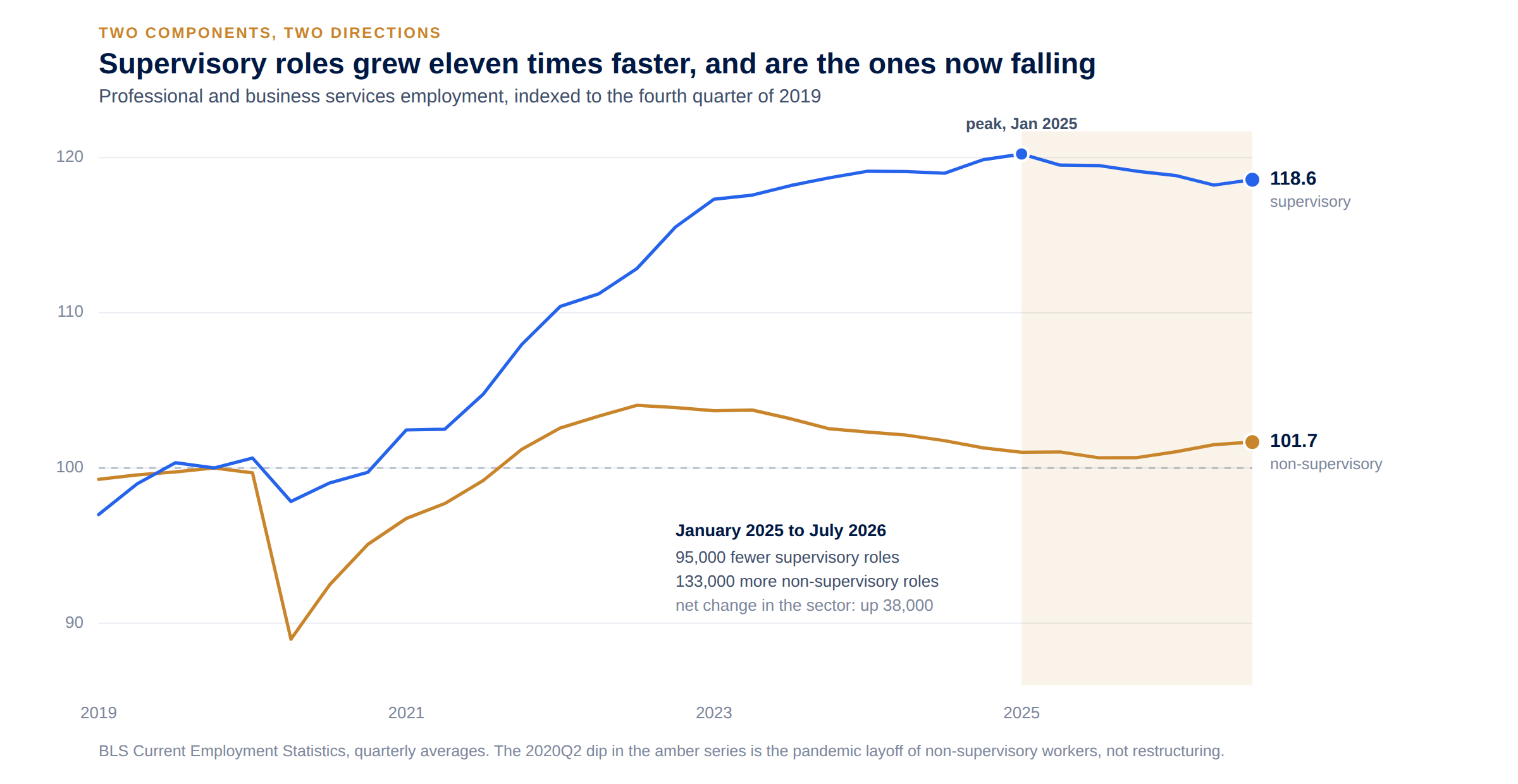
That is the anomaly. A sector added supervisors at eleven times the rate it added anyone else for six years, hit an all-time high in the ratio, and has spent the eighteen months since reversing.