Friday's jobs report was written up everywhere as a strong one. Payrolls rose 162,000 in August, more than five times the average monthly gain of 31,000 over the prior twelve months, and the unemployment rate held at 4.1 percent. That is a fair description of what the Bureau of Labor Statistics published.
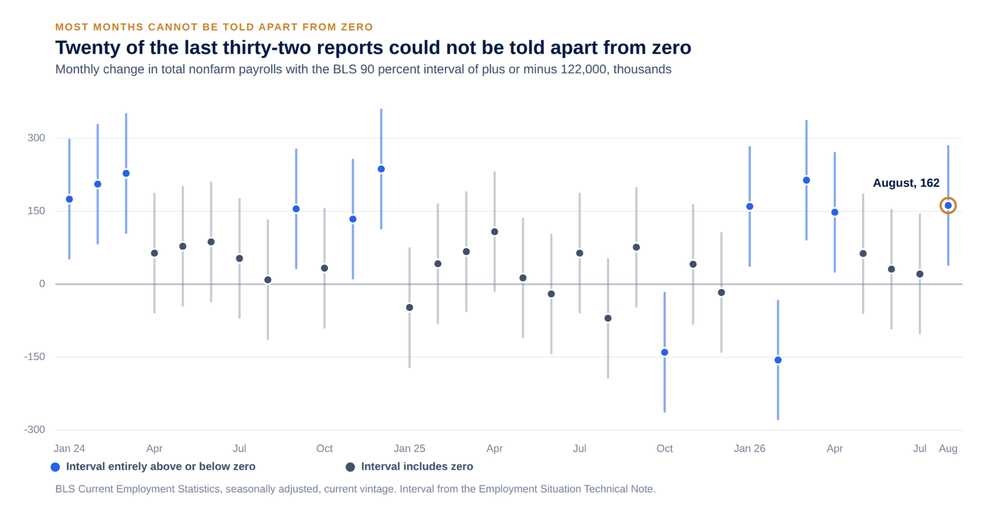
Attached to the same release, in the technical note that almost nobody opens, BLS publishes the standard it applies to its own work. The 90 percent confidence interval on a one-month change in total nonfarm payrolls is plus or minus 122,000. BLS then works an example. If the reported gain is 50,000, the true change lies somewhere between a loss of 72,000 and a gain of 172,000, and in their words we could not say with confidence that employment increased at all.
Run that arithmetic the other way and it gives you a bar. A reported gain has to clear 122,000 before the whole interval sits above zero, and only then can you say from a single month that payrolls grew.
August cleared it, by 40,000 jobs.
That is the good news, and it is thinner than it sounds, because the first print is not the last word. Since January 2023, thirty-one months have printed above 122,000. Twelve of them no longer do.
What the release actually said
Take the report on its own terms first, because there is real information in it.
Payrolls rose 162,000. June was revised up 11,000, from 20,000 to 31,000. July was revised up 44,000, from a loss of 23,000 to a gain of 21,000, which turned a reported contraction into a modest expansion. Together the two months came in 55,000 higher than previously reported.
The unemployment rate was unchanged at 4.1 percent, with 7.0 million people unemployed. Labor force participation edged up to 61.6 percent, though it remains half a point below where it stood in January. The employment to population ratio was 59.1 percent. The number of people working part time because they could not find full time work fell by 414,000 to 4.4 million, which is a large move for that series.
Average hourly earnings rose 10 cents to $37.75, up 3.1 percent over the year. The average workweek edged up a tenth of an hour to 34.4 hours.
Underneath the total, the August gain is concentrated. Food services and drinking places added 59,000 against a twelve-month average of 12,000. Local government education added 42,000, which BLS itself describes as largely offsetting a decrease in the prior month, and which the agency notes has shown little net change since January 2025. Those two lines are 101,000 of the 162,000, or 62 percent of the month, and BLS is telling you that a large part of one of them is a calendar reversal rather than new hiring.
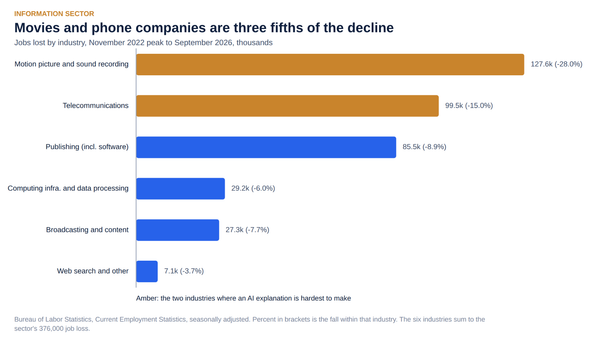
Manufacturing added 16,000 and is up 58,000 since a low in December 2025. Health care added 13,000, well below its own twelve-month average of 32,000. Information lost 23,000, against an average monthly loss of 8,000, with declines in computing infrastructure and data processing, in publishing, and in broadcasting.
That is the report. Now the harder question, which is how much of it you can actually act on.