The unemployment rate fell to 4.1% in July, from 4.3% a year earlier. That is the lowest reading in thirteen months and it is the number that will get quoted.
Over the same twelve months, the share of Americans who have a job fell from 59.6% to 58.9%.
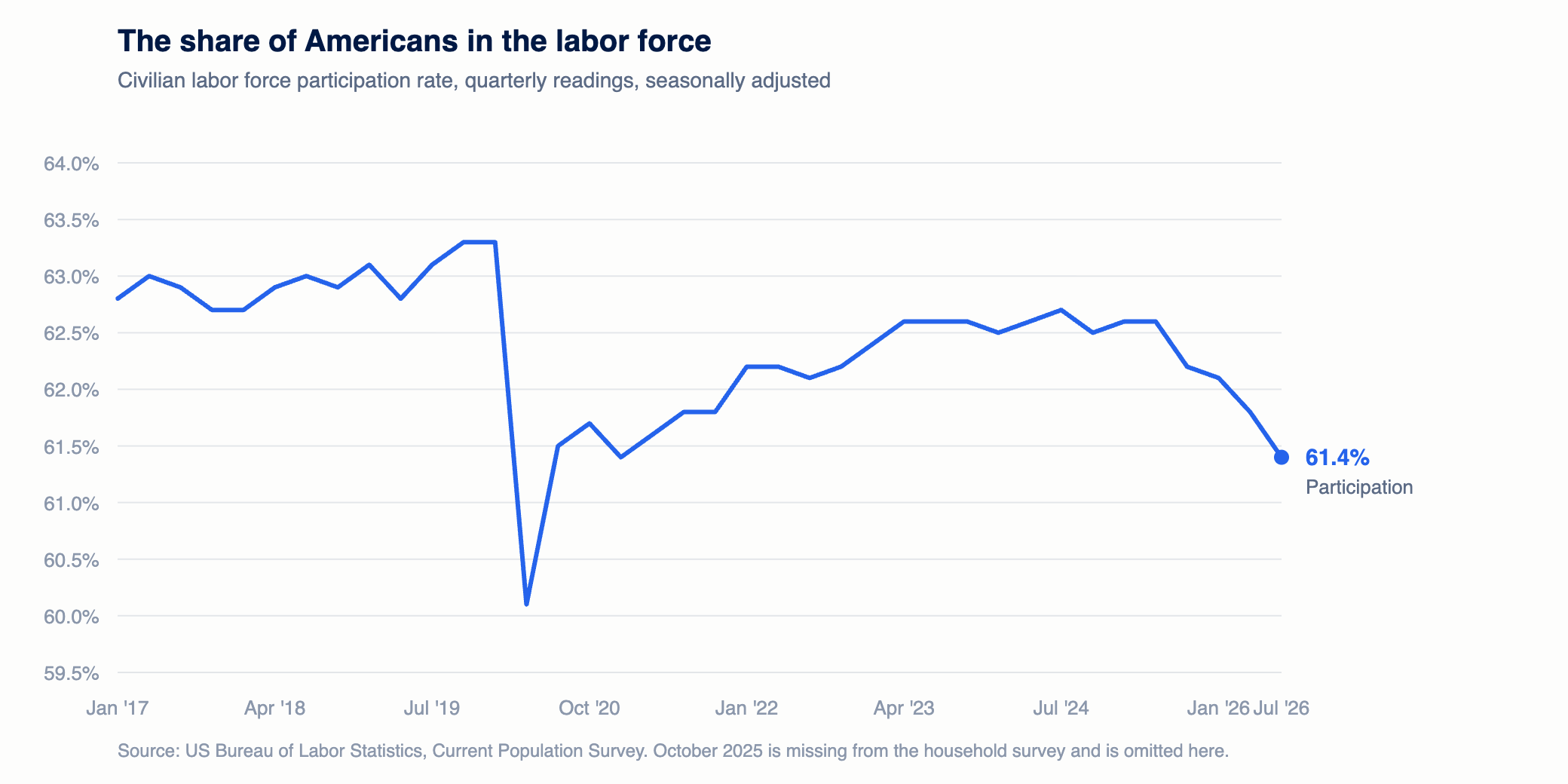
Both of those are true, and they can only both be true if people are leaving the labor force. The unemployment rate is a fraction of the people looking for work. Stop looking and you stop counting.
So the question worth answering is not whether the labor market is weakening. It is who left.
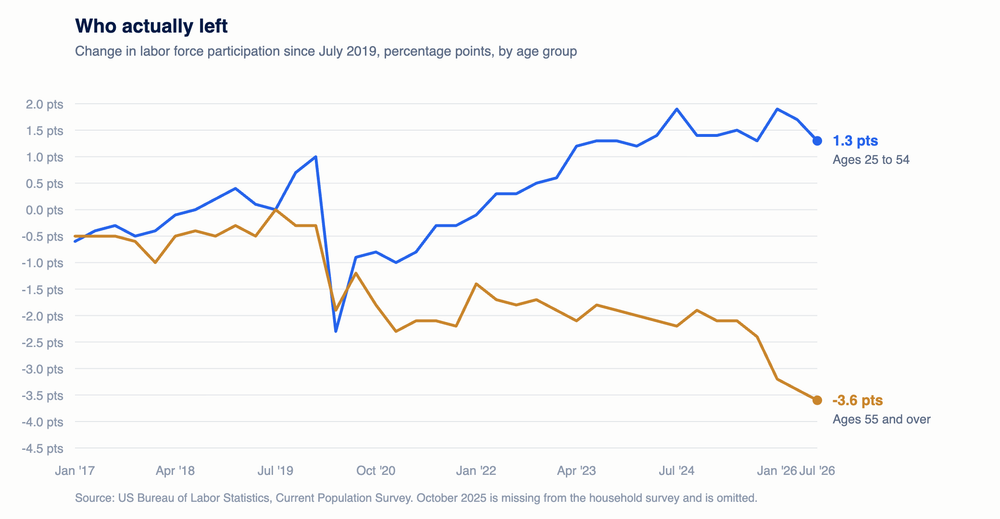
The entire decline is people over 55. Participation in that group fell from 38.1% to 36.9% in twelve months. Among 25 to 54 year olds it did not move at all: 83.4%, flat for the year, and higher than it stood in 2019. A market that was genuinely deteriorating would show up first in the people who are supposed to be working. It has not.
Nor is this the baby boom retiring on schedule. That was already running, at about four tenths of a point a year for six years. The last twelve months delivered 1.2 points, three times the pace, and the rate has fallen at every consecutive reading since the start of 2025. Ordinary demographics do not accelerate like that.
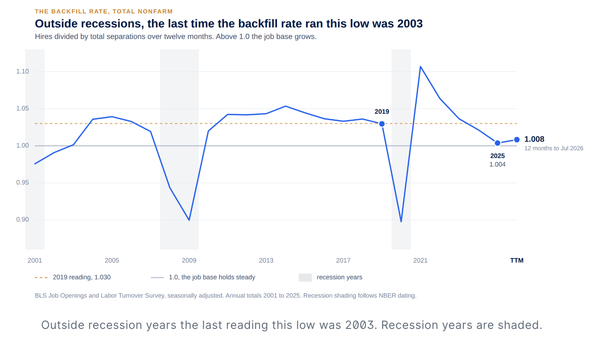
So the labor market is not weakening across the board. It is contracting at the top of the age distribution, and that one fact explains most of what has looked strange this year: quits frozen for 31 straight months, layoffs pinned inside a narrow band, hiring below its 2019 pace, and health care supplying more than all of the past year's job growth. Employers do not need to cut when retirement is doing it for them, and the sector absorbing the growth is the sector that serves the people leaving.
Start with the arithmetic
Three rates, measured on the same survey of the same households in the same month.
The unemployment rate is unemployed people divided by the labor force. It fell 0.2 points.
The participation rate is the labor force divided by the working age population. It fell 0.8 points, from 62.2% to 61.4%.
The employment to population ratio is employed people divided by the same population. It fell 0.7 points.
A falling unemployment rate alongside a falling employment ratio is not a contradiction, it is a definition. The numerator of the unemployment rate shrank because people stopped meeting the test for being unemployed, which requires actively looking for work in the last four weeks.
This is the oldest known weakness of the headline number and it is why anyone serious looks at participation next. What is unusual here is not that participation fell. It is where it fell.