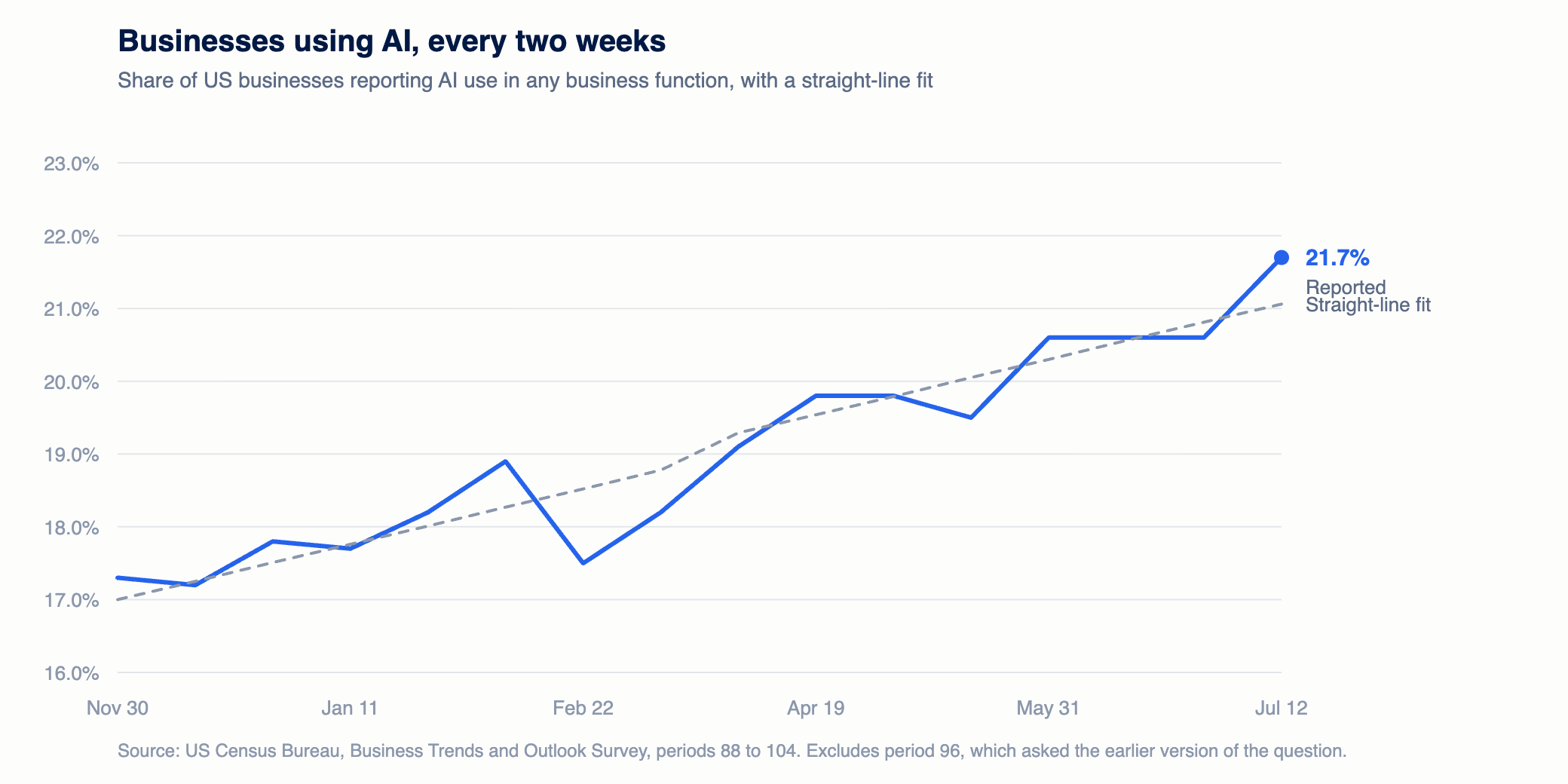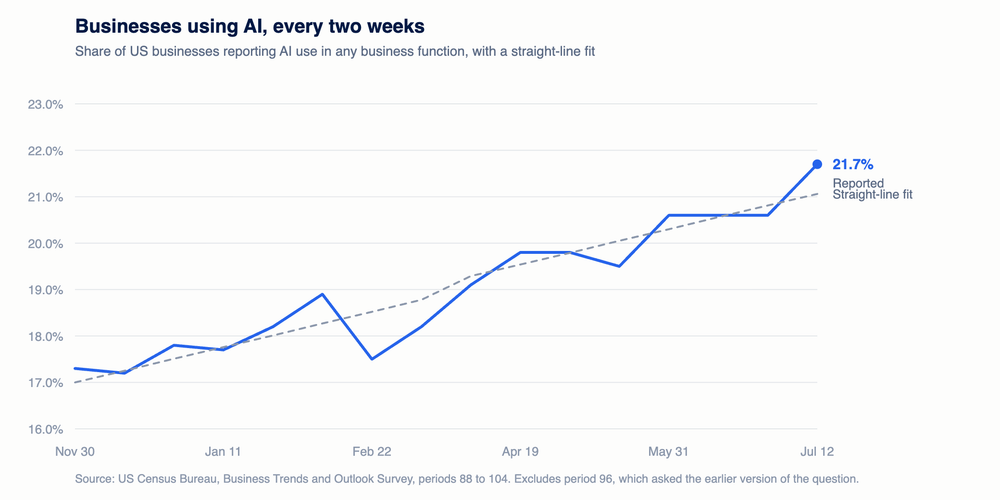
At the end of November, the Census Bureau asked about a million American businesses whether they expected to be using AI six months from then. They said 21.1%.
The end of May arrived. The answer was 20.6%.
That is a small miss, and on its own it is not worth an edition. What makes it worth an edition is that the survey asks the same question every fortnight, which means it is possible to do something almost nobody does with a forecast: go back and mark it.
Four of those forecasts have now come due. All four were too high. Not by much, and not by a wild amount, but in the same direction every time.
Marking the forecast
The Business Trends and Outlook Survey asks two questions about AI. Whether the business used it in the last two weeks, and whether it expects to be using it in six months. Both go out every fortnight, so a forecast made in November can be checked against the reading exactly thirteen fortnights later, which is the same calendar date six months on.
Here is what that produces.
The forecast made on 30 November said 21.1%. The reading on 31 May came in at 20.6%. Over by half a point.
The forecast made on 14 December said 20.9%. The reading on 14 June was 20.6%. Over by three tenths.
The forecast made on 28 December said 21.3%. The reading on 28 June was 20.6%. Over by seven tenths.
The forecast made on 11 January said 22.4%. The reading on 12 July was 21.7%. Over by seven tenths.
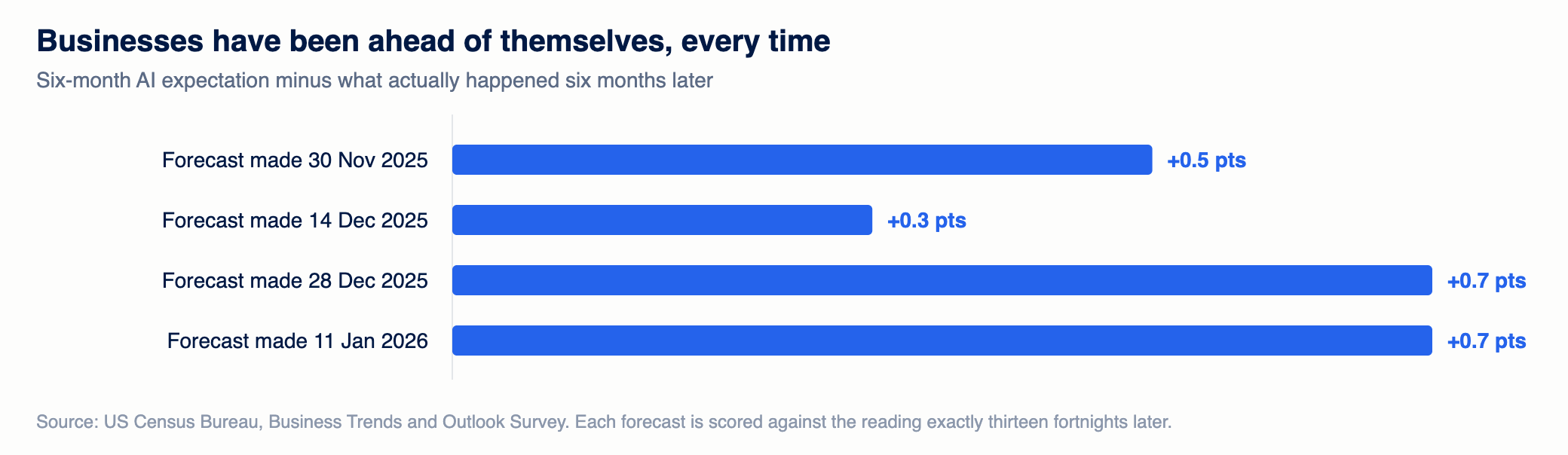
Average overshoot: 0.55 points. Four for four in the same direction.
That is a small sample and it does not prove a permanent bias. But there is a reason to expect one, and it is not that businesses are lying. A forecast about your own behavior is a statement about intent, and intent runs ahead of procurement. Somebody in the business has decided AI is happening. The security review, the vendor contract, the training, the person who has to actually change how they work on a Tuesday, all of that lands later than the decision does.
Which means the six-month expectation is probably better read as a measure of intent than as a forecast. It tells you what businesses have decided. The current reading tells you what has landed.
What they are saying now
In the fortnight to 12 July, 21.7% of businesses said they were using AI. Asked about six months out, 24.5% said they expected to be.
That implies a gain of 2.8 points between now and mid-January. Set that next to what businesses have actually delivered over the four completed six-month windows: 3.3 points, 3.4, 2.8 and 4.0. An average of 3.4.
So the current expectation sits below the average realized gain, and it does so from a group that has overshot every time it has been marked. Knock the average bias off and the forecast lands at roughly 24.0 in mid-January.
The trend line says something different. The straight line running through every reading since the question took its current form points at 25.0 by mid-January.
A point apart is not a large disagreement, and it would be easy to split the difference and move on. It is worth naming instead, because the two methods have been agreeing for eight months and this is the first time they have not. Either businesses are seeing a slowdown in their own pipelines that has not shown up yet, or the intent signal has simply stopped running as far ahead as it was.