Two numbers, same week, pointing in opposite directions.
+15% and -2.1%. JPMorgan grew its operating expenses 15% year over year last quarter, largely by hiring and paying people more. Microsoft cut about 2.1% of its staff. One got treated as a warning sign. The other got treated as discipline. Hold those two reactions next to each other, because the gap between them is the whole edition.
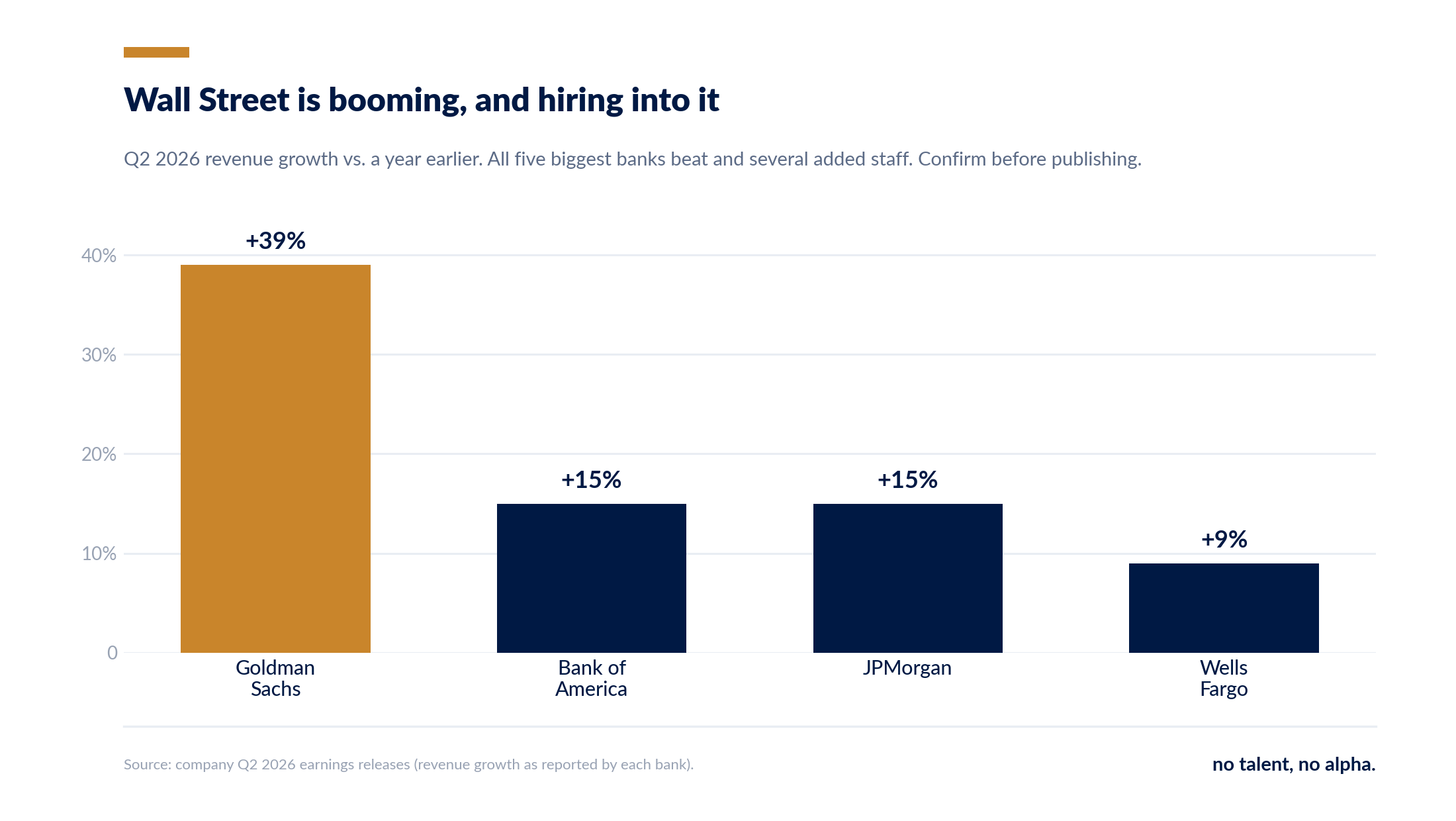
Here's the setup. Q2 earnings season opened with the big banks, and it was a monster. JPMorgan posted what was reported as the largest quarterly profit in the history of American banking, net income around $16.9 billion, on roughly 23% return on tangible equity. Goldman Sachs had the best quarter in its history, earnings of $20.98 a share, nearly double a year ago, revenue up 39%. Bank of America's profit jumped 27% on record equities trading. Wells Fargo's profit rose 17%. All five of the biggest banks beat. And every one of them did it while doing the thing tech spent the year being praised for not doing: adding people.
The market's new sorting factor
The word that matters in the bank results is "expense." JPMorgan's noninterest expense hit $27.3 billion in the quarter, up 15%, and the bank raised its full-year expense guide to roughly $107.5 billion. Management was blunt about why: higher compensation, more front-office hiring, technology, and plain labor inflation. That's a bank leaning into people at exactly the moment software is leaning out.
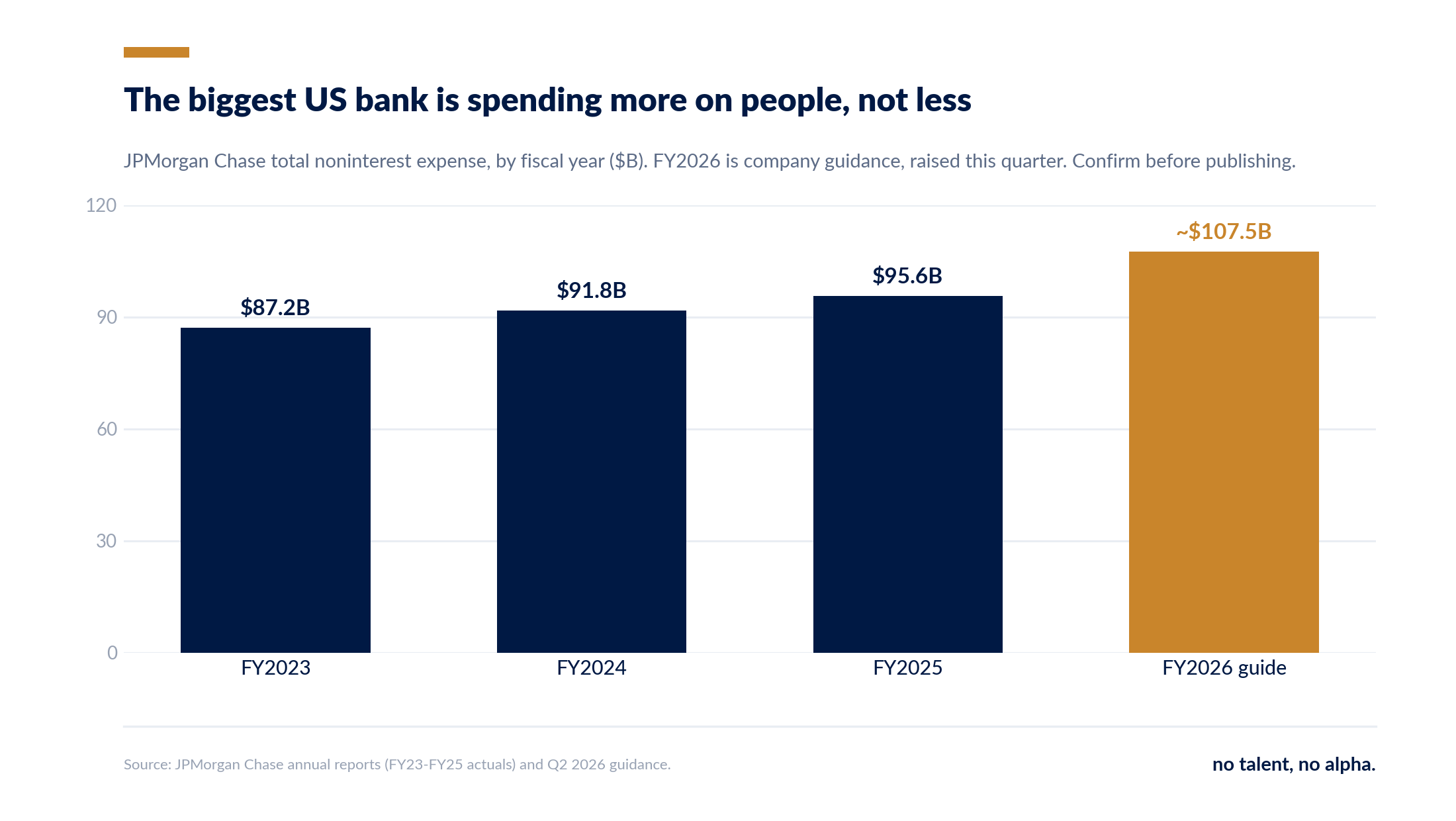
Look at the trajectory. JPMorgan's total operating expense ran $87.2 billion in 2023, $91.8 billion in 2024, $95.6 billion in 2025, and the company is now guiding to about $107.5 billion this year. The cost of running the biggest bank in the country keeps climbing, and a large chunk of that climb is people. It's the mirror image of what the market's darlings in tech are doing: Microsoft just cut 4,800 people and is pouring money into compute instead. Same economy, two playbooks, opposite decisions about where the next dollar goes.
And the market is grading them on it. Microsoft, cutting labor and buying silicon, is getting marked down for its capital bill but praised for its discipline on headcount. The banks, adding labor into a boom, printed records and still drew questions about their efficiency ratios, the basic "how much do you spend to earn a dollar" measure that worsens when costs grow faster than you'd like. The factor underneath both reactions is the same: how labor-intensive is this business, and is that intensity going up or down? Labor going down earns applause. Labor going up earns a squint, even when it comes with the best quarter you've ever had.
Why the factor is having a moment
The reason labor intensity became a sorting factor this year is AI, and it's worth being precise about the logic because the logic is half-right.
A labor-light business is one that can grow revenue without growing its payroll in step. That's the dream software has always sold, and AI supercharges the pitch: if a model can do the work, you can add customers without adding headcount, and every incremental dollar drops closer to the bottom line. A labor-heavy business is the opposite. To serve more customers, a bank hires more bankers, an airline staffs more crews, a hospital adds more nurses. Growth costs you labor, and labor costs keep rising. So in a year where investors are trying to figure out who AI helps and who it doesn't, "how much of your cost base is people" turned into a quick proxy for "how much operating leverage can you get." Labor-light equals scalable. Labor-heavy equals stuck.
That framing isn't crazy. But it flattens a distinction that turns out to matter enormously, and you can see the distinction most clearly in why the labor-heavy companies are adding people at all.
The part the factor misses
Here's the thing the "labor-heavy is stuck" story skips. JPMorgan and Goldman aren't adding people because they're bloated or slow. They're adding people because the work is there and it pays. Goldman's revenue grew 39% on a trading and dealmaking boom. JPMorgan is hiring front-office staff, the bankers and traders who directly generate revenue, into the same wave. That's not a cost problem. That's a company buying more of the thing that's working while it's working. The added labor is offense, not overhead.
You can see it in the one number that's supposed to catch bloat. Bank of America grew its costs and added staff last quarter, and its efficiency ratio, the basic measure of how many cents of expense it takes to earn a dollar of revenue, actually improved, to 59%, because revenue outran the added cost. Labor that pays for itself doesn't look like the labor the factor is built to punish. It looks like growth.
Now put that against the labor-light side. A meaningful share of this year's tech "efficiency" is defensive: cost-cutting into a soft patch, dressed in AI language because AI language earns a better multiple. AI was the single most-cited reason for layoffs four months running. Some of those cuts are genuine productivity. Some are just cuts. And the operating leverage that's supposed to justify the labor-light premium, the AI revenue that scales without payroll, is still, for most of these companies, more promise than income statement. The margin is coming, management says. The market is paying for it now.
So the factor sorts companies into "labor-light, good" and "labor-heavy, bad," and in doing so it can end up paying a premium for margin that hasn't arrived while discounting record earnings that already have. That's the mispricing, and it's worth saying plainly.
The trade
Here's the capital-allocation read, up front and concrete. (Analysis, not advice, sector-level.)
The factor to watch this year is labor intensity, and the opportunity is in the places where the market is applying it too bluntly. Within the labor-heavy world, separate two very different things. There are businesses where the people generate live, cyclically-strong, high-return revenue right now, the capital-markets-levered banks are the cleanest example, Goldman and JPMorgan's trading and investment-banking engines, where adding staff is a direct claim on a boom. And there are businesses where the people mostly serve steady consumer demand that's now under quiet pressure, airlines, restaurants, other consumer services, where labor cost is rising but the revenue depends on a consumer whose real income just went flat. Delta is the live example. It beat last quarter on strong travel demand, but its non-fuel cost per seat still climbed in the mid-single digits, roughly 6%, with crew and labor a big part of the reason, and it guided that pressure to keep running into the third quarter. Rising labor cost against a consumer whose paycheck isn't growing is a very different setup than rising labor cost against a trading boom. The first group is where the discount looks like a gift. The second is where "labor-heavy" is a fair warning.
On the labor-light side, the caution is the opposite: be careful paying full price for operating leverage that's still a forecast. The AI-efficiency names deserve scrutiny on one question, is the margin showing up in free cash flow yet, or just in the layoff press release. The cleanest way to hold all this in your head is a barbell: lean toward labor-heavy businesses whose humans are attached to live, high-return revenue and that are being marked on an efficiency-ratio reflex, and be warier of labor-light businesses whose premium rests on AI margins that haven't cleared the bank yet. My read is the market has the factor pointed in roughly the right direction and is applying it with too broad a brush, which is usually where the money is.
The bull case for the factor, made properly
Take the strongest version of "the market's sort is right," because it's a real argument. Operating leverage is the most powerful force in equity returns, and labor intensity is a clean read on it. A business whose costs rise 15% to grow revenue 15% is running to stand still. Its margins don't expand, its efficiency ratio doesn't improve, and in a downturn its cost base is sticky in the worst way, because you can't easily unwind a headcount you just added. JPMorgan's own numbers make the point: record profit, yes, but on a rising cost guide, which means the profit came from revenue strength that can reverse, sitting on top of an expense base that won't. The labor-light companies, whatever you think of their AI storytelling, are at least building a structure where the next dollar of revenue is cheaper than the last. That is the business model the market has always paid up for, and paying up for it now, ahead of the proof, is just the market doing what it does: discounting the future. When the AI margins land, the labor-light names will look cheap in hindsight and the labor-heavy record-printers will look like the top of a cycle.
The skeptic's read
Now the other side, which I think is the stronger one here. The factor is being used as a substitute for thinking. "Labor-heavy" and "labor-light" are being treated as fixed traits, when what actually matters is why labor is moving. Goldman adding traders into a 39% revenue quarter and some software company cutting 10% of staff into flat sales are being scored on the same axis, and the axis says the second one is the better business. That's backwards. One is investing into strength; the other is defending into weakness. And the "record profit but rising costs" worry cuts the other way too: a bank that's willing to add expensive front-office staff is telling you it sees durable, high-return revenue worth staffing for, that's information, not bloat. Even the exceptions prove it. Citigroup, the one big bank leaning hard into cost-cutting, said it will pull forward job cuts and tech spending in the second half, which is to say the banks cut when they don't see the revenue and hire when they do. The labor-heavy names adding people are pointing at where the live money is. Meanwhile the labor-light premium is underwritten by an AI payoff that, for most of these companies, still hasn't shown up in cash flow. Buying promised operating leverage at a premium while selling proven record returns at a discount is not discipline. It's a factor being run on autopilot, and autopilots are where mispricings live.
What would change my mind
This is falsifiable, and the tells come fast. First, the labor-heavy bull case depends on the revenue being durable, not just a trading-desk sugar high, so watch whether capital-markets revenue holds through the next couple of quarters or rolls over. If Goldman's and JPMorgan's markets revenue fades and the added headcount stays, then the "offense not overhead" argument breaks and the market's efficiency worry was right all along. Second, the labor-light side gets its test at the late-July mega-cap tech earnings, Microsoft, Meta, Alphabet, where the question is whether AI efficiency is finally showing up in free cash flow and margins, or still just in headcount charts. If it is, the premium is earned and the factor is fair. Third, watch the consumer. Real wages just went flat on the year (more on that below), and the labor-heavy consumer-services names, the airlines and restaurants, live or die on a consumer whose paycheck isn't stretching. If real income keeps stalling, "labor-heavy" becomes a genuine problem for that group even as it stays a false alarm for the banks. The single cleanest question to keep asking on any name: is the labor being added or cut because of demand, or because of AI? Demand-driven labor moves tell you where the revenue is. AI-driven ones tell you where the bet is. The market is pricing them as if they're the same.
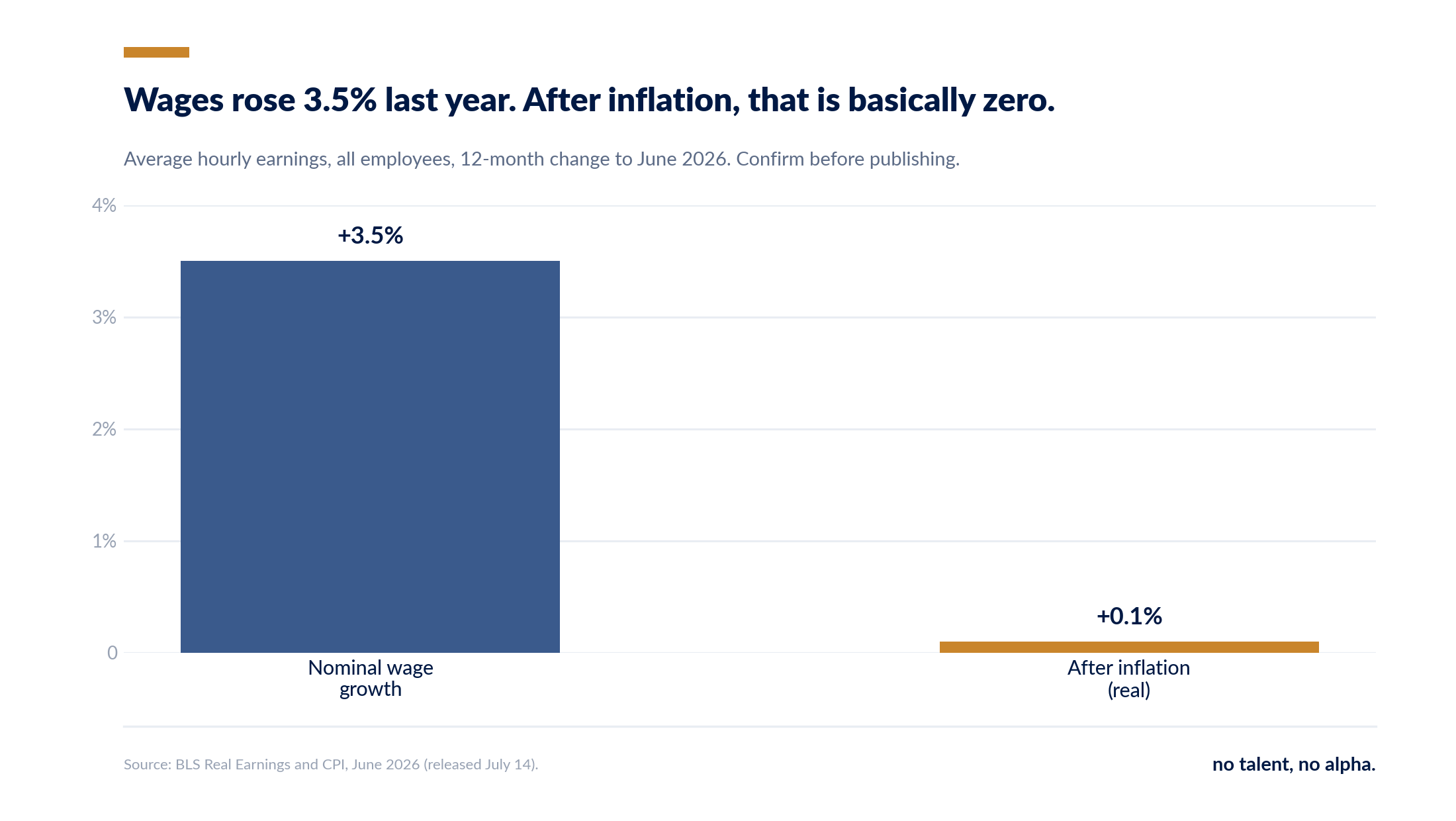
That last thread deserves its own number, because it reframes the whole consumer side of this. June's inflation report looked friendly, prices actually fell 0.4% on the month, and that gave workers a real "raise" of 0.8% for June. But zoom out and the picture is flatter than it looks. Over the full year, real average hourly earnings rose just 0.1%. Nominal wage growth has cooled to about 3.5%, the softest of this cycle, and after inflation that's basically nothing. The June pop wasn't bigger paychecks. It was one month of cheaper gas. So the American worker's real income is running flat, which is the quiet constraint sitting under every labor-heavy consumer business, and the reason the banks (levered to markets and capital, not to the worker's wallet) are a cleaner expression of the labor-heavy trade than anything selling to that flat-income consumer.
One last thought. The market found a fast, clean factor this year, count the people, and fast clean factors are exactly the ones that work until they don't. Labor intensity tells you something real about operating leverage. It tells you nothing about whether a company is adding people because the work is pouring in or cutting them because it's drying up. That difference is the entire game, and right now the tape is treating it as noise.
Worth a look: JPMorgan's own Q2 numbers, where the expense line tells the labor story, JPMorgan 2Q26 earnings release, and the flat-real-wage backdrop from BLS Real Earnings, June 2026. Late July brings the mega-cap tech prints, the other half of this trade.
And hit reply: on the names you follow, is the labor moving because of demand or because of AI? The clearest examples of the market confusing the two shape the next edition.